


- Most travelers in Morocco focus on five cities, leaving the country’s diverse terrains largely unexplored.
- Adventure travel in Morocco offers opportunities like sleeping under Sahara stars, summiting peaks, and connecting with Berbers beyond typical city visits.
- Planning to explore multiple regions, timing visits carefully, and hiring local guides enhances the authentic and safe experience for adventurers.
Most travelers who visit Morocco see the same five cities. They admire Marrakech’s medina, sip mint tea in Fes, and call it done. But 84% of tourist traffic stays locked in those same urban hubs, which means the country’s most extraordinary terrain goes almost entirely unwalked. Morocco adventure travel is something else entirely. It’s sleeping under the Sahara’s stars, summiting a 4,167-meter peak, and sharing bread with a Berber shepherd who has never met a tourist. This guide cuts past the obvious and gives you the real thing.
Table of Contents
- Key takeaways
- Morocco adventure travel: the lay of the land
- Trekking routes and mountain adventures
- Desert escapades: Sahara safaris and cultural immersion
- Beyond the obvious: gorges, climbing, and coastal hikes
- Planning your Morocco adventure trip
- What I’ve learned from years of Morocco adventure
- Plan your Morocco adventure with expert support
- FAQ
Key takeaways
| Point | Details |
|---|---|
| Most of Morocco is underexplored | Over 80% of visitors cluster in five cities, leaving mountains, deserts, and gorges wide open for adventurers. |
| Multi-day treks beat quick summits | The 6-day Toubkal Circuit offers better acclimatization and scenery compared to the rushed 2-day route. |
| September to October is prime season | Stable weather and thinner crowds make this the best window for high-altitude trekking and desert trips. |
| No visa needed for U.S. travelers | American citizens can stay up to 90 days without a visa, making spontaneous planning straightforward. |
| Combine terrain types in one trip | Morocco’s compact geography lets you move from Atlas peaks to Sahara dunes to the Atlantic coast within days. |
Morocco adventure travel: the lay of the land
Morocco packs an extraordinary range of terrain into a country roughly the size of California. That geographic density is exactly what makes it such a compelling destination for adventure travelers. You can be ankle-deep in Atlantic surf in the morning and tracing a canyon wall in the afternoon.
Here are the main geographic zones you need to know before planning:
- High Atlas Mountains: The spine of Morocco, topping out at Mount Toubkal (4,167m). This is the go-to zone for multi-day trekking, high-altitude camping, and Berber village visits. Marrakech serves as the primary gateway, just 60 miles from the trailhead.
- Sahara Desert (Erg Chebbi and Erg Chigaga): Morocco’s share of the Sahara delivers everything the imagination promises: towering orange dunes, camel caravans at dusk, and nights so dark the Milky Way looks painted on. Merzouga is the main access point for Erg Chebbi.
- Anti-Atlas Mountains: Far less trafficked than the High Atlas, the Anti-Atlas offers dramatic ridges, ancient kasbahs, and landscapes that feel genuinely remote. The Jebel Sirwa and Saghro Massif sit in this zone and reward travelers willing to get off the beaten path.
- Todra and Dades Gorges: Carved by rivers through the southern plateau, these gorges deliver rock climbing, canyon hiking, and some of the most dramatic roadside scenery in North Africa. Tinghir is your base for Todra.
- Atlantic Coast near Essaouira: For adventurers who want wind, open sky, and coastal trails without crowds, Essaouira delivers. It’s also one of the world’s top windsurfing destinations.
- Cultural adventure hubs: Marrakech, Merzouga, Tinghir, and Essaouira each anchor a different adventure region and offer local guides, gear rentals, and accommodation ranging from budget guesthouses to luxury desert camps.
Understanding which region aligns with your interests and fitness level is the first real planning decision. The country’s diverse terrain and compact geography mean you can combine multiple adventure types within a single two-week itinerary without burning half your trip on transportation.
Trekking routes and mountain adventures
Mount Toubkal is the obvious centerpiece of any trekking conversation about Morocco, but it’s far from the whole story. Knowing the difference between routes and choosing the right one for your fitness and schedule determines whether you come home exhilarated or wrecked.
The standard 2-day Toubkal trek
The classic route involves roughly a 2,000m elevation gain split across two days. Day one takes four to five hours to reach the Toubkal Refuge at 3,207m. Day two is the demanding one: an eight-to-ten-hour round trip to the summit and back down to the starting village of Imlil. You cover close to 20km on mixed terrain in that single day. The route is manageable for fit hikers with some altitude experience, but it leaves little margin for bad weather or fatigue.
Why the 6-day circuit wins
The 6-day Toubkal Circuit adds Lake Ifni, remote valleys, and significantly less trafficked paths to the experience. Acclimatization happens naturally because you gain altitude slowly. You reach the summit fresher and with far more energy for the descent. Guides with deep local knowledge consistently recommend this route for travelers who want a genuine mountain experience rather than a badge.
Pro Tip: Book a licensed mountain guide through a registered Moroccan guiding association. They carry first-aid certification, know evacuation routes, and provide irreplaceable cultural context that no app can replicate.
Other routes worth knowing
| Route | Location | Difficulty | Duration |
|---|---|---|---|
| M’Goun Massif | Central High Atlas | Moderate to Hard | 4 to 7 days |
| Aït Bouguemez Valley | Happy Valley | Moderate | 3 to 5 days |
| Jebel Sirwa | Anti-Atlas | Moderate | 5 to 6 days |
| Saghro Massif | Eastern Anti-Atlas | Moderate | 3 to 5 days |
| Toubkal Circuit | High Atlas | Hard | 6 days |
The M’Goun Massif, at 4,068m, offers a genuine alternative to Toubkal’s crowds without sacrificing altitude drama. Aït Bouguemez, known locally as the “Happy Valley,” delivers pastoral beauty and terraced farmland that feels lifted from another century. Hiking Morocco involves regional networks of shepherd paths rather than single marked trails, so tailoring your itinerary to your experience level matters more here than in places with developed trail infrastructure.
Timing is critical. The best months for high-altitude trekking are September through October. April and May carry lingering snow on high passes. July and August push temperatures on lower trails into uncomfortable territory. Winter ascents of Toubkal require crampons and ice axe skills. September gives you stable skies, cool mornings, and trails that aren’t clogged with other trekkers. For a full multi-activity itinerary that covers the Atlas and beyond, Moroccotravel1’s 10-day hiking tour is worth reviewing before you finalize your plans.
Desert escapades: Sahara safaris and cultural immersion
The Sahara is not a single place. It’s a collection of distinct landscapes, each with its own rhythm and character. Morocco’s piece of it delivers two iconic dune systems: Erg Chebbi near Merzouga in the southeast and Erg Chigaga near M’Hamid in the far south. Erg Chebbi is more accessible. Erg Chigaga is more remote and rewards the extra effort with genuine solitude.
Here’s how a well-structured Morocco desert safari actually unfolds:
- Arrive in Merzouga by afternoon. The drive from Marrakech takes around nine to ten hours by car, or you can fly to Errachidia and transfer. Arriving in the late afternoon puts you on a camel for the sunset ride into the dunes.
- Camel trek into the erg. One to three hours on camelback brings you to a desert camp positioned for optimal dune views. The pace is slow enough to notice the color of the sand changing as the light drops.
- Spend the night in a desert camp. Quality camps offer private canvas tents with real beds, local cuisine, and Gnawa music around the fire. The star visibility at Erg Chebbi, with zero light pollution nearby, is genuinely among the best on the planet.
- Wake before sunrise. The dunes at dawn are a different world from what you saw at sunset. Cold air, orange light, and absolute quiet. Most camel groups return to the village before the heat arrives.
- Extend deeper with a multi-day trek. Two to three days in the desert on camelback, visiting nomadic camps and oases, transforms the experience from a photo opportunity into something that changes how you think about space and time.
Pro Tip: Ask your desert camp operator specifically about visiting a working nomadic family rather than a staged cultural performance. The difference in authenticity is obvious within five minutes.
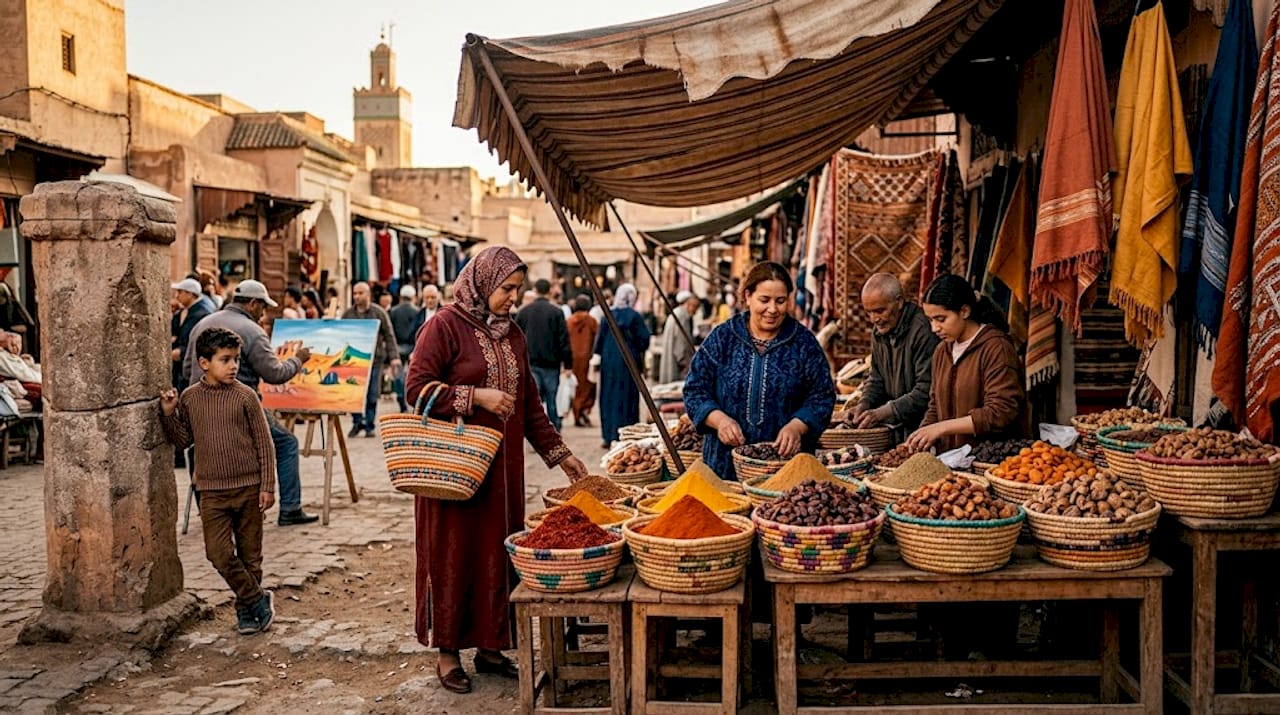
Beyond the dunes, the desert region offers oasis towns like Tinjdad and Rissani where weekly souks still operate the way they did 200 years ago. Morocco adventure travel at its best blends physical challenge with this kind of cultural texture. Berber cooking sessions, evening storytelling, and traditional music aren’t add-ons here. They’re the point. For a ready-built itinerary that covers the full desert arc, take a look at Moroccotravel1’s Morocco Desert Tours Guide for detailed logistics and camp options.
Beyond the obvious: gorges, climbing, and coastal hikes
Morocco’s adventure catalog extends well past mountains and deserts. Some of the country’s most memorable terrain involves canyon walls, river trails, and Atlantic headlands that most itineraries skip entirely.
- Todra Gorge, near Tinghir: The gorge narrows to just a few meters wide at its tightest point, with rock walls rising to 1,600 feet on either side. Rock climbers come specifically for the bolted sport routes on the main walls. Non-climbers hike the riverside path or take longer canyon routes that extend several kilometers upstream. The drive from Marrakech is four to five hours, which makes it a practical overnight stop on a southern Morocco loop.
- Dades Gorge: Dades sits about 60 km west of Todra and is equally dramatic from a scenic standpoint. The switchback road ascending from the valley floor has been photographed millions of times, but hiking the trails above the valley delivers a perspective no car window can match.
- Coastal walking near Essaouira: The Atlantic coast north and south of Essaouira offers low-altitude trail walking with sea views, migratory bird sightings, and access to fishing communities that rarely interact with tourists. Wind is constant and sometimes fierce, which makes it less appealing for casual visitors and perfectly suited for adventure travelers.
- Cycling expeditions: Road cycling through the Draa Valley, from Ouarzazate toward Zagora, is growing in popularity among endurance cyclists. The terrain is varied, traffic is manageable, and the visual reward of cycling past kasbahs and palmeries is hard to match anywhere in North Africa.
- Canyoneering in the Ziz Valley: Between Errachidia and Midelt, the Ziz River has cut a canyon lined with date palms and mud-brick villages. Guided canyoneering here involves swimming sections, narrow slots, and rappels that would feel at home in any serious canyon destination worldwide.
The principle that runs through all of these activities is the same: hire a local guide. Not just for safety, though that matters. Local guides in Morocco carry the kind of contextual knowledge about terrain, weather patterns, and community relationships that transforms a hike into a genuine encounter with place.
Planning your Morocco adventure trip
Good planning is what separates an extraordinary trip from an expensive frustration. Here’s what actually matters when preparing for adventure tours in Morocco.
When to go:
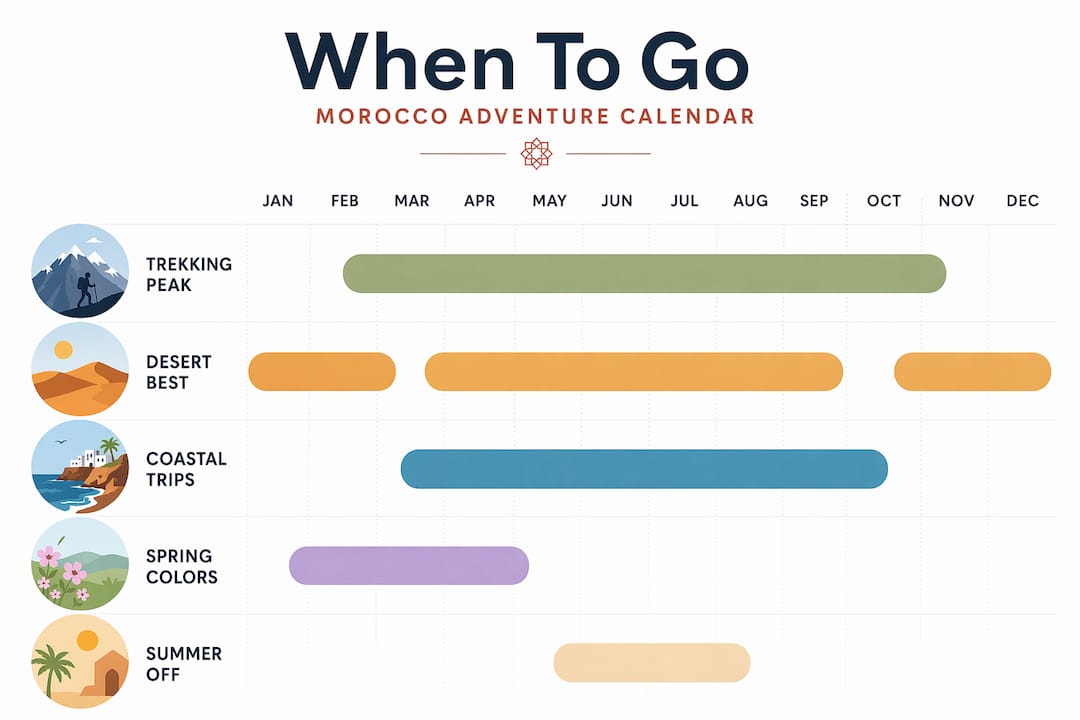
The optimal months split by activity. For high-altitude trekking, September through October is the clear winner. For desert adventures, October through April avoids summer heat that pushes midday temperatures past 45°C. Coastal activities near Essaouira are viable year-round, with the windiest months running from April through September.
Visa and entry:
U.S. citizens do not need a visa for tourist stays under 90 days. Most EU, UK, and Canadian passport holders operate under similar arrangements, though you should confirm current requirements before travel. Your passport must be valid for at least six months beyond your entry date.
Getting around:
- Marrakech is the primary adventure hub and is well-connected to international airports.
- Shared taxis (grand taxis) connect many smaller towns at low cost.
- Private drivers offer flexibility for reaching remote trailheads and desert access points.
- Renting a car works well for the southern circuit through Ouarzazate, Draa Valley, and Merzouga if you’re comfortable driving on single-lane mountain roads.
Packing essentials for mountain and desert conditions:
- Layering system: temperature swings of 25°C between night and midday are common in both the Atlas and Sahara.
- Sun protection: Morocco’s UV intensity is higher than most North American destinations at similar latitudes.
- Trekking poles: mandatory on steep descents, especially with a loaded pack.
- Electrolytes and a quality water filter: tap water is not safe for drinking in rural areas.
Cultural etiquette that actually matters:
Dress conservatively when entering villages, remove shoes before entering a home, and accept offered tea without rushing. Refusing hospitality causes genuine offense in Berber culture, where generosity toward guests is a matter of deep community pride.
Respecting these norms isn’t just polite. It opens doors. Travelers who approach cultural travel in Morocco with genuine curiosity rather than a checklist mentality consistently report the most meaningful experiences. You get invited to a meal. You learn the name of the valley’s founding family. That’s the trip that actually stays with you.
What I’ve learned from years of Morocco adventure
Here’s what I’ve come to believe after watching how different travelers experience Morocco: the two-day Toubkal summit is a rite of passage that often teaches the wrong lesson. You arrive in Imlil, push hard for two days, reach the summit exhausted, and come home having “done Toubkal.” But you’ve missed the mountain. The remote cirques, the shepherd settlements above the snowline, and the way the light moves across the Atlas at 5am. Those things only reveal themselves when you slow down.
The same truth applies to the Anti-Atlas and regions like Aït Bouguemez. I’ve seen travelers return from these areas more transformed than anyone who spent the same time on Toubkal’s crowded ridge. Less altitude drama, more genuine encounters. No souvenir shops at the trailhead.
Morocco adventure travel combines physical challenge with cultural depth in a way that very few destinations manage. But only if you resist the urge to optimize the itinerary into a highlight reel. The traveler who spends three unhurried days in a single Saharan valley learns more about themselves than the one who hits four desert stops in the same window.
My honest advice on sustainable tourism: tip your guides generously, buy directly from artisans, and eat in local restaurants rather than tourist-facing dining rooms. The infrastructure that keeps Morocco’s adventure regions accessible depends on travelers who spend money where it actually circulates in the community. Slow down, pay fairly, and the country gives you back ten times what you put in.
— Moroccotravel1.com
Plan your Morocco adventure with expert support
If you’re serious about getting the most out of Morocco’s adventure regions, working with specialists who know the terrain makes a real difference in what’s possible. Moroccotravel1 builds private and custom tours that combine desert safaris, Atlas Mountain treks, gorge hikes, and cultural immersion in itineraries designed around your pace and interests. Whether you want a 9-day Sahara adventure from Marrakech to the deep desert or a focused trekking package through the Atlas, the team handles logistics, licensed local guides, and accommodation from riads to luxury desert camps. 24/7 support means help is always a message away, regardless of where the trail takes you.
FAQ
What is the best time for Morocco adventure travel?
September through October offers the best conditions for high-altitude trekking in the Atlas Mountains, with stable weather and thinner crowds. Desert trips are ideal from October through April, when temperatures are comfortable rather than extreme.
Do U.S. travelers need a visa for Morocco?
No. American citizens can enter Morocco for tourist stays of up to 90 days without a visa. Your passport must be valid for at least six months beyond your planned departure date.
How hard is the Mount Toubkal trek?
The standard 2-day route involves a 2,000m elevation gain and requires hiking up to 20km in a single day at altitude. It is manageable for fit hikers with some elevation experience, though the longer 6-day circuit is recommended for a more rewarding and safer experience.
What are the top activities in Morocco for adventure travelers?
The top activities include high-altitude trekking in the High Atlas; multi-day Morocco desert safari camel treks through Erg Chebbi; rock climbing and canyon hiking in Todra Gorge; coastal walking near Essaouira; and canyoneering in the Ziz Valley.
Is Morocco safe for solo adventure travelers?
Morocco is generally considered safe for solo travelers. Hiring a licensed local guide for mountain and desert routes significantly reduces risk, improves navigation on unmarked shepherd trails, and enriches the cultural dimension of any adventure tour in Morocco.


