

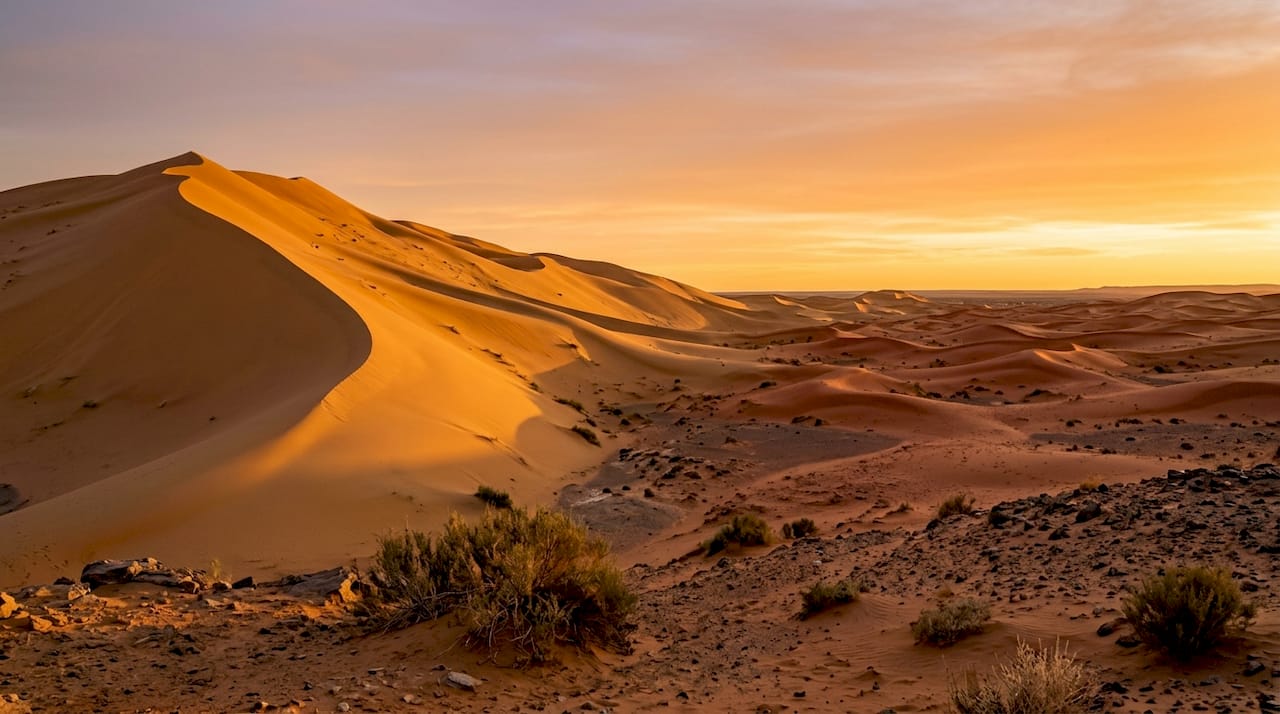
- Merzouga offers dramatic 150-meter dunes and a quieter atmosphere but requires at least three days from Marrakech.
- Zagora’s smaller dunes and scenic route make it suitable for two-day trips and are more accessible for limited schedules.
- Choosing between them depends on trip duration, activity preferences, and whether dramatic dunes or cultural landscapes matter more.
Merzouga and Zagora are Morocco’s two most visited Sahara Desert destinations, and the choice between them shapes your entire southern Morocco itinerary. The Merzouga vs. Zagora desert debate comes down to three factors: dune scale, drive time from Marrakech, and how many days you can commit. Merzouga’s Erg Chebbi dunes tower up to 150 meters high with a deep orange-red color, while Zagora’s Erg Lehoudi dunes reach only 30–50 meters across a flatter, rockier terrain. Get this choice wrong and you either rush one of Morocco’s most dramatic landscapes or spend two days driving for a dune experience that underwhelms.
How far are Merzouga and Zagora from Marrakech?
Distance from Marrakech is the single most practical factor in the Merzouga vs Zagora comparison. Most travelers depart from Marrakech, and the road distance to each desert determines how much of your trip is spent in a car versus on the sand.
Merzouga: the long road to Erg Chebbi
Merzouga sits 560 km from Marrakech, a drive of 9–10 hours on winding mountain and desert roads. That distance demands a minimum three-day trip. One day goes to driving in, one day gives you real dune time, and one day covers the return. Trying to compress Merzouga into two days means roughly 20 hours of driving with almost no time in the dunes. Experts consistently advise against it.
Zagora: the accessible Sahara gateway
Zagora is 350 km from Marrakech, a 6–7 hour drive that makes a two-day trip genuinely workable. The route passes through the Draa Valley, one of Morocco’s most scenic corridors, lined with palmeries and ancient kasbahs. That scenery turns the drive into part of the experience rather than just transit. For travelers with a long weekend or a tight itinerary, Zagora delivers a real desert experience without sacrificing two full days to road travel.
- Merzouga: 560 km, 9–10 hours, minimum 3-day trip
- Zagora: 350 km, 6–7 hours, manageable in 2 days
- Merzouga route: crosses the High Atlas via the Tizi n’Tichka pass
- Zagora route: follows the Draa Valley with kasbah and palmery stops
- Key rule: never attempt Merzouga in 2 days; choose Zagora instead
Pro Tip: If you have exactly two days, book Zagora without hesitation. A rushed Merzouga trip wastes more time in a car than it gives you in the desert.
What do the dunes and landscapes actually look like?
The physical difference between these two deserts is more dramatic than most travelers expect. Merzouga and Zagora are not two versions of the same experience at different distances. They are genuinely different landscapes.
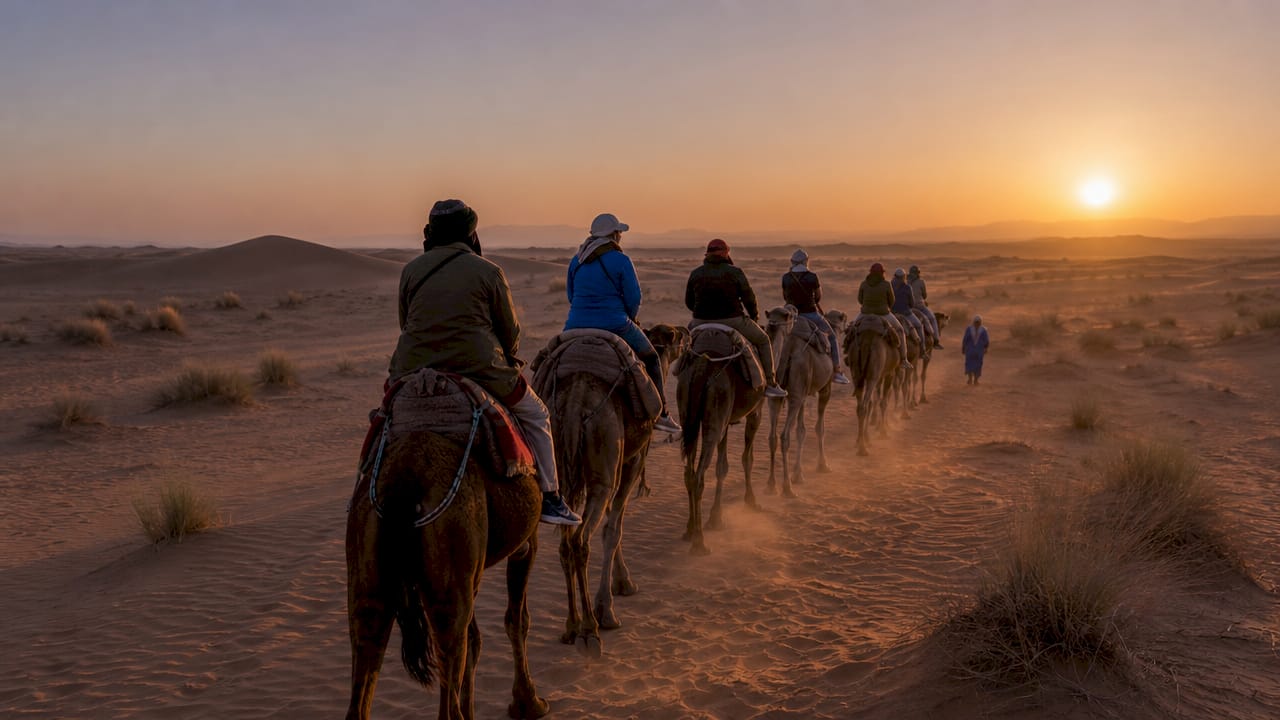
Erg Chebbi: Merzouga’s towering dunes
Merzouga’s Erg Chebbi is a classic Saharan sand sea. The dunes reach up to 150 meters, which is tall enough that climbing one takes 30–45 minutes of real effort. The color shifts from pale gold at midday to deep burnt orange at sunrise and sunset, producing the kind of photography that defines Morocco’s desert image worldwide. The scale creates natural solitude. You can walk 20 minutes from your camp and feel genuinely alone in the sand.
Merzouga also draws fewer crowds than Zagora, which surprises most travelers given its fame. The extra distance filters out day-trippers and short-stay tourists. That quieter atmosphere makes sunrise camel rides and overnight camps feel more authentic.
Erg Lehoudi: Zagora’s compact desert
Zagora’s Erg Lehoudi dunes top out at 30–50 meters. They are real sand dunes, not a beach, but the scale is noticeably smaller. The surrounding terrain is rockier and flatter, with more gravel plains visible between dune formations. That landscape has its own appeal, particularly for travelers who want a varied desert scene rather than pure sand. Photographers find the contrast between rock and sand interesting, though the iconic towering dune shots require Merzouga.
| Feature | Merzouga (Erg Chebbi) | Zagora (Erg Lehoudi) |
|---|---|---|
| Dune height | Up to 150 meters | 30–50 meters |
| Dune color | Deep orange-red | Pale gold to tan |
| Terrain type | Pure sand sea | Mixed sand and rocky plains |
| Crowd level | Lower, quieter | Higher, more accessible |
| Photography appeal | Iconic, dramatic | Scenic, varied |
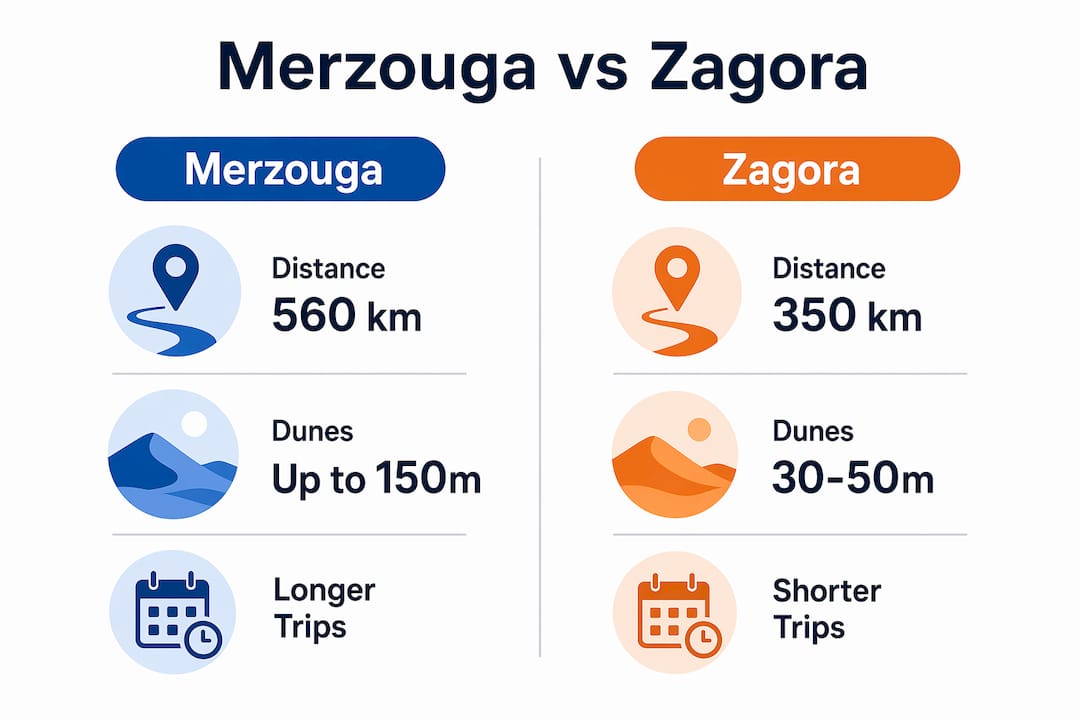
The dune height gap is not a minor detail. At 150 meters, Erg Chebbi dunes produce a physical sense of scale that smaller dunes simply cannot replicate. Travelers who have visited both consistently describe Merzouga as the more memorable visual experience. Zagora still delivers a genuine Sahara atmosphere, but the wow factor differs significantly.
What activities and amenities does each desert offer?
Activities and accommodation quality differ sharply between the two deserts, and those differences affect both your experience and your budget.
Merzouga activities and camps
Merzouga offers the widest range of desert adventures in Morocco. Camel treks here run for 1–3 hours into the dunes, reaching ridgelines that give panoramic views across the sand sea. Quad biking covers serious terrain, with routes that climb dune faces and cross open desert flats. Sandboarding on the steep dune slopes is a genuine sport here, not a novelty. Stargazing at Merzouga ranks among the best in North Africa because the low population density and minimal light pollution produce exceptional night skies.
Camp quality at Merzouga spans the full range. Budget camps offer basic Berber tents with shared facilities. Mid-range camps add private tents, traditional dinners, and live music. Ultra-luxury camps feature en-suite bathrooms, proper beds, and private terraces facing the dunes. A 3-day Merzouga tour typically costs 250–450 EUR per person on a shared basis.
- Camel trekking: 1–3-hour routes into Erg Chebbi
- Quad biking: extensive routes across dune terrain
- Sandboarding: steep dune faces suitable for real runs
- Stargazing: exceptional due to low light pollution
- Camp range: budget tents to ultra-luxury private suites
Zagora activities and camps
Zagora’s activity menu is shorter. Camel rides are available but cover less dramatic terrain, typically 30–60 minute routes along smaller dune formations. Quad biking options are limited compared to Merzouga. The cultural dimension is stronger here, with nearby ancient kasbahs and the Draa Valley providing context that Merzouga’s more remote location lacks. A standard 2-day Zagora itinerary runs 180–320 EUR per person on shared tours. Camps are generally mid-range, with fewer luxury options than Merzouga.
Pro Tip: Book a camp that faces east at either desert. The sunrise over the dunes is the single best moment of any desert trip, and east-facing camps get it without walking.
When is the best time to visit Merzouga or Zagora?
Timing your desert visit correctly determines whether you have a comfortable, memorable experience or a physically punishing one. Both deserts share the same climate pattern, so the seasonal advice applies equally to both.
The optimal travel window is October through April. During these months, daytime temperatures stay in the 20–30°C range, nights are cool to cold, and the desert light is at its most dramatic. Spring (March and April) brings occasional wildflowers to the desert edges, which creates a striking contrast with the sand. Autumn (October and November) offers warm days and mild nights with very few tourists.
Summer is a different story. Daytime temperatures regularly exceed 45°C from june through august. That level of heat makes outdoor activities dangerous and camping deeply uncomfortable. Most experienced guides refuse to take clients on camel rides between 10 a.m. and 4 p.m. during summer months.
- Best months: october to april for comfortable temperatures
- Peak season: december to february for cool nights and clear skies
- Avoid June, july, and august for safety reasons
- Spring advantage: mild heat, occasional desert blooms, fewer crowds
- Winter note: nights can drop near freezing; pack warm layers for camp
Luxury travelers benefit most from the October to April window. High-end camps at Merzouga offer heated tents and premium bedding, but the outdoor experience, camel rides, dune climbing, and stargazing depend entirely on bearable temperatures. Budget travelers should also target this window, as the cost of a miserable summer trip outweighs any low-season savings.
How to choose the right desert based on your trip
The decision between Merzouga and Zagora is not about which desert is better in absolute terms. It is about which desert fits your specific trip.
- You have 3 or more days: Choose Merzouga. The extra travel time is worth it for the dune scale, the quieter atmosphere, and the full range of activities. A 5-day itinerary from Marrakech gives you two full nights in the desert with time to explore properly.
- You have exactly 2 days: Choose Zagora. The shorter drive preserves your actual desert time. Zagora delivers a real Sahara experience without the exhaustion of a rushed Merzouga trip.
- Your priority is photography: Choose Merzouga. The 150-meter dunes, deep-orange color, and lower crowd levels produce the images that define Morocco’s desert reputation.
- Your priority is cultural context: Consider Zagora. The Draa Valley route adds kasbah visits, palmery walks, and historical depth that the Merzouga road does not match.
- Your budget is tight: Zagora costs less in both tour price and travel time. A 2-day Zagora trip at 180–320 EUR per person is a meaningful desert experience at a lower total cost.
- You want both: A 9-day Morocco desert tour can include both deserts without rushing either. Combining them shows you the full range of Morocco’s southern landscapes.
The one mistake to avoid at all costs is rushing Merzouga into two days. The math is brutal: 20 hours of driving for a few hours of dune time. That is not a desert trip. That is a commute with sand.
Key Takeaways
Merzouga suits travelers with three or more days who want dramatic dunes and full desert immersion; Zagora suits those with two days who want an accessible, genuine Sahara experience.
| Point | Details |
|---|---|
| Distance from Marrakech | Merzouga is 560 km (9–10 hrs); Zagora is 350 km (6–7 hrs). |
| Minimum trip length | Allow 3 days for Merzouga; 2 days works for Zagora. |
| Dune scale | Merzouga dunes reach 150 m; Zagora dunes reach 30–50 m. |
| Activities and camps | Merzouga offers more activities and wider camp quality; Zagora is more limited. |
| Best travel season | October to April for both deserts; avoid June through August. |
My honest take on the Merzouga vs Zagora choice
After years of helping travelers plan southern Morocco itineraries, I have one consistent observation: most people underestimate how much the drive matters. Travelers who rush Merzouga into two days almost always say the same thing afterward. They saw the dunes, but they did not feel them. There is a difference between passing through a landscape and actually being in it.
Zagora gets unfairly dismissed as the lesser option. It is not lesser. It is different. The Draa Valley drive alone justifies the trip for anyone interested in Moroccan history and architecture. The dunes at Erg Lehoudi are real, the sunsets are beautiful, and a night in a desert camp there is genuinely memorable. For a first-time visitor with limited time, Zagora often delivers more satisfaction than a rushed Merzouga trip.
What most travelers overlook is the crowd factor at Merzouga. Because it requires more commitment to reach, it draws a self-selecting group of travelers who actually want to be there. That changes the atmosphere at camp in ways that are hard to quantify but easy to feel. The luxury desert experiences at Merzouga benefit especially from this. You are not sharing a sunrise with a bus tour. You are watching it with a handful of other people who drove nine hours to be there.
My recommendation: if you have the time, go to Merzouga and do it properly. If you do not, go to Zagora and enjoy it fully. Never compromise either experience by rushing it.
— Moroccotravel1.com
Plan your Morocco desert tour with Moroccotravel1
Moroccotravel1.com designs private and custom Morocco desert tours that match your timeline, budget, and experience goals. Whether you want three nights in a luxury Merzouga camp, a cultural two-day Zagora circuit through the Draa Valley, or a combined itinerary covering both deserts, every package includes expert local guides, vetted accommodations, and flexible scheduling. The team handles all logistics from Marrakech transfers to camp bookings, so you arrive at the dunes without the stress of planning. Moroccotravel1 also offers family-friendly and honeymoon-specific desert packages for travelers who need more than a standard group tour.
FAQ
How far is Merzouga from Marrakech?
Merzouga is approximately 560 km from Marrakech, a drive of 9–10 hours. A minimum three-day trip is required to make the journey worthwhile.
Is Zagora or Merzouga better for a short trip?
Zagora is the better choice for a two-day trip. At 350 km and 6–7 hours from Marrakech, it leaves meaningful time in the desert without exhausting travel.
What is the best time to visit the Moroccan desert?
The optimal window is October through April, when daytime temperatures stay comfortable. Summer temperatures regularly exceed 45°C and make outdoor desert activities unsafe.
Are the dunes at Zagora worth visiting?
Yes. Zagora’s Erg Lehoudi dunes reach 30–50 meters and deliver a genuine Sahara experience. They are smaller than Merzouga’s Erg Chebbi but still produce memorable sunsets and camel treks.
How much does a desert tour cost in Morocco?
A standard 3-day Merzouga tour costs approximately 250–450 EUR per person on a shared basis. A 2-day Zagora itinerary runs 180–320 EUR per person, making it the more budget-friendly option.


