

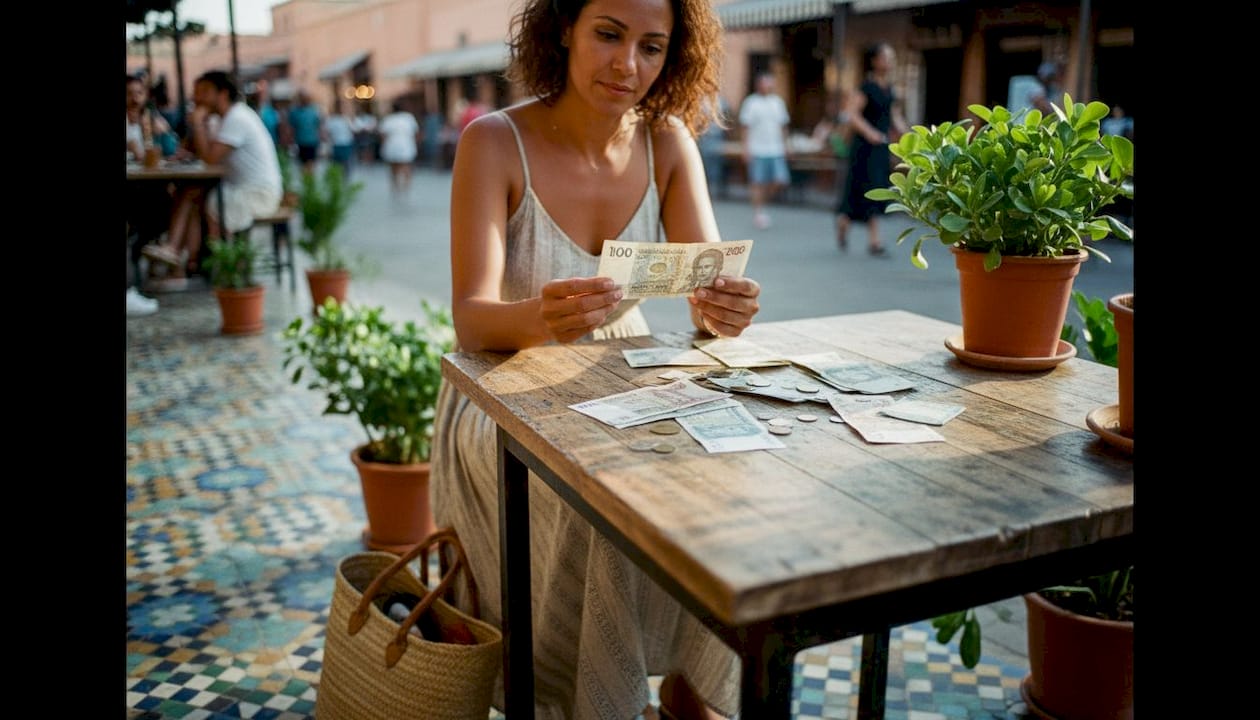
- The Moroccan dirham is the official currency, pegged to a mix of euros and U.S. dollars, and used exclusively in Morocco.
- Travelers should use city center ATMs for better exchange rates and learn local slang like “rials” and “francs” to avoid confusion with prices.
- Carry cash carefully, exchange a small amount at the airport, and spend leftover dirhams before leaving, as most cannot be exchanged abroad.
The Moroccan dirham (MAD) is the official currency in Morocco, issued exclusively by Bank Al-Maghrib and subdivided into 100 santimat. It is the only legal tender accepted for all official transactions across the country. Understanding how the dirham works, what exchange rates to expect, and how locals talk about money will save you real money and real frustration on your trip. This guide covers everything from denominations and local slang to the best places to exchange your cash before and after you arrive.
What are the denominations used for currency in Morocco?
The Moroccan dirham replaced the Moroccan franc in 1960. Current banknotes come in denominations of 20, 50, 100, and 200 dirhams. Coins circulate in ½, 1, 5, and 10 dirham values, along with smaller santimat coins that you will rarely see in everyday use. Bank Al-Maghrib has issued both paper and polymer banknotes featuring Moroccan kings and national landmarks.
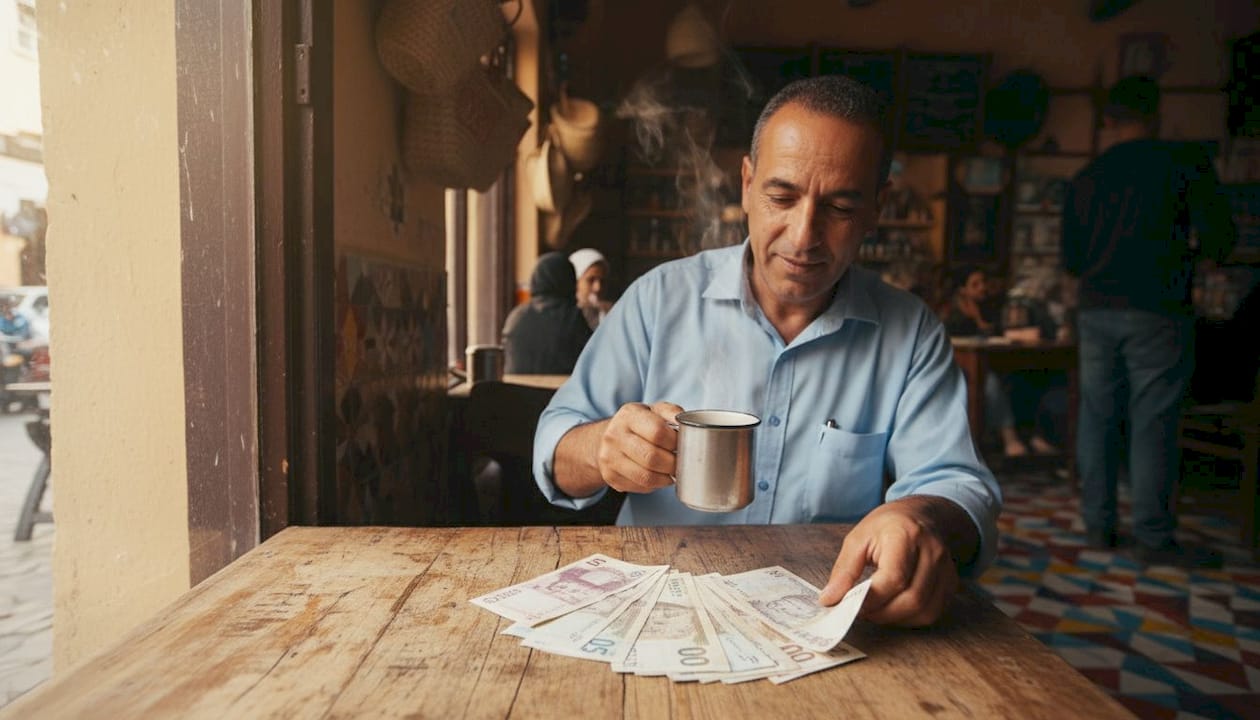
The 100 and 200 dirham notes are the workhorses of daily spending. You will use them for taxis, restaurants, and market purchases. The 20 dirham note is handy for tips and small street purchases. Keep a mix of denominations on hand because vendors in souks and smaller towns rarely carry enough change for large bills.
Local terms that confuse most travelers
Two informal terms trip up nearly every first-time visitor. “Rial” equals 5 centimes, and “franc” equals 1 centime in local Moroccan Arabic. These terms are used conversationally among Moroccans, especially when quoting prices for very cheap items. A vendor saying “twenty rials” means 1 dirham, not 20 dirhams.
This distinction matters more than most travel guides admit. If a seller quotes you a price in rials and you hear it as dirhams, you could pay 20 times the actual price. The confusion is genuine and common, not a scam. Financial experts recommend requesting prices in writing or on a calculator to eliminate any ambiguity.
- Dirham (MAD): The official unit. All formal prices, hotel bills, and receipts use dirhams.
- Santim: One hundredth of a dirham. Rarely used in practice for everyday purchases.
- Rial: Local slang for 5 centimes. Common in markets and informal settings.
- Franc: Local slang for 1 santim. Mostly heard in rural areas and traditional markets.
Pro Tip: When a price sounds surprisingly low or high, ask the vendor to write it down or show it on a phone calculator. This single habit eliminates the most common currency confusion tourists face in Morocco.
How do Moroccan dirham exchange rates work?
The dirham is pegged to a basket of 60% euro and 40% U.S. dollars. This peg keeps the dirham relatively stable compared to fully floating currencies. It also means the dirham moves in a predictable direction when the euro or dollar strengthens or weakens against each other.
Mid-market rates as of mid-2026 sit at approximately 9.36 MAD per USD and 10.70 MAD per EUR. The 52-week EUR/MAD rate ranged from 10.38 to 11.09 MAD. That range tells you the dirham does not swing wildly, but a difference of 0.71 MAD per euro still adds up across a two-week trip with significant spending.
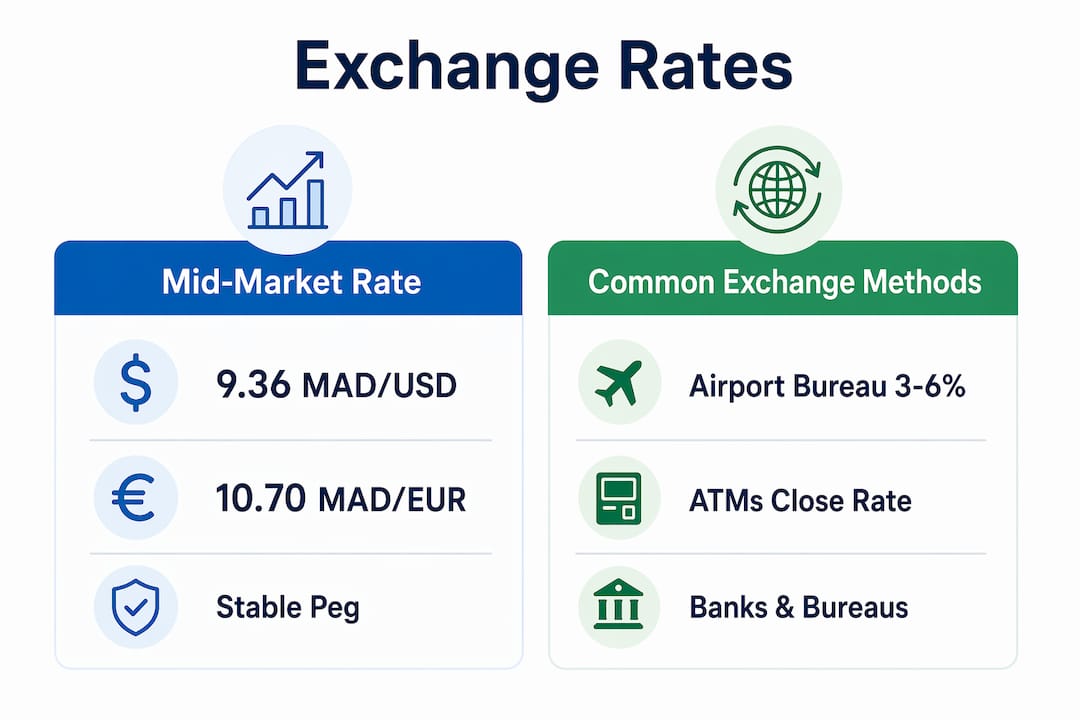
Mid-market rate vs. what you actually get
The mid-market rate is the “real” exchange rate you see on Google or a currency converter app. Banks and exchange bureaus never give you that rate. They add a margin, sometimes called a spread, which is how they make money. The gap between the mid-market rate and the bureau rate is your actual cost of exchanging money.
| Exchange Method | Typical Rate vs. Mid-Market | Fees | Best For |
|---|---|---|---|
| Airport bureau de change | 3–6% below mid-market | Often none stated | Emergency only |
| City center exchange bureau | 1–3% below mid-market | Usually none | Convenient cash top-ups |
| ATM in Morocco | Closest to mid-market | ATM fee + bank fee | Best overall value |
| Your home bank (pre-trip) | 2–5% below mid-market | Possible service fee | Small amounts only |
| Digital multi-currency card | Near mid-market | Low or zero | Frequent travelers |
ATMs in Morocco consistently deliver rates closer to the mid-market than bureaus or home banks. The trade-off is a flat ATM fee per withdrawal, so larger, less frequent withdrawals reduce your per-dirham cost. Use a travel-focused debit card that reimburses ATM fees, and you get close to the mid-market rate on every transaction.
Pro Tip: Check the live EUR/MAD or USD/MAD rate on Google before every exchange. If a bureau offers more than 3% below that rate, walk to the next one. In Marrakech, Fes, and Casablanca, you will find another bureau within two minutes.
How is the dirham used day to day in Morocco?
Cash is the dominant payment method across Morocco. Credit cards are common in urban areas like Marrakech, Casablanca, and Agadir, but rural regions, small guesthouses, and market vendors operate entirely on cash. Carrying enough dirhams at all times is not optional; it is a practical necessity.
Santimat coins show up as change from small purchases. Most vendors round to the nearest dirham in practice, so you will accumulate a handful of coins rather than precise change. Keep a small coin purse or a dedicated pocket for these. They are useful for public toilets, tips for parking attendants, and small street snacks.
Handling cash safely while traveling
Petty theft exists in any tourist destination, and Morocco is no exception. Splitting your cash across two locations, such as a hotel safe and your day bag, reduces your exposure. Never carry your full budget in one wallet.
- Keep your daily spending cash in a front pocket or a zipped inner compartment.
- Store larger bills and backup cards in your accommodation’s safe.
- Avoid counting large amounts of cash in public or at market stalls.
- Use a money belt under your clothing for airport travel and long bus or train rides.
- Check your Morocco travel tips for specific advice on staying secure in riads, medinas, and desert camps.
What to do with leftover dirhams
The dirham is a restricted currency. Morocco limits MAD imports and exports to 2,000 dirhams per traveler. You cannot legally take large amounts home, and exchanging dirhams back to dollars or euros outside Morocco is difficult because most foreign banks do not hold MAD. The practical solution is to exchange leftover dirhams at a Moroccan bank or bureau before you leave. Keep your exchange receipts throughout your trip. Some bureaus require proof of original exchange before they will buy dirhams back from you.
Where and how should you exchange money for Morocco?
The timing and location of your exchange matter as much as the rate. Most travelers make the mistake of exchanging everything at the airport on arrival. Airport bureaus offer the worst rates in the country. They know you just landed, you need cash, and you have no time to shop around.
- Exchange a small amount at the airport. Enough for your taxi and first meal. MAD 200–300 covers most airport-to-hotel transfers.
- Use an ATM in the city center on day one. Withdraw a larger amount at a competitive rate. Look for ATMs attached to major Moroccan banks like Attijariwafa Bank, Banque Populaire, or CIH Bank.
- Visit a licensed exchange bureau for top-ups. City center bureaus in Marrakech’s Gueliz district or Casablanca’s city center offer rates significantly better than airport counters.
- Consider a digital multi-currency card before you leave home. Cards that hold multiple currencies and convert at near mid-market rates give you flexibility without carrying excess cash.
- Keep all exchange receipts. Moroccan law requires documentation if you want to exchange dirhams back to your home currency before departure.
- Exchange leftover dirhams before your departure flight. Once you clear Moroccan customs, your options shrink fast. Most international airports outside Morocco will not exchange MAD at all.
Currency exchange bureaus often only buy back banknotes, not coins. Spend your santimat coins and small dirham coins before you head to the airport. A coffee, a bottle of water, or a final pastry at a café will clear your coin pocket and leave you with nothing to lose.
One detail most guides skip: some Moroccan ATMs offer “dynamic currency conversion,” which means they ask if you want to be charged in your home currency instead of MAD. Always choose MAD. Choosing your home currency lets the ATM set the exchange rate, and it is always worse than your bank’s rate.
Pro Tip: Read your bank’s foreign transaction fee policy before you travel. Some U.S. banks charge 3% on every foreign ATM withdrawal on top of the ATM fee. A no-foreign-fee debit card from a bank like Charles Schwab or a travel-focused account can save you a meaningful amount across a two-week trip.
Key Takeaways
The Moroccan dirham (MAD) is the only legal currency in Morocco, pegged at 60% euro and 40% U.S. dollar, and travelers get the best exchange rates by using ATMs in city centers rather than airport bureaus.
| Point | Details |
|---|---|
| Official currency | The Moroccan dirham (MAD) is the sole legal tender, issued by Bank Al-Maghrib. |
| Local slang matters | “Rial” means 5 centimes, and “franc” means 1 centime; always confirm prices in dirhams. |
| Best exchange method | City center ATMs deliver rates closest to mid-market; avoid airport bureaus for large amounts. |
| Legal export limit | Morocco restricts MAD to 2,000 dirhams per traveler; exchange leftovers before departure. |
| Card acceptance | Credit cards work in urban Morocco, but cash is required in rural areas and most markets. |
What I’ve learned about Moroccan money after years on the ground
Most travelers obsess over the exchange rate and ignore the thing that costs them far more: local currency terminology. I have watched visitors hand over 20 dirhams for something priced at 20 rials, which is actually 1 dirham. The vendor was not cheating them. The vendor was speaking the way Moroccans speak. The traveler just did not know the code.
My honest advice is to learn two numbers before you land. One rial equals 5 centimes. One franc equals 1 centime. Write it on your phone’s notes app. Pull it out whenever a price sounds off. That single habit will save you more money than hunting for the best exchange rate ever will.
The second thing I tell every traveler is to carry two separate stashes of cash. One for the day, one for emergencies. Morocco is safe, but medinas are crowded, and crowded places attract pickpockets everywhere in the world. A well-planned Morocco trip accounts for this from day one, not after something goes wrong.
Finally, do not leave Morocco with a wallet full of dirhams. The currency is restricted and nearly impossible to exchange abroad. Spend down your coins on the last day, exchange your remaining notes at a city bureau, and walk to your departure gate with clean pockets. That is the move every experienced Morocco traveler makes.
— Moroccotravel1.com
Plan your Morocco trip with confidence
Understanding the dirham is the foundation of a well-budgeted Morocco trip. The next step is putting that budget to work on an itinerary worth every dirham you spend. Moroccotravel1 offers private and custom Morocco tours built around your schedule, your interests, and your budget, from a fast-paced city circuit through Casablanca, Fes, and Marrakech to a full 14-day grand tour covering the Sahara, the Atlas Mountains, and the Atlantic coast. Every package includes local expert guides, vetted accommodations, and 24/7 support so your money goes toward experiences, not guesswork.
FAQ
What is the official currency used in Morocco?
The Moroccan dirham (MAD) is Morocco’s official currency, issued by Bank Al-Maghrib and subdivided into 100 santimat. It is the only legal tender for all transactions in the country.
What is the current Moroccan dirham exchange rate?
Mid-market rates as of mid-2026 are approximately 9.36 MAD per U.S. dollar and 10.70 MAD per euro. Rates at bureaus and banks will be slightly lower than these mid-market figures.
Can you use U.S. dollars or euros in Morocco?
Most hotels, upscale restaurants, and tour operators in major cities accept euros and sometimes dollars, but the dirham is required for markets, taxis, and smaller establishments. Always carry dirhams for daily spending.
Where is the best place to exchange money in Morocco?
ATMs attached to major Moroccan banks in city centers offer the most competitive rates. Airport exchange bureaus and hotel desks consistently offer the worst rates and should be used only for small emergency amounts.
Can you take Moroccan dirhams out of the country?
Morocco legally limits MAD exports to 2,000 dirhams per traveler. Dirhams are very difficult to exchange outside Morocco, so convert leftover notes back to your home currency at a Moroccan bank or bureau before your departure flight.


