

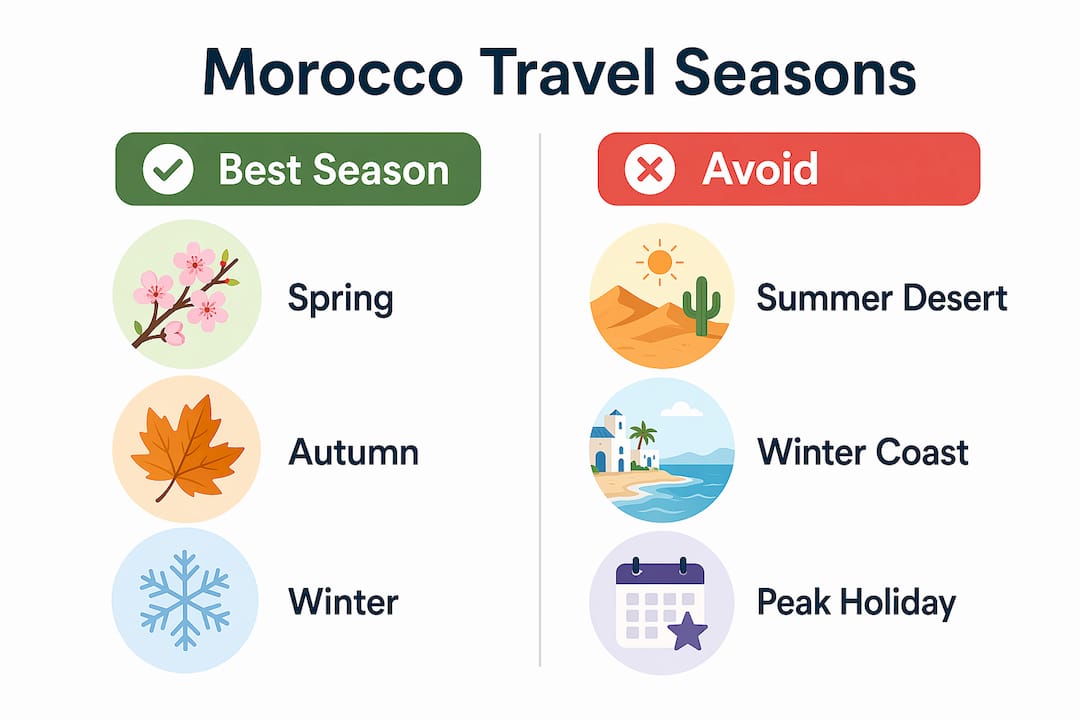
- The best time to visit Morocco depends on the region and season, with spring and autumn offering the most favorable weather for most destinations.
- Coastal areas enjoy mild summers with reliable sunshine, while the mountains and Sahara Desert have specific seasons for skiing and desert camping, respectively.
- Planning a trip around the regional climate and flexible scheduling ensures a more enjoyable experience across Morocco’s diverse microclimates.
Morocco by season is defined as the practice of aligning your travel dates with the country’s distinct regional climates to get the most out of every destination. Spring (March to May) and autumn (September to November) are the best overall times to visit Morocco, offering mild temperatures, open mountain passes, and manageable crowds. The country spans four major climate zones: the Atlantic coast, the High Atlas Mountains, the interior plains, and the Sahara Desert. Each zone behaves differently across the year, which means the best time to visit depends entirely on where you are going and what you plan to do. Moroccotravel1 builds every itinerary around this principle.
How do Morocco’s seasons affect travel in different regions?
Morocco’s regional climate diversity means there is no single best season for the whole country. A traveler heading to Marrakech in July faces a very different experience than one heading to Tangier or Toubkal. Understanding each zone is the foundation of smart seasonal planning.
Atlantic coast
The Atlantic coastline runs from Tangier in the north to Agadir in the south. Summers here are dry and sunny, with near-zero precipitation in July and August. Agadir enjoys over 300 sunny days annually, making it one of the most reliable beach destinations in North Africa. That consistency is why the coast draws families and sun-seekers throughout the summer months. Winters are mild and wet, with annual rainfall figures of around 270 mm in Agadir, 300 mm in Essaouira, and 400 mm in Safi.
High Atlas Mountains
The Atlas Mountains operate on a completely different schedule. Snow covers the high passes from December through February, and the ski resort at Oukaïmeden sits above 2,600 meters, making it Morocco’s main winter sports destination. Late spring and early autumn bring the most reliable trekking conditions, but altitude can still produce dramatic weather swings. Travelers planning hikes should always verify trail and pass conditions close to their travel dates.
Sahara Desert
The Sahara is the most extreme zone. Desert summer temperatures reach 45–50°C, making a July or August visit genuinely dangerous for most travelers. That heat makes the desert a winter and spring destination. Winter days in the Sahara are comfortable and sunny, though nights can drop near freezing. Packing warm layers for desert camping is not optional.
Interior cities: Marrakech and Fez
Marrakech and Fez sit on the interior plains, sheltered from Atlantic moisture but exposed to summer heat. Temperatures regularly exceed 38°C in July and August. Spring and autumn are the sweet spots, with daytime highs in the low to mid-20s Celsius. These cities are best visited outside the summer peak unless you plan to limit outdoor activity to early mornings.
| Region | Best season | Avoid |
|---|---|---|
| Atlantic coast (Agadir, Essaouira) | Summer, spring | Heavy winter rain (north) |
| High Atlas Mountains | Late spring, early autumn | Winter (pass closures) |
| Sahara Desert | Winter, spring | Summer (extreme heat) |
| Interior cities (Marrakech, Fez) | Spring, autumn | July and august |
What makes spring and autumn the best times to visit Morocco?
Spring and autumn are the optimal travel seasons for most travelers because they hit a rare combination of comfortable temperatures, open roads, and active cultural life. The country feels alive without the punishing heat or the holiday crowds that define summer and winter peaks.
Why spring works so well
March through May brings wildflowers to the Atlas foothills, green valleys in the Draa and Dades regions, and comfortable walking temperatures in the medinas of Fez and Marrakech. The mountain passes reopen after winter snow, making multi-region road trips possible. Rainfall is still possible in the north through May, but it rarely disrupts travel plans for more than a day.
- Daytime temperatures in Marrakech sit in the low to mid-20s Celsius
- Mountain passes reopen, connecting cities to desert routes
- Fewer crowds than july and august at major sites like Jemaa el-Fna
- Local festivals and cultural events are concentrated in spring and autumn
- Landscapes are at their most colorful before summer dries them out
Why october is the traveler’s favorite month
October is especially favored by experienced Morocco travelers for its warm but not hot conditions and manageable tourist numbers. The summer crowds have thinned, prices at riads and desert camps often drop slightly, and the light in the late afternoon is extraordinary for photography. The desert is fully accessible again after the brutal summer heat, and the Atlas trails are dry and clear before the first winter snow arrives.
Pro Tip: Book October desert camps at least six to eight weeks in advance. Word has spread about October’s ideal conditions, and the best luxury camps in Merzouga and Zagora fill up faster than most travelers expect.
Autumn’s added advantage
September through November also aligns with Morocco’s harvest season in rural areas. You can witness olive and date harvests in the Draa Valley and Figuig, which adds a layer of authentic cultural experience that summer visitors simply miss. These moments are not staged for tourists. They are part of daily Moroccan life, and timing your visit to coincide with them makes the trip feel genuinely different.
What to expect when traveling to Morocco in summer and winter?
Summer and winter are not wrong times to visit Morocco. They are just specific times that suit specific travelers and specific regions. Knowing what each extreme season delivers helps you plan with confidence rather than avoid it out of habit.
Summer travel: coast over desert
Summer is the right season for Morocco’s Atlantic coast and completely wrong for the Sahara and interior cities. Atlantic winds keep coastal temperatures around 25°C in July and August, while desert temperatures can reach 45–50°C in the same months. That gap is the defining fact of Moroccan summer travel. Essaouira, with its famous trade winds, is one of the best summer destinations in the entire Mediterranean region.
- Stick to the coast. Agadir, Essaouira, and Asilah are all excellent summer bases.
- Avoid the Sahara completely. Heat at this level is a health risk, not just discomfort.
- Visit interior cities early. If you must see Marrakech in summer, plan all outdoor activity before 10 a.m.
- Book well ahead. Peak accommodation demand hits in July and August, and popular riads sell out months in advance.
- Use the heat as a reason to slow down. Hammams, cooking classes, and museum visits all work beautifully in summer.
“The Atlantic coast in summer is one of North Africa’s best-kept secrets. While everyone debates the Sahara, Essaouira sits at a perfect 24°C with a steady ocean breeze.”
Winter travel: mountains and desert nights
Winter is Morocco’s most underrated season for the right traveler. The High Atlas ski season runs primarily from December through February at Oukaïmeden and Ifrane, offering a genuinely surprising experience for travelers who associate Morocco only with heat. The coast stays mild and largely crowd-free. Desert nights in winter are cold, sometimes near freezing, but that cold produces some of the clearest skies in the world for stargazing. Layering is the key skill for winter desert travel.
Winter also brings the Christmas and New Year holiday surge. Families and couples book Marrakech riads and desert camps heavily during this window, so early booking is as critical in December as it is in July.
How to plan a multi-region Morocco itinerary that rides the seasons
The most rewarding Morocco trips combine multiple climate zones in a single journey. The key is sequencing regions to match the season rather than fighting it. Shoulder season travel across Morocco’s regions lets you experience city medinas in spring or autumn and desert escapes in cooler months, avoiding extreme heat entirely.
Timing your regions in sequence
A classic multi-region trip might run from Fez through the Middle Atlas, down through the Ziz Valley to Merzouga, then back through the Draa Valley to Marrakech. In April or October, every leg of that route is comfortable. The mountain passes are open, the desert is warm but not dangerous, and the cities are lively without being overwhelmed.
| Season | Best regions to combine | Regions to skip |
|---|---|---|
| Spring (march to may) | Fez, Atlas, Sahara, Marrakech | Northern coast (rain risk) |
| Summer (june to august) | Atlantic coast, Essaouira, Asilah | Sahara, Marrakech interior |
| Autumn (september to november) | Marrakech, Sahara, Draa Valley, Atlas | High passes (early snow) |
| Winter (december to february) | Oukaïmeden, Ifrane, Agadir coast | High Atlas passes (closed) |
Factoring in festivals and cultural events
Local festivals align closely with seasonal changes, and building your itinerary around one or two adds real depth to the trip. The Fes Festival of World Sacred Music runs in June. The Rose Festival in Kelaat M’Gouna happens in May. The Tan-Tan Moussem, a UNESCO-recognized nomadic festival, takes place in spring. These events are not tourist productions. They are living traditions, and attending one changes how you understand Morocco.
Pro Tip: Confirm mountain pass conditions no more than two weeks before your travel date. A late spring snowfall can close the Tizi n’Tichka Pass without warning, which reshapes an entire itinerary.
Booking strategy by season
Peak periods require the most lead time. July, August, December, and the Easter window all see high demand at quality riads and desert camps. Spring and autumn are busy but more forgiving, with availability opening up closer to travel dates. A season-by-season booking guide helps travelers understand exactly when to lock in accommodations for each region. The general rule: book desert camps and mountain lodges first, then city accommodations.
Key takeaways
Spring and autumn are the most reliable seasons for multi-region Morocco travel, but every climate zone has a window that rewards the right traveler at the right time.
| Point | Details |
|---|---|
| Spring and autumn lead | March to May and September to November offer the best all-around conditions for most Moroccan regions. |
| The coast wins in summer | Atlantic winds keep Agadir and Essaouira at around 25°C when the desert hits 45–50°C. |
| Winter has real appeal | Oukaïmeden skiing, Sahara stargazing, and mild coastal weather make winter worth considering. |
| Sequence your regions | Plan your route so each stop matches its ideal season, especially for mountain passes and desert camps. |
| Book early for peaks | July, August, December, and Easter require the most advance booking at popular riads and camps. |
What I’ve learned from Morocco’s seasons after years of planning trips there
Most travelers pick a date and then figure out what to do. The travelers who come back from Morocco with the best stories did it the other way around. They decided what they wanted to experience and then found the season that made it possible.
The single most common mistake I see is treating Morocco as one destination with one climate. It is not. Marrakech in July and Essaouira in July are two completely different countries in terms of comfort and experience. The Atlas Mountains in April and the Atlas Mountains in January require entirely different gear, routes, and expectations. Once you accept that Morocco is a collection of microclimates rather than a single weather pattern, the planning becomes much clearer.
The coastal summer escape is genuinely underrated. Essaouira in August is one of my favorite places in the world. The wind is constant, the temperature is perfect, and the town empties of the interior-city crowds that pile into Marrakech. If you have never considered a Morocco beach trip, you are missing one of the country’s best-kept seasonal secrets.
For desert trips, I always push travelers toward November or March over the obvious October peak. Both months offer nearly identical conditions with noticeably less competition for the best camps. The light in November over the Erg Chebbi dunes is extraordinary, and the nights are cold enough to make a fire feel earned.
Packing for Morocco across seasons requires thinking in layers rather than outfits. Even in summer, a light jacket is essential for coastal evenings and air-conditioned riads. In winter, a serious down layer for desert nights is non-negotiable. The travelers who pack for one temperature always regret it. Morocco’s regional weather guide is the most practical resource I point people to when they start building their packing list.
The deeper truth about Moroccan seasonal travel is that the country rewards flexibility. If you can shift your dates by two weeks in either direction, you will almost always find a better window. That flexibility is a skill worth developing before you book.
— Moroccotravel1.com
Plan your Morocco trip around the season that fits you
Moroccotravel1.com designs private and custom Morocco tours built around exactly this kind of seasonal thinking. Whether you want a spring medina tour through Fez and Chefchaouen, an autumn desert camp in Merzouga, a winter ski trip to Oukaïmeden, or a summer coastal escape along the Atlantic, every itinerary is matched to the conditions that make it work. The 14-day Morocco Grand Tour covers multiple climate zones in a single trip, sequenced to ride the best weather across each region. For travelers who want mountains and desert combined, the 10-day hiking and desert package is built around the spring and autumn windows when both zones are at their best. Book early for October and April departures.
FAQ
What is the best month to visit Morocco overall?
October is the single most recommended month for Morocco travel. It offers warm but comfortable temperatures, accessible desert routes, and fewer crowds than the summer peak.
Is Morocco too hot to visit in summer?
The Atlantic coast is excellent in summer, with temperatures around 25°C. The Sahara and interior cities like Marrakech can reach 45°C or higher, making summer visits there uncomfortable and potentially risky.
Can you ski in Morocco?
Yes. Oukaïmeden in the High Atlas operates as Morocco’s main ski resort above 2,600 meters, with a season running primarily from December through February.
When does Morocco’s rainy season occur?
Morocco’s rainy season runs mainly from November through March, with northern Atlantic-influenced regions sometimes seeing rain as late as May.
How far in advance should I book a Morocco desert camp?
Book popular desert camps in Merzouga or Zagora at least six to eight weeks ahead for October and April travel and three to four months ahead for December and the Christmas holiday window.


