

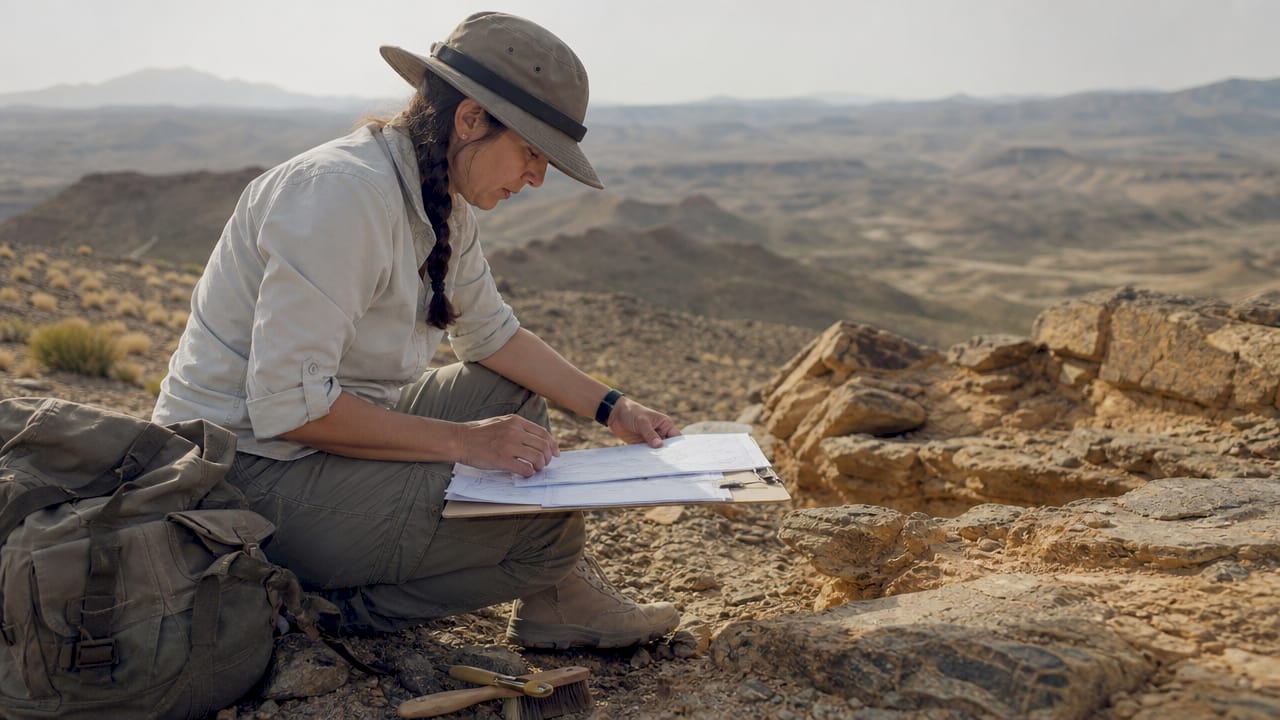
- Morocco has been continuously inhabited for over 400,000 years, shaping its rich, layered history.
- Its strategic location facilitated interactions among African, European, and Middle Eastern civilizations, reflected in its cultural and architectural heritage.
- The country’s historical sites symbolize the enduring legacies of prehistoric, Islamic, colonial, and trade influences.
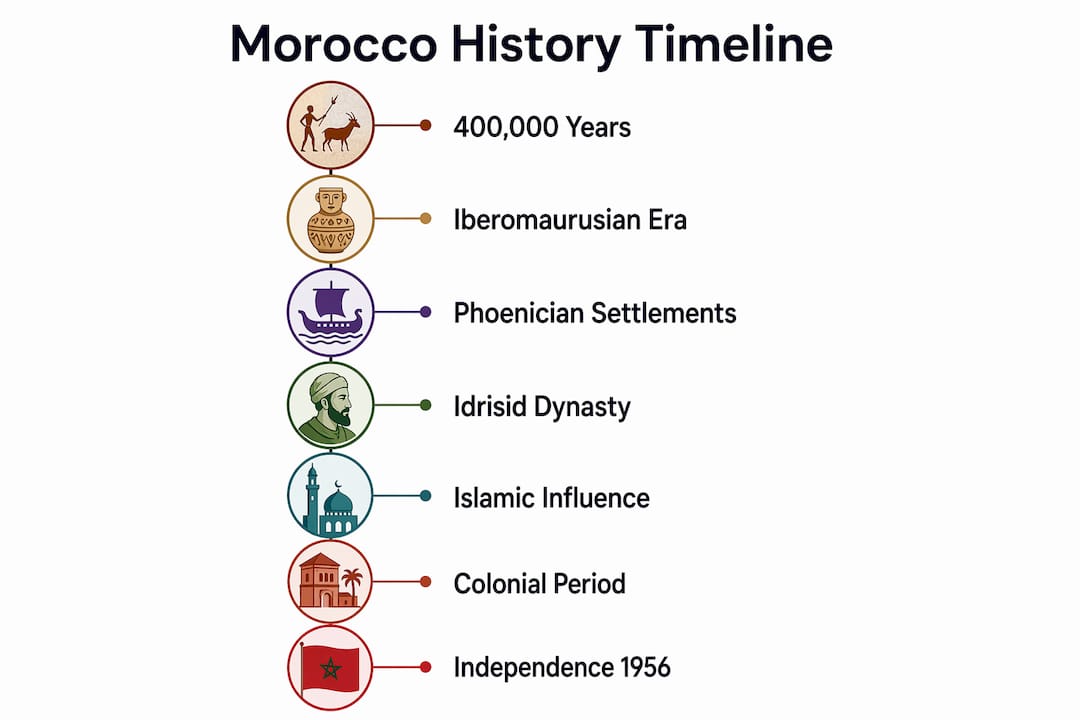
Morocco’s history is defined by over 400,000 years of continuous human presence, making it one of the longest-inhabited territories on Earth. From Lower Paleolithic hominids at Jebel Irhoud to the founding of the Idrisid dynasty in 788 CE, the country’s past spans prehistoric origins, medieval Islamic empires, trans-Saharan trade networks, and a colonial chapter that ended with independence in 1956. For researchers and history enthusiasts, Morocco offers a rare convergence of African, European, and Middle Eastern civilizations compressed into a single geographic corridor. This article traces that full arc, from ancient bones to UNESCO-listed medinas.
What are the earliest human history discoveries in Morocco?
Morocco’s earliest human presence dates to at least 400,000 years ago, placing it among the most significant prehistoric sites in the world. The evidence comes primarily from Jebel Irhoud, a site in western Morocco where fossilized remains of Homo sapiens were discovered alongside stone tools and animal bones. These findings pushed back the accepted date of anatomically modern human origins and reframed Africa’s role in early human evolution. Jebel Irhoud is not a footnote in prehistory. It is one of its central chapters.
The Iberomaurusian culture, which flourished roughly 25,000 to 10,000 years ago, represents the next major phase of ancient Moroccan culture. The Taforalt cave in northeastern Morocco is the most extensively excavated Iberomaurusian site, yielding skeletal remains, shell ornaments, and evidence of communal burial practices. These findings confirm that Morocco’s prehistoric populations were not isolated foragers but socially organized communities with symbolic behavior. That distinction matters for understanding how complex cultures later took root here.
Phoenician traders established coastal settlements along Morocco’s Atlantic and Mediterranean shores between the 8th and 6th centuries BCE. Cities like Lixus, near modern Larache, and Mogador, near Essaouira, served as commercial outposts connecting North Africa to the broader Mediterranean economy. These were not temporary camps. Lixus shows evidence of permanent structures, religious temples, and long-term occupation. The Phoenician presence introduced writing, coinage, and Mediterranean trade goods to Morocco’s indigenous Berber populations.
Rome absorbed Morocco’s northern territories into the province of Mauretania Tingitana in 40 CE. The Roman city of Volubilis, near modern Meknes, became the administrative capital of this frontier province and grew into a prosperous urban center with basilicas, triumphal arches, and elaborate mosaic floors. Roman influence lasted until the late 3rd century CE, after which Byzantine and Vandal powers competed for control of North Africa’s western edge.
Pro Tip: If you are researching ancient Morocco culture, the Taforalt cave findings and Volubilis ruins are the two sites that offer the most direct physical evidence of Morocco’s prehistoric and classical periods. Both are accessible to visitors and have active ongoing archaeological programs.
- Jebel Irhoud: Lower Paleolithic site, approximately 400,000 years old
- Taforalt cave: Iberomaurusian burials, shell ornaments, 25,000 to 10,000 years ago
- Lixus and Mogador: Phoenician coastal settlements, 8th to 6th centuries BCE
- Volubilis: Roman provincial capital, 40 CE onward, now a UNESCO World Heritage Site
How did Morocco’s early dynasties shape its political identity?
The Idrisid dynasty, founded in 788 CE, is the recognized origin point of the Moroccan state as a distinct political entity. Idris I, a descendant of the Prophet Muhammad through his grandson Hasan, fled Abbasid persecution after the Battle of Fakh and found refuge among the Berber Awraba tribe in northwestern Morocco. His religious lineage gave him immediate legitimacy among local populations, and he quickly consolidated political authority across the region. This combination of religious descent and urban political strategy, rather than military conquest alone, defined how Moroccan dynasties would claim authority for centuries.
Idris II, who ruled from 803 to 828 CE, expanded his father’s legacy by founding the city of Fez as a planned urban capital. Fez attracted Arab settlers from Andalusia and Kairouan, creating a cosmopolitan intellectual and commercial center from its earliest decades. The Idrisid dynasty’s legitimacy rested on this dual foundation: Sharifian religious lineage and the patronage of urban institutions. That model persisted through every subsequent Moroccan dynasty.
The Almoravid dynasty, which rose to power in the 11th century from Saharan Berber origins, extended Moroccan political reach into sub-Saharan Africa and the Iberian Peninsula simultaneously. Their control of trans-Saharan gold routes funded the construction of Marrakesh as a new imperial capital in 1070 CE. The Almohad dynasty that followed in the 12th century pushed ideological reform even further, imposing a strict theological program across Morocco, Spain, and Algeria. Both dynasties illustrate how Moroccan rulers used religion, trade, and military power as interlocking instruments of state.
The Saadi dynasty, ruling from 1549 to 1659, consolidated southern Morocco and reinforced the Sharifian tradition of claiming descent from the Prophet Muhammad as the primary source of political legitimacy. Their most celebrated achievement was the Battle of the Three Kings in 1578, where Moroccan forces defeated a Portuguese invasion at Wadi al-Makhazin. That victory secured Morocco’s independence from European colonial pressure for another three centuries and cemented the Saadi rulers as defenders of Islamic sovereignty.
- Idrisid dynasty (788 to 974 CE): Founded by Idris I, established Fez as Morocco’s first Islamic capital, its legitimacy rooted in Sharifian descent.
- Almoravid dynasty (1040 to 1147 CE): Saharan Berber origins, founded Marrakech, and controlled trans-Saharan gold trade and Iberian territories.
- Almohad dynasty (1121 to 1269 CE): Theological reform movement, extended empire across North Africa and Andalusia.
- Marinid Sultanate (1244 to 1465 CE): Patronized Fez as a center of Islamic scholarship and built the Bou Inania madrasa.
- Saadi dynasty (1549 to 1659 CE): Defeated the Portuguese invasion, reinforced Sharifian legitimacy, and expanded trade with sub-Saharan Africa.
Pro Tip: When studying Moroccan dynasties and empires, trace each dynasty’s capital city. The shift from Fez to Marrakesh to Meknes to Rabat maps political priorities as clearly as any written chronicle.
Why is Morocco considered a crossroads of civilizations?
Morocco’s crossroads geography explains the extraordinary layering of external influences that define its culture, language, and architecture. Positioned at the junction of the Atlantic and Mediterranean, with the Sahara to the south and the Strait of Gibraltar to the north, Morocco was never isolated. Every major civilization that touched the Mediterranean or West Africa eventually touched Morocco. That geographic reality produced a culture of synthesis rather than uniformity.
Trans-Saharan trade routes connected Morocco’s imperial cities to the gold and salt economies of Mali, Ghana, and Songhai. Caravans departing from Sijilmasa, a now-ruined city in the Tafilalt oasis, carried Saharan gold northward to Fez and Marrakesh, where it was minted into coins and traded across the Mediterranean. This commerce funded mosque construction, madrasa endowments, and royal patronage of scholarship. The wealth of medieval Morocco was, in significant part, African wealth flowing north.
Mediterranean connections brought Andalusian refugees, Jewish scholars, Genoese merchants, and Ottoman diplomats into Moroccan cities. After the fall of Granada in 1492, tens of thousands of Muslims and Jews expelled from Spain resettled in Fez, Tetouan, and Salé. They brought Andalusian architectural styles, musical traditions, and craft techniques that permanently altered Moroccan urban culture. The distinctive geometric tilework and stucco plasterwork found in Moroccan riads today traces directly to this Andalusian influx.
| City | Primary historical role | Key cultural influence |
|---|---|---|
| Fez | Idrisid and Marinid capital, Islamic scholarship | Andalusian refugees, Kairouan settlers |
| Marrakesh | Almoravid and Almohad imperial seat | Sub-Saharan African trade, Berber architecture |
| Rabat | Almohad military base, later colonial capital | French urban planning, Atlantic trade |
| Meknes | Alaouite imperial capital under Moulay Ismail | Ottoman and European baroque influences |
| Tetouan | Post-Reconquista Andalusian resettlement | Spanish colonial administration, Moorish heritage |
The impact of Islam in Morocco extended far beyond religious practice. Arabic became the language of law, scholarship, and administration. Sufi brotherhoods organized rural communities around shared spiritual practices and local saints’ shrines. Islamic legal institutions, particularly the qadi courts and madrasa networks, created a literate administrative class that outlasted individual dynasties. Morocco’s Islamic identity was never monolithic. It absorbed Berber, African, Andalusian, and later Ottoman influences into a distinctly Moroccan expression of the faith.
What are the historical significances of Morocco’s UNESCO World Heritage Sites?
Morocco holds 9 UNESCO World Heritage Sites, each functioning as a physical archive of a distinct historical period. These sites reflect Roman frontier life, Islamic dynastic patronage, trans-Saharan commerce, and colonial urban planning within a single country. Reading them as a sequence reveals how different powers left tangible architectural legacies that map political and economic dynamics across centuries. For researchers, they are primary sources built in stone, brick, and earthen clay.
The Medina of Fez, inscribed in 1981, preserves the largest intact medieval urban fabric in the Arab world. The Marinid Sultanate used Fez as its capital and endowed it with the Bou Inania madrasa, the al-Attarine madrasa, and the Qarawiyyin mosque complex, which houses one of the world’s oldest continuously operating universities. Walking through Fez’s medina is not a nostalgic exercise. It is an encounter with a fully functioning medieval city that has never been abandoned or rebuilt.
Volubilis, inscribed in 1997, preserves the most complete Roman urban site in Morocco. Its mosaics depicting Orpheus, Bacchus, and athletic competitions reveal a provincial elite that was thoroughly integrated into Roman cultural life while remaining geographically distant from Rome. The site’s triumphal arch, built in honor of Emperor Caracalla in 217 CE, still stands to near its original height. Volubilis was later occupied by Idris I, who made it his base before founding Fez, connecting Roman and Islamic Morocco in a single location.
Aït Benhaddou, inscribed in 1987, is a fortified ksar along a former caravan route between the Sahara and Marrakesh. Its earthen pisé architecture, dating to at least the 11th century, illustrates how geography, commerce, and building tradition intersected in pre-Saharan Morocco. The site demonstrates that Morocco’s architectural heritage is not limited to Islamic urban centers. It extends into the desert margins, where Berber communities built sophisticated fortified settlements adapted to extreme climate and long-distance trade.
| UNESCO Site | Dynasty or period | Primary historical significance |
|---|---|---|
| Medina of Fez | Idrisid, Marinid | Medieval Islamic urbanism, Qarawiyyin University |
| Medina of Marrakesh | Almoravid, Saadi | Imperial capital, trans-Saharan trade hub |
| Volubilis | Roman, early Idrisid | Roman frontier province, mosaic art |
| Aït Benhaddou | Berber, pre-Saharan | Caravan route architecture, earthen construction |
| Historic City of Meknes | Alaouite | 17th-century imperial capital, Moulay Ismail’s court |
| Rabat | Almohad, French protectorate | Colonial urban planning, Hassan Tower |
- The Qarawiyyin Mosque in Fez, founded in 859 CE, is recognized as the world’s oldest continuously operating educational institution.
- Volubilis mosaics remain in situ, making them among the best-preserved Roman floor mosaics in Africa.
- Aït Benhaddou has served as a filming location for productions including Lawrence of Arabia and Gladiator, bringing global attention to its architectural heritage.
- Rabat’s UNESCO inscription in 2012 specifically recognized its layered history spanning Almohad, Alaouite, and French colonial urban planning.
Pro Tip: When visiting historical sites in Morocco, hire a licensed guide certified by the Moroccan Ministry of Tourism. Independent guides at UNESCO sites frequently provide historically accurate context that general travel resources omit.
How did colonialism and independence shape modern Morocco?
The Treaty of Fez in 1912 formalized the French protectorate over Morocco, ending four centuries of Sharifian sovereignty and restructuring the country’s political, economic, and urban systems. France retained the Alaouite sultan as a nominal figurehead while French resident-generals exercised actual administrative control. Spain simultaneously claimed a northern zone around Tetouan and a southern zone around Tarfaya. The legal treaty date of 1912 and the reality of on-ground French military control, which began earlier through military campaigns in the east, are distinct facts that researchers must separate to understand how Moroccan sovereignty was actually dismantled.
Moroccan colonial history produced one of North Africa’s most organized nationalist movements. The Istiqlal Party, founded in 1944, articulated a formal demand for independence grounded in Islamic identity, Moroccan historical continuity, and opposition to French settler colonialism. Sultan Mohammed V, who had maintained a careful public neutrality, openly aligned with the nationalist cause in 1947 in a speech delivered in Tangier. France responded by exiling him to Madagascar in 1953, a miscalculation that transformed him from a political figure into a national symbol.
- 1912: Treaty of Fez establishes French protectorate; Spain controls northern and southern zones.
- 1930: Berber Dahir attempts to separate Berber communities from Islamic law, triggering nationalist protests.
- 1944: Istiqlal Party publishes independence manifesto, signed by leading Moroccan intellectuals and religious figures.
- 1953: France exiles Mohammed V to Madagascar, accelerating nationalist mobilization.
- 1956: Morocco regains independence; Mohammed V becomes king; French and Spanish protectorates formally dissolved.
- 1975: The Green March sends 350,000 Moroccan civilians into Western Sahara, asserting a territorial claim after Spanish withdrawal.
Mohammed V’s return from exile in November 1955 and Morocco’s formal independence on March 2, 1956, represented a negotiated transition rather than a revolutionary rupture. The Alaouite monarchy retained its central role, now reframed as the legitimate heir to pre-colonial Moroccan sovereignty. Hassan II, who succeeded his father in 1961, consolidated royal authority through a combination of constitutional reform, suppression of political opposition, and the 1975 Green March into Western Sahara. The Western Sahara question remains unresolved in 2026, representing the most contested element of Morocco’s post-independence territorial identity.
Key takeaways
Morocco’s history is best understood as a continuous process of synthesis: prehistoric origins, Islamic dynastic formation, cross-continental trade, and colonial disruption all built upon each other to produce a civilization of exceptional depth and complexity.
| Point | Details |
|---|---|
| Prehistoric depth | Human presence at Jebel Irhoud dates to 400,000 years ago, making Morocco central to human origins research. |
| Dynastic legitimacy | The Idrisid dynasty established Sharifian descent as the primary basis for political authority, a model every subsequent dynasty replicated. |
| Crossroads culture | Trans-Saharan trade, Andalusian refugees, and Mediterranean commerce layered African, European, and Middle Eastern influences into Moroccan cities. |
| UNESCO as archive | Morocco’s 9 UNESCO World Heritage Sites map distinct historical periods from Roman frontier life to colonial urban planning. |
| Colonial transition | The 1912 Treaty of Fez and 1956 independence mark the boundaries of a colonial chapter that reshaped Morocco’s political institutions without erasing its dynastic continuity. |
Morocco’s history rewards the researcher who reads between the monuments
Most visitors to Fez or Marrakesh encounter Morocco’s history as a visual experience: the geometry of a madrasa courtyard, the scale of a city wall, the density of a souk. That is a legitimate entry point. But from my perspective, the more revealing approach is to track what each dynasty chose to build and where. The Marinids endowed madrasas in Fez because they needed religious scholars to legitimize their rule. The Alaouites built Meknes as a Versailles-scale imperial statement because Moulay Ismail needed to project power to European rivals. Architecture is policy made permanent.
The challenge I find most underappreciated in Morocco history research is the gap between archaeological evidence and written records. Morocco’s prehistoric and early historic periods are extraordinarily rich in physical evidence but thin in indigenous written sources. Most early accounts come from Arab geographers like al-Bakri and al-Idrisi, who wrote from outside Morocco and filtered their observations through their own cultural frameworks. Cross-referencing those texts with archaeological findings from sites like Taforalt or Volubilis produces a more accurate picture than either source alone.
Heritage preservation in Morocco is also more politically charged than it appears. The medinas of Fez and Marrakesh are UNESCO-listed, but they are also living neighborhoods where residents face pressure from tourism development and real estate speculation. Preservation that serves researchers and travelers without serving residents is not preservation. It is extraction. The most culturally immersive stays I have encountered treat heritage as a living practice, not a museum exhibit. That distinction shapes how authentically any visitor or researcher can engage with Morocco’s historical fabric.
— Moroccotravel1.com
Experience Morocco’s history firsthand with Moroccotravel1.com
Morocco’s historical depth is not fully accessible through reading alone. The Qarawiyyin courtyard, the Roman mosaics at Volubilis, and the earthen towers of Aït Benhaddou require physical presence to register their scale and meaning. Moroccotravel1 designs custom Morocco tour packages that place you inside these historical layers, guided by local experts who connect sites to their dynastic, religious, and commercial contexts. The 14-day Morocco Grand Tour covers Fez, Meknes, Volubilis, the Sahara, and Marrakesh in a sequence that mirrors the Morocco history timeline. For researchers and enthusiasts who want depth over distance, Moroccotravel1 also offers top cities in Morocco itineraries focused on urban heritage and cultural immersion.
FAQ
How far back does Morocco’s recorded history go?
Morocco’s recorded history and earliest archaeology extend back at least 400,000 years, based on evidence from Jebel Irhoud. Written historical records begin with Phoenician coastal settlements in the 8th century BCE.
What was the first Moroccan dynasty?
The Idrisid dynasty, founded in 788 CE by Idris I, is considered the first Moroccan state. Idris I established political authority by combining Sharifian religious lineage with Berber tribal alliances and founded the city of Fez.
How many UNESCO World Heritage Sites does Morocco have?
Morocco has 9 UNESCO World Heritage Sites, including the Medinas of Fez and Marrakesh, Volubilis, Aït Benhaddou, and the historic city of Meknes. Each site represents a distinct historical period in Moroccan dynastic and cultural development.
When did Morocco gain independence from France?
Morocco regained independence on March 2, 1956, following the dissolution of the French protectorate established by the Treaty of Fez in 1912. The nationalist movement, led by Mohammed V and the Istiqlal Party, secured this transition after decades of organized resistance.
What makes Morocco a crossroads of civilizations?
Morocco’s position at the junction of the Atlantic, Mediterranean, Sahara, and the Strait of Gibraltar made it a meeting point for African, European, and Middle Eastern civilizations. Trans-Saharan trade routes, Andalusian migration, and Phoenician and Roman colonization all contributed to Morocco’s layered cultural identity.


