


- Morocco offers diverse landscapes from imperial cities and mountains to deserts and coasts, rewarding slow travel.
- Key sites include Marrakech’s Jemaa el-Fnaa, Fes el-Bali medina, and Aït Benhaddou, each requiring guided exploration for full immersion.
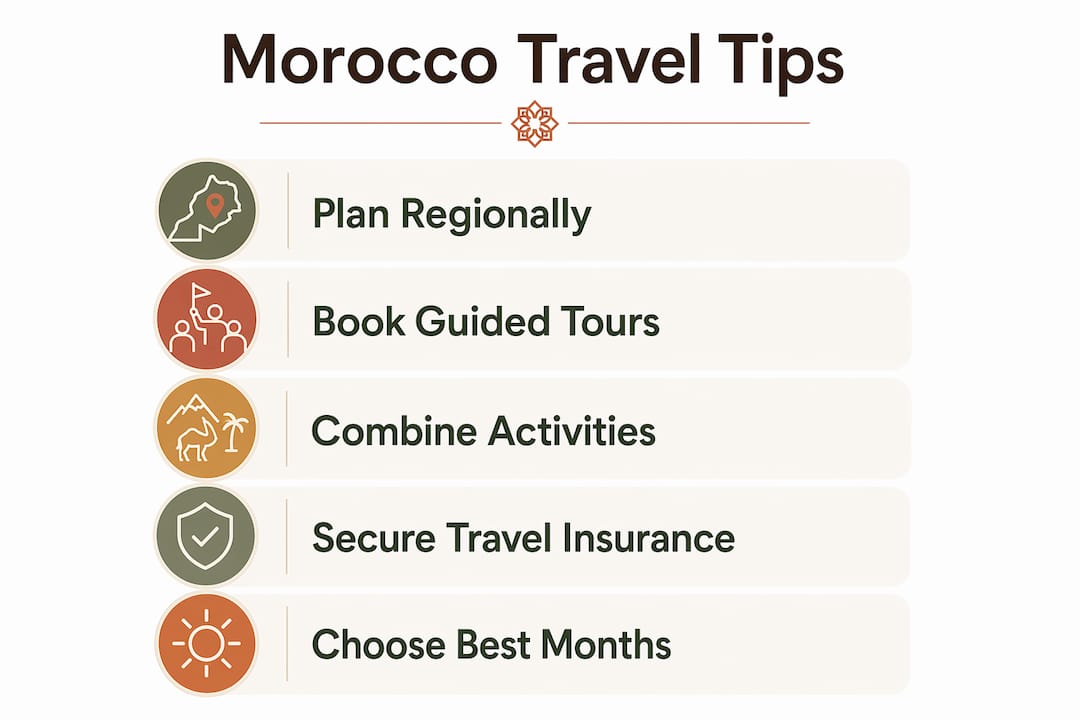
- Organizing travel by geographic regions and prioritizing deep experiences enhances your visit while ensuring safety in adventure activities.
Morocco is one of the world’s most varied travel destinations, where a single two-week trip can take you from medieval medinas and Roman ruins to Saharan dunes and Atlantic surf. The top things to see and do in Morocco fall into four geographic clusters: imperial cities, mountain landscapes, desert adventures, and coastal escapes. Marrakech’s Jemaa el-Fnaa, the ancient lanes of Fes el-Bali, and the UNESCO-listed kasbah of Aït Benhaddou represent just the opening chapter. Whether you want cultural immersion, outdoor adventure, or both, Morocco rewards travelers who plan with geography in mind.
What are the must-see cities and medinas in Morocco?
Morocco’s imperial cities are the backbone of any serious Morocco travel guide, and each one delivers a distinct personality. Marrakech’s Jemaa el-Fnaa and Bahia Palace are among the country’s most iconic urban landmarks, drawing visitors with their theatrical energy and ornate architecture. The square at Jemaa el-Fnaa transforms from a daytime market of snake charmers and orange juice vendors into a sprawling open-air food theater after sunset. Bahia Palace, built in the late 19th century, showcases the finest Moroccan craftsmanship in its painted ceilings and mosaic courtyards.
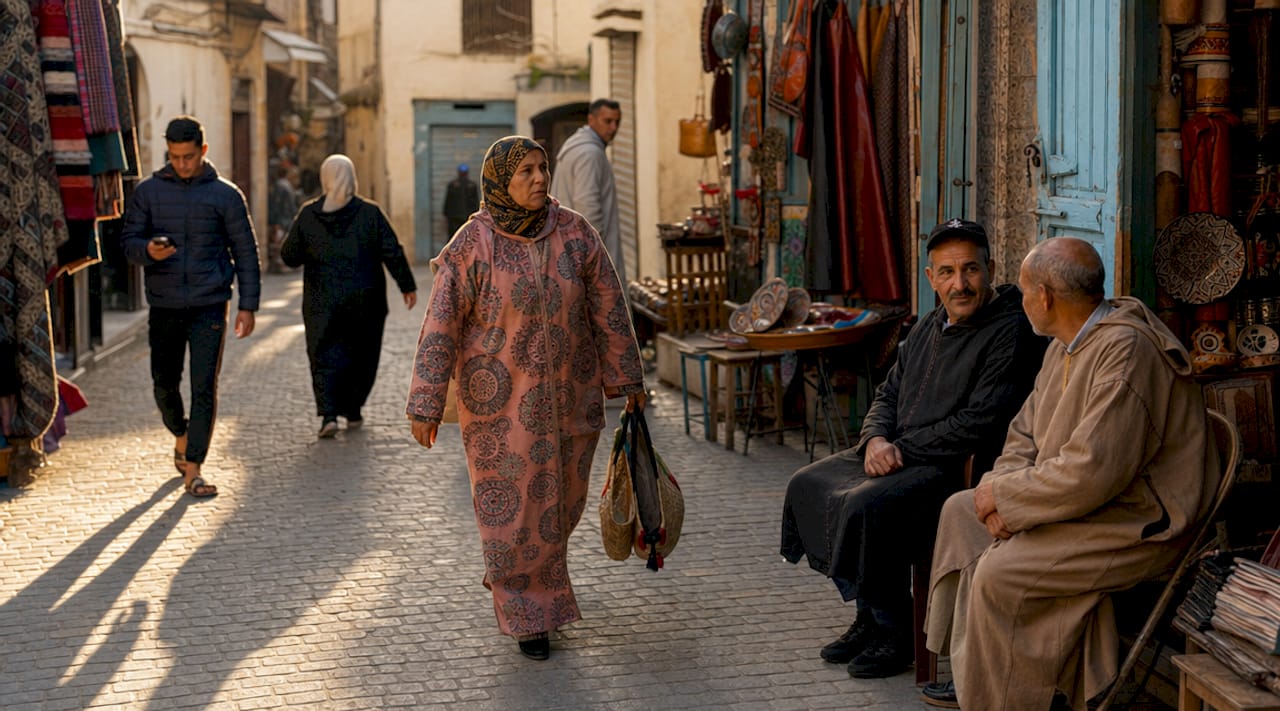
Fes demands equal attention. Fes el-Bali is the largest car-free medieval city in the world, with over 9,000 narrow, interconnected alleyways that have functioned as a living city since its founding in 789 CE. This is not a preserved relic. It is an operating urban organism where tanneries, madrasas, and spice markets run on medieval logic. Walking its lanes without a guide is genuinely disorienting, which is part of the appeal.
Casablanca rounds out the city circuit. The Hassan II Mosque, completed in 1993, sits on a promontory over the Atlantic and holds 25,000 worshippers inside its walls. It is one of the few mosques in Morocco open to non-Muslim visitors, making it a rare window into Islamic architecture and spiritual practice.
Key urban highlights to plan around:
- Jemaa el-Fnaa, Marrakech: best experienced at dusk when food stalls ignite and musicians fill the square
- Bahia Palace, Marrakech: allow 90 minutes to absorb the detail in each courtyard
- Fes el-Bali medina: book a licensed local guide for at least the first half-day to orient yourself
- Chouara Tannery, Fes: view from a leather shop balcony for the full aerial perspective
- Hassan II Mosque, Casablanca: guided tours run most mornings and last approximately one hour
Pro Tip: In Fes el-Bali, agree on a guide fee before you start and confirm the route covers the tannery, Al-Attarine Madrasa, and the Nejjarine fountain. These three sites alone justify a full morning.
Expert travel guides recommend combining guided tours with self-guided exploration in complex medinas to balance genuine immersion with practical orientation. The best approach is to hire a guide for the morning, then return alone in the afternoon when you already know the main arteries. You will notice entirely different details the second time through.
Which natural landscapes and adventure activities should you prioritize?
Morocco’s outdoor adventures rank among the best activities in Morocco for travelers who want more than city sightseeing. The country packs the High Atlas Mountains, the Sahara Desert, and a 1,200-mile Atlantic and Mediterranean coastline into a geography smaller than Texas. Each zone offers a different physical experience and a different pace.
Here is a practical sequence for planning your outdoor itinerary:
- Trek the High Atlas Mountains. The Toubkal massif near Marrakech contains North Africa’s highest peak at 4,167 meters. Day hikes from the village of Imlil are accessible without technical climbing experience, while a two-day summit attempt requires basic fitness and a licensed mountain guide.
- Ride camels at Erg Chebbi. The Sahara Desert’s Erg Chebbi dunes near Merzouga are the visual centerpiece of Morocco’s desert region. Camel treks at sunrise or sunset take one to two hours and connect to overnight desert camps where you sleep under the open sky.
- Spend a night in a desert camp. Fixed luxury camps near Merzouga offer private tents with proper beds, Moroccan dinners, and live Gnawa music. Budget camps offer the same stars for a fraction of the price. Both are worth experiencing.
- Windsurf or kitesurf in Essaouira. The Atlantic port city of Essaouira channels consistent trade winds that make it one of Africa’s top windsurfing destinations. Surf schools on the beach offer half-day lessons for beginners.
- Relax on Agadir’s beaches. Agadir offers a more resort-style coastal experience with calm waters, organized beach clubs, and easy access to the Anti-Atlas foothills for day trips.
Up-to-date safety advice and travel insurance covering your full itinerary and planned activities are non-negotiable for desert and mountain adventures. Heat exhaustion, altitude sickness, and sudden weather changes in mountain terrain are real risks. Carry at least two liters of water per person on any desert or mountain excursion, and share your planned route with your accommodation host before departing.
Pro Tip: Book your Erg Chebbi camel trek and desert camp together through a single operator based in Merzouga rather than through a Marrakech agency. You cut out the middleman, get a better price, and deal directly with the people who know the dunes.
The Atlas Mountains also serve a practical itinerary function. They sit between Marrakech and the desert, so the Tizi n’Tichka Pass becomes a natural scenic route rather than a detour. Stopping at the Telouet Kasbah along this road adds a crumbling, atmospheric ruin to your drive without adding significant time.
What UNESCO World Heritage sites should be on your Morocco itinerary?
Morocco holds nine UNESCO World Heritage Sites, and three of them belong on any serious itinerary: Aït Benhaddou, Volubilis, and the medinas of Fes and Marrakech. Each represents a different chapter of Moroccan history and a different architectural tradition.
| Site | Location | Key Feature | Recommended Visit Time |
|---|---|---|---|
| Aït Benhaddou | Draa-Tafilalet region | Preserved earthen kasbah village | 1 to 2 hours |
| Volubilis | Near Meknes | Roman mosaic floors and triumphal arch | 2 to 3 hours |
| Fes el-Bali medina | Fes | Medieval Islamic urban fabric | Full day minimum |
| Marrakech medina | Marrakech | Jemaa el-Fnaa and historic souks | Multiple days |
Aït Benhaddou was designated a UNESCO site in 1987 for its outstanding example of southern Moroccan earthen architecture. The ksar sits on a hillside above the Ounila River and is built entirely from rammed earth and adobe. You may recognize it from film productions including Gladiator and Game of Thrones, but the site’s real power comes from its age and its construction logic. Every tower, granary, and communal wall was built to manage heat, water, and defense simultaneously.
Aït Benhaddou’s preservation relies on local communities using traditional materials and techniques rather than modern concrete or synthetic sealants. This approach keeps the site architecturally authentic in a way that many restored heritage sites fail to achieve. A small number of families still live inside the ksar, which means you are walking through an inhabited monument, not a museum replica.
Volubilis, located near Meknes in northern Morocco, preserves the most complete Roman ruins on African soil outside of Tunisia. The site’s triumphal arch, Capitoline temple, and floor mosaics depicting mythological scenes have survived largely intact since the 3rd century CE. Visiting Volubilis alongside Meknes and the holy town of Moulay Idriss turns a single day into one of the most historically dense experiences available anywhere in North Africa.
How should you plan your Morocco itinerary by region?
Organizing a Morocco trip by geographic clusters reduces transit time and improves the quality of each experience. Morocco’s attractions are spread across a country roughly the size of California, and random point-to-point routing burns days in transit. The most efficient structure groups your trip into four zones and moves through them in a logical arc.
A well-structured regional sequence looks like this:
- Start in Casablanca or Marrakech. Both cities have international airports with direct flights from North America and Europe. Marrakech makes the stronger opening because it delivers immediate sensory impact and sits closest to both the Atlas Mountains and the desert route.
- Move south through the Atlas Mountains. The Tizi n’Tichka pass connects Marrakech to Ouarzazate in approximately three hours by road. Ouarzazate serves as the gateway to Aït Benhaddou and the Draa Valley.
- Continue east to the Sahara. From Ouarzazate, the road to Merzouga passes through the Draa Valley’s palm groves and the Todra Gorge, a canyon with walls rising 300 meters. Budget two days for this stretch to avoid rushing.
- Head north through Fes. After the desert, the route north through Erfoud and Midelt brings you to Fes, where you shift from landscape travel to deep urban immersion. Fes also connects easily to Meknes and Volubilis for a northern heritage day.
- Close the loop on the Atlantic coast. Essaouira and Agadir sit on the return arc toward Marrakech, making the coast a natural final chapter before your departure flight.
Lonely Planet and travel experts consistently recommend this regional cluster approach as the framework that maximizes both experience diversity and logistical efficiency. A 10-day trip can cover all four zones without feeling rushed if you resist the urge to add too many single-night stops. Two nights minimum in each major hub gives you enough time to go beyond the obvious sights.
Transportation between regions works best by private transfer or rented car for flexibility and by CTM bus or shared grand taxi for budget travelers. Trains connect Casablanca, Rabat, Meknes, Fes, and Marrakech reliably, but do not reach the desert or the coast south of Casablanca.
Pro Tip: Book your Fes accommodation in the medina itself, not outside the walls. Waking up inside Fes el-Bali before the crowds arrive at 9 a.m. is one of the most atmospheric experiences Morocco offers.
For travelers who want a pre-built version of this regional arc, the 13-day Morocco highlights tour from Casablanca to Marrakech covers all four zones with expert local guides and pre-arranged logistics.
Key takeaways
Morocco rewards travelers who organize their trip around geographic zones rather than a random checklist of sites.
| Point | Details |
|---|---|
| Prioritize regional clustering | Group cities, mountains, desert, and coasts into a logical arc to cut transit time and deepen each experience. |
| Fes el-Bali requires a guide | The world’s largest car-free medieval city has 9,000+ alleyways; a licensed guide transforms confusion into context. |
| Aït Benhaddou is a two-hour stop | This UNESCO kasbah sits on the Marrakech-to-desert route and adds heritage depth without disrupting your schedule. |
| Desert safety is non-negotiable | Travel insurance covering adventure activities and up-to-date safety checks protect you in remote Saharan terrain. |
| Combine guided and self-guided time | Use guides for orientation in medinas, then return alone to absorb details at your own pace. |
What I’ve learned from years of planning Morocco trips
Most travelers underestimate how much Morocco rewards slowness. The instinct when you arrive in Marrakech is to sprint through every landmark in two days and move on. That approach produces photographs but not understanding. The Fes el-Bali medina, which functions as a living medieval city with intact social and commercial practices from the 9th century, cannot be absorbed in three hours. It needs a full day, ideally two.
The other mistake I see constantly is treating the desert as a single night’s detour. Erg Chebbi is a 12-hour round trip from Marrakech if you rush it. Travelers who spend two nights in Merzouga, take a sunrise camel trek on day one, and explore the dunes on foot on day two come back with a fundamentally different experience than those who arrive at dusk and leave at dawn.
My honest recommendation is to cut one city from your list and spend that time going deeper in the places you do visit. Most itineraries try to hit Casablanca, Rabat, Meknes, Fes, Chefchaouen, Marrakech, Essaouira, and the desert in 10 days. That is a transit schedule, not a travel experience. Choose four or five anchors, build your regional arc around them, and let the places between surprise you.
Cultural etiquette matters more in Morocco than in most destinations. Dress conservatively in medinas and religious sites; learn five words of Darija, Arabic, or French; and accept tea when it is offered. These small gestures open doors that no guidebook can unlock.
— Moroccotravel1.com
Plan your Morocco trip with Moroccotravel1.com
Moroccotravel1 designs custom Morocco tour packages that cover every region described in this guide, from Marrakech’s medina and the Sahara dunes to Aït Benhaddou and the Atlantic coast. The 14-day Morocco Grand Tour combines imperial cities, UNESCO heritage sites, desert adventures, and coastal escapes into one expertly sequenced itinerary with local guides, riad accommodations, and private transfers included. For families, the 10-day family tour package balances cultural depth with kid-friendly pacing. Every package includes 24/7 support and can be customized to your travel dates, group size, and interests.
FAQ
What are the top things to do in Morocco for first-time visitors?
First-time visitors should prioritize Marrakech’s Jemaa el-Fnaa, a guided tour of the Fes el-Bali medina, a night in a Sahara Desert camp near Erg Chebbi, and a stop at the UNESCO kasbah of Aït Benhaddou. These four experiences cover Morocco’s urban, cultural, and natural highlights in a single efficient arc.
How many days do you need to see Morocco’s main attractions?
Ten to fourteen days covers Morocco’s four main regions: the imperial cities, Atlas Mountains, Sahara Desert, and Atlantic Coast. Fewer than ten days forces you to skip either the desert or the north, both of which are worth the travel time.
Is Morocco safe for adventure activities like desert trekking and mountain hiking?
Morocco is generally safe for adventure travel when you follow current travel safety advice and carry travel insurance that covers your specific activities. Desert and mountain excursions require preparation, including adequate water, a licensed guide for technical terrain, and sharing your route with your accommodation host.
What is the best way to get around Morocco between cities?
Private transfers and rental cars offer the most flexibility for regional travel, especially between Marrakech, Ouarzazate, and the desert. Trains connect the northern imperial cities of Casablanca, Rabat, Meknes, and Fes efficiently and affordably.
When is the best time to visit Morocco?
March through May and September through November offer the most comfortable temperatures across all regions. Summer heat in the Sahara regularly exceeds 45°C, making desert travel difficult from June through August. Winter is ideal for the south but cold in the Atlas Mountains without proper gear.


