


- A Morocco riad is a traditional house centered around a courtyard garden, offering authentic cultural immersion.
- They feature passive climate control, handcrafted decor, hammams, and rooftop terraces, varying widely in luxury and price.
A Morocco riad is a traditional Moroccan house built around a central courtyard garden, designed to deliver privacy, tranquility, and a cultural depth that no conventional hotel can replicate. The word “riad” derives from the Arabic word for “garden,” and that courtyard at the heart of the structure is what separates a true riad from the many boutique hotels that borrow the label. Across Marrakech, Fes, and Essaouira, these inward-facing homes have sheltered families, merchants, and now travelers for centuries. If you are planning a trip to Morocco and want to sleep inside the country’s living architectural heritage, understanding how riads work, what they cost, and where to find the best ones is the single most useful thing you can do before you book.
What makes the architecture of Morocco riads unique?
A riad’s defining feature is its central courtyard garden, which gives the structure its name and its logic. Every room faces inward toward this open-air space rather than outward toward the street. The result is a building that turns its back on the noise and heat of the medina while creating a cool, shaded sanctuary inside.
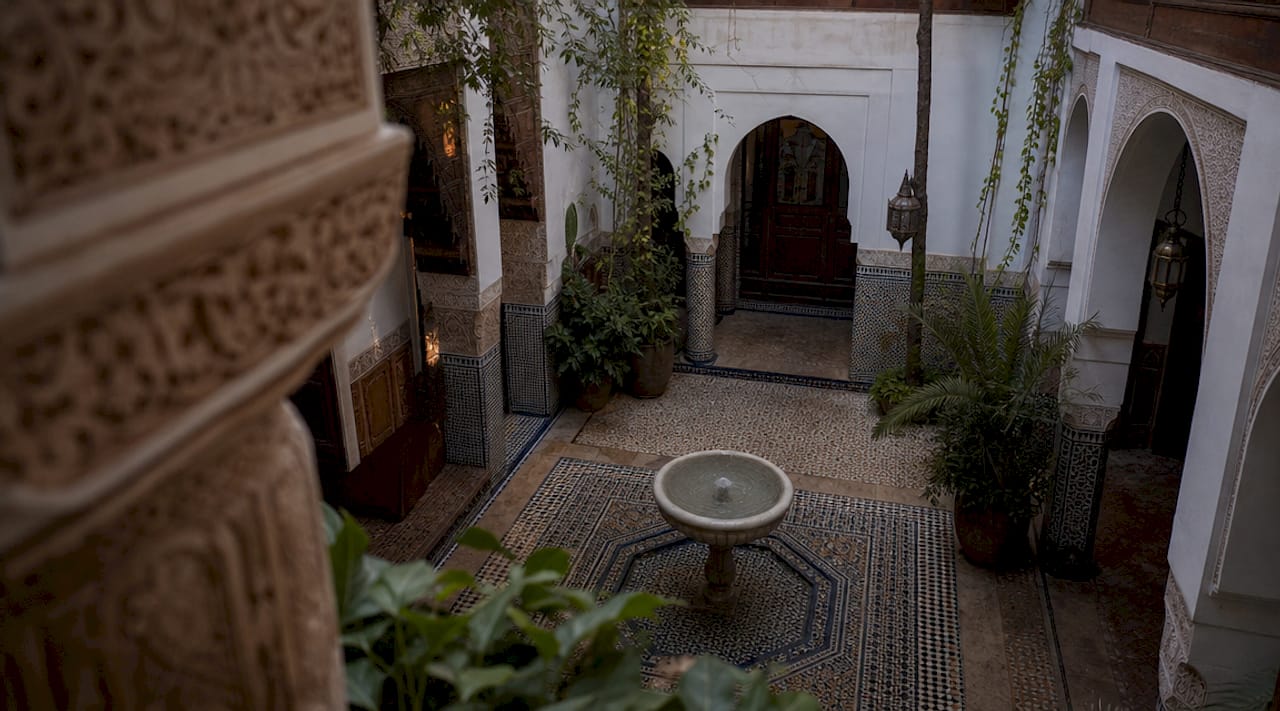
The courtyard as climate control
The central courtyard does more than look beautiful. In Marrakech’s summer heat, the open sky above and the fountain or planting below create a natural convection effect that pulls cooler air through the lower rooms. Thick earthen walls retain the cool of the night well into the afternoon. This is centuries-old passive climate engineering, and it works better than you might expect.
Craftsmanship that defines authenticity
Authentic riads are distinguished by three signature craft traditions:
- Zellige tilework: Hand-cut ceramic tiles arranged in geometric patterns cover floors, fountain basins, and lower walls. Each tile is individually shaped by a craftsman using a small hammer and chisel. No two installations are identical.
- Carved stucco: Upper walls feature intricate plasterwork carved by hand into arabesque and geometric patterns. The depth and precision of this carving are a direct indicator of a riad’s quality and age.
- Cedarwood ceilings: Artisanal cedarwood ceilings, painted or carved in honeycomb and star patterns, crown the main reception rooms and bedrooms. Cedar is prized for its scent as well as its durability.
These three elements together create an interior that functions as a sensory experience. Running your hand across carved stucco or looking up at a painted cedar ceiling tells you something about Moroccan culture that no guidebook can.
Hammams and rooftop terraces
Most riads of any quality include a hammam, the traditional steam bath that is central to Moroccan social and wellness culture. The rooftop terrace is equally standard. From up there, you get an unobstructed view across the medina’s flat rooftops, the minarets rising above them, and the Atlas Mountains on clear days. These two spaces, the hammam below and the terrace above, frame the riad experience from morning to evening.
Pro Tip: Ask your riad host whether the hammam is private or shared with other guests. At entry-level properties, hammam time is often scheduled by appointment. At luxury riads, it is typically reserved exclusively for your room.
How do Morocco riads vary by luxury level and price?
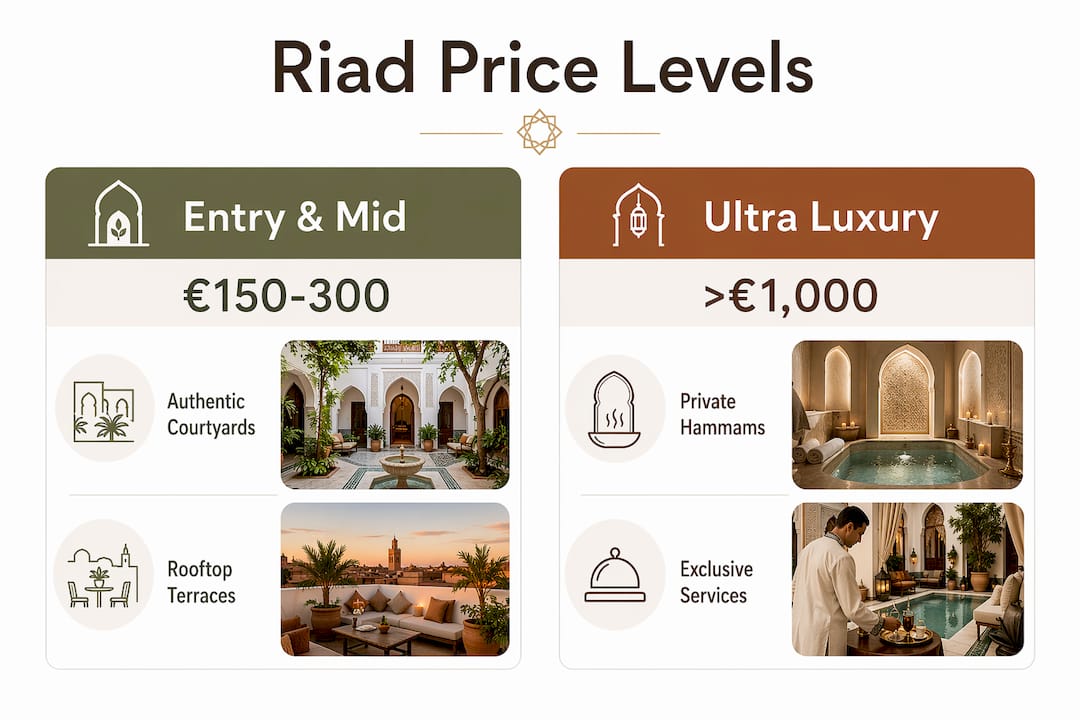
Riad pricing in 2026 spans a wider range than most travelers expect. Entry-level boutique riads start around €150 to €300 per night, while ultra-luxury private properties reach €700 to over €1,800 per night depending on season and configuration. That spread reflects genuine differences in architecture, service, privacy, and craftsmanship, not just thread counts.
Entry-level and mid-range riads
At the €150 to €300 tier, you get the authentic courtyard experience, traditional decor, and usually a rooftop terrace with breakfast included. Staff is present but small, and services like airport transfers or cooking classes are typically arranged on request at an additional cost. These riads are often family-run, which adds warmth and personality but means fewer formal amenities.
Mid-range riads in the €300 to €700 bracket typically offer more polished interiors, private bathrooms with better fixtures, and a more curated approach to decor. Many include in-house hammam access, a small plunge pool, and concierge services for organizing local tours. The Michelin Guide’s selection of best riad hotels in Marrakech sits largely in this bracket.
Ultra-luxury: Royal Mansour and the private riad model
Royal Mansour in Marrakech represents the ceiling of the riad concept. Its 53 private standalone riads are three-floor houses, each with a private courtyard, rooftop terrace, plunge pool, and dedicated butler. The property uses hidden staff corridors so that service appears and disappears without you ever seeing a staff member cross your path. The effect is genuinely palace-like. Rates at this level exceed €1,800 per night in peak season.
The table below summarizes what to expect at each price tier:
| Price tier | Nightly rate (2026) | Typical amenities | Service level |
|---|---|---|---|
| Entry-level boutique | €150–€300 | Courtyard, rooftop terrace, breakfast | Small family-run staff |
| Mid-range | €300–€700 | Private hammam, plunge pool, concierge | Dedicated team, curated services |
| Ultra-luxury | €700–€1,800+ | Private courtyard, butler, pool, spa | 24/7 invisible service model |
Pro Tip: Shoulder season in Marrakech runs from October to November and March to April. Booking a mid-range riad during these months often gets you near-luxury quality at entry-level prices, since occupancy drops and properties offer significant discounts.
Where are the best riads located?
Most Morocco riad hotels sit inside medinas, the ancient walled city centers that predate modern urban planning by several centuries. Marrakech’s medina is the most visited, but Fes el-Bali, the medina of Fes, holds the largest concentration of historic riads in the country. Location within the medina matters more than most travelers realize.
Key neighborhoods in Marrakech
Marrakech’s medina contains several distinct neighborhoods, each with a different character:
- Mouassine: Upscale and relatively quiet, close to the souks but set back from the main tourist corridors. Many of the city’s best mid-range and luxury riads are here.
- Bab Doukkala: Slightly further from Jemaa el-Fna but more residential in feel. Riads here tend to be larger and less expensive than those in Mouassine.
- Kasbah: Located near the Saadian Tombs and El Badi Palace, this neighborhood suits travelers focused on historic monuments. It is quieter at night than in the central medina.
- Near Jemaa el-Fna: Riads within five minutes’ walk of the main square offer unbeatable access to Marrakech’s most famous gathering point. The tradeoff is noise, particularly on weekend evenings.
For travelers focused on top Moroccan cities beyond Marrakech, Fes and Chefchaouen also offer excellent riad options with less tourist saturation.
Accessibility and the medina constraint
Medina streets were built for pedestrians, donkeys, and the occasional motorbike. Vehicle access is limited throughout most medinas, and some riads are accessible only through alleys too narrow for any vehicle. Travelers with mobility concerns, heavy luggage, or young children should verify exactly how close a taxi or horse-drawn carriage can get to the riad’s front door before booking. Most reputable riads will send a staff member to meet you at the nearest accessible drop-off point and carry your bags.
How do riads offer authentic cultural immersion?
A riad stay is not simply accommodation. Authentic riads act as cultural repositories, curating museum-quality artifacts, traditional textiles, and handcrafted furniture that tell the story of Moroccan artisanship across generations. Riad Kniza in Marrakech, for example, is known for its owner’s personal collection of antique Moroccan objects displayed throughout the property. Staying there is closer to sleeping in a private museum than checking into a hotel.
Services that go beyond lodging
The standard guest services at most authentic riads in 2026 include:
- Traditional hammam treatments with black soap and kessa glove exfoliation
- Moroccan cooking classes taught in the riad’s kitchen, covering tagine, couscous, and pastilla
- Private guided tours of the medina’s souks, tanneries, and historic monuments
- Airport transfers with dedicated drivers who double as informal guides
- 24/7 concierge support for reservations, transport, and activity bookings
These services are not add-ons. They are the mechanism through which a riad transforms from a place to sleep into a way of experiencing Morocco. The cooking class alone, held in a centuries-old kitchen with a local cook, teaches you more about Moroccan food culture than a week of restaurant meals.
The intimacy factor
Riads typically hold between four and twelve guest rooms. That scale creates a social dynamic closer to a private home than a hotel. You share breakfast in the courtyard with the same handful of guests each morning. The host knows your name and your plans. This intimacy is precisely what culturally immersive boutique lodging delivers that larger hotels cannot. It is also why repeat visitors to Morocco often say the riad was the most memorable part of the trip.
What practical tips help you choose the right riad?
Choosing a riad requires a different checklist than booking a standard hotel. The category is broad enough that two properties both called “riads” can deliver completely different experiences.
- Define your privacy preference first. A shared-corridor riad with eight rooms suits social travelers who enjoy meeting fellow guests over breakfast. A standalone private riad, like those at Royal Mansour, suits couples or families who want a self-contained space. Standalone private riads are the preferred choice for maximum privacy and are worth the premium if that matters to you.
- Verify the courtyard. Many properties in Moroccan medinas market themselves as riads but are technically townhouse conversions without a true garden courtyard. A genuine riad has a central courtyard garden, not just a tiled atrium. Ask directly or check photos carefully before booking.
- Check the hammam arrangement. Confirm whether the hammam is private, shared, or available only at scheduled times. For a wellness-focused trip, a private hammam is worth prioritizing over other amenities.
- Read recent reviews for noise levels. Riads near Jemaa el-Fna or major souks can be loud until late at night. Reviews from the past six months will tell you more than the property description.
- Ask about luggage logistics. Confirm the nearest vehicle drop-off point and whether the riad sends staff to assist. This single question prevents the most common arrival frustration in Medina travel.
Pro Tip: When booking, ask the riad directly whether a private car or taxi can reach the front door. If the answer is no, ask for the GPS coordinates of the nearest drop-off point and whether a staff member will meet you there. Most good riads handle this automatically, but confirming in advance removes all uncertainty.
For travelers planning unique luxury experiences beyond the riad itself, combining your stay with a desert camp night in the Sahara or a guided Atlas Mountains trek adds a dimension that no single accommodation type can provide on its own.
Key takeaways
Morocco riads deliver authentic cultural immersion through traditional architecture, intimate scale, and curated services that standard hotels cannot replicate at any price point.
| Point | Details |
|---|---|
| Definition matters | A true riad has a central courtyard garden; verify this before booking to avoid townhouse conversions. |
| The price range is wide | Riads range from €150 to over €1,800 per night; mid-range properties offer the best value in shoulder season. |
| Location shapes experience | Neighborhoods like Mouassine and Bab Doukkala offer quieter stays than riads directly near Jemaa el-Fna. |
| Cultural services are built in | Hammam treatments, cooking classes, and private guides are standard at most authentic riads, not extras. |
| Accessibility requires planning | Medina vehicle access is limited; always confirm drop-off logistics and staff assistance before arrival. |
How riads changed how I think about travel accommodation
I have stayed in a lot of hotels across a lot of countries, and I can say without hesitation that a well-chosen riad in Marrakech or Fes reframes what accommodation is supposed to do. A hotel room, even a beautiful one, is a container. A riad is a context. The moment you step through that unmarked wooden door in a medina alley and the courtyard opens up in front of you, with the sound of a fountain and the smell of orange blossom, you understand that you are not just somewhere to sleep. You are inside a specific culture’s idea of what a home should be.
What surprises most first-time riad guests is how much the architecture does the work for them. The inward-facing rooms, the filtered light, and the scale of the space—all of it creates a psychological shift that no amount of hotel design can manufacture. Luxury in this context is not about square footage or thread counts. It is about tactile linen quality, the weight of a cedar door, and the precision of hand-cut zellige under your feet.
The evolving luxury riad scene does carry a tension worth acknowledging. As international demand grows, some properties have traded authentic craftsmanship for Instagram-ready aesthetics. The best way to avoid this is to look for riads with documented provenance, properties that have been in operation for at least a decade and that employ local artisans for ongoing maintenance. The boutique hotel experience at its best is exactly what a great riad delivers: personal, specific, and impossible to replicate at scale.
My honest recommendation is to spend at least three nights in a riad rather than one. The first night you are adjusting. The second night you start to understand the rhythms of the space. By the third morning, when you come down to the courtyard for breakfast and the light is hitting the zellige at that particular angle, you will understand why people come back to Morocco specifically to stay in riads again.
— Moroccotravel1.com
Plan your Morocco riad stay with Moroccotravel1.com
Moroccotravel1 builds itineraries around riad stays that are selected for architectural authenticity, location quality, and cultural programming. The 14-day Morocco Grand Tour includes carefully chosen riad accommodations in Marrakech and Fes, paired with desert camp nights, Atlas Mountain excursions, and guided medina tours led by local experts. For couples, the 10-day honeymoon package pairs luxury riad stays with private experiences designed around romance and cultural depth. Every itinerary is customizable, and Moroccotravel1’s team provides 24/7 support from booking through departure. If you want to experience Morocco’s riad culture without the logistics of researching and booking each property independently, these packages are the most direct route.
FAQ
What is a riad in Morocco?
A riad is a traditional Moroccan house built around a central courtyard garden. The word comes from the Arabic term for “garden,” and the courtyard is the defining architectural feature that separates a true riad from other Moroccan guesthouses.
How much does it cost to stay in a Morocco riad?
Riad prices in 2026 range from approximately €150 per night at entry-level boutique properties to over €1,800 per night at ultra-luxury private riads like those at Royal Mansour Marrakech. Mid-range riads typically fall between €300 and €700 per night.
Are riads near Jemaa el-Fna worth it?
Riads near Jemaa el-Fna offer unbeatable access to Marrakech’s central square but can be noisy at night. Travelers who prioritize quiet should consider neighborhoods like Mouassine or Bab Doukkala, which are still walkable to the square.
Do Morocco riads have pools?
Many mid-range and luxury riads include a plunge pool or small swimming pool in the courtyard. Ultra-luxury properties like Royal Mansour include private pools within each standalone riad unit. Always confirm pool availability directly with the property before booking.
Is it hard to get to a riad in a medina?
Medina streets have limited vehicle access, so taxis and cars typically drop guests at the nearest accessible point. Most reputable riads send a staff member to meet guests at the drop-off point and assist with luggage through the narrow alleys.


