


- Morocco helicopter tours offer a dramatic and immersive way to experience the country’s desert landscapes, with route and aircraft choice shaping the experience.
- Direct landings at desert camps provide unique silent arrivals but require careful planning, permits, and early booking, especially for private flights.
- Combining aerial views with ground exploration creates a seamless journey, emphasizing that the experience relies on both flight and curated land-based activities.
Most travelers arrive in Morocco prepared for camel treks and 4×4 desert drives. Few realize that Morocco helicopter tours have quietly redefined how adventurers experience the country’s most dramatic terrain. The difference between watching the Sahara from a dusty road and seeing it from 2,000 feet is the difference between knowing a place and feeling it. But not all helicopter tours work the same way. Routes vary, aircraft matter more than most operators will admit, and the choice between landing at an airport versus touching down directly in the desert changes the entire character of the trip.
Table of Contents
- Key Takeaways
- Morocco helicopter tours: routes, routes, routes
- Helicopter types and why they matter
- What the air reveals: sightseeing highlights and immersive arrivals
- Practical planning: booking, weather, and cost
- Helicopters vs. hot air balloons and ground transfers
- My honest take on what most travelers miss
- Plan your Morocco helicopter adventure with Moroccotravel1
- FAQ
Key Takeaways
| Point | Details |
|---|---|
| Routes shape everything | Choosing between Marrakech and Zagora and a direct camp landing affects your total travel time and depth of immersion. |
| Aircraft choice affects comfort | The Airbus H130 is purpose-suited for direct desert landings due to its dust-rated design and quiet cabin. |
| Book early for direct landings | Direct desert camp landings require at least 14 days’ advance notice to secure the right aircraft and permits. |
| Weather has backup plans | Reputable operators always schedule ground transfer alternatives when helicopter flights face weather disruptions. |
| Helicopter and desert culture combine | The best trips integrate helicopter arrivals with camel rides, Berber camps, and luxury overnight stays. |
Morocco helicopter tours: routes, routes, routes
The most important decision you will make when planning helicopter rides in Morocco is the route. It is not about picking the prettiest one. It is about understanding how much of your experience happens in the air versus on the ground, and whether that ratio matches what you came here for.
The standard route flies from Marrakech to Zagora Airport. Flight time runs 60 to 75 minutes, followed by a 45-minute 4×4 transfer to reach the dunes. You still get the aerial perspective over the High Atlas, the red valleys of the Draa, and the gradual shift from mountain to desert. But you land at an airport first, which means a ground leg before the dunes.
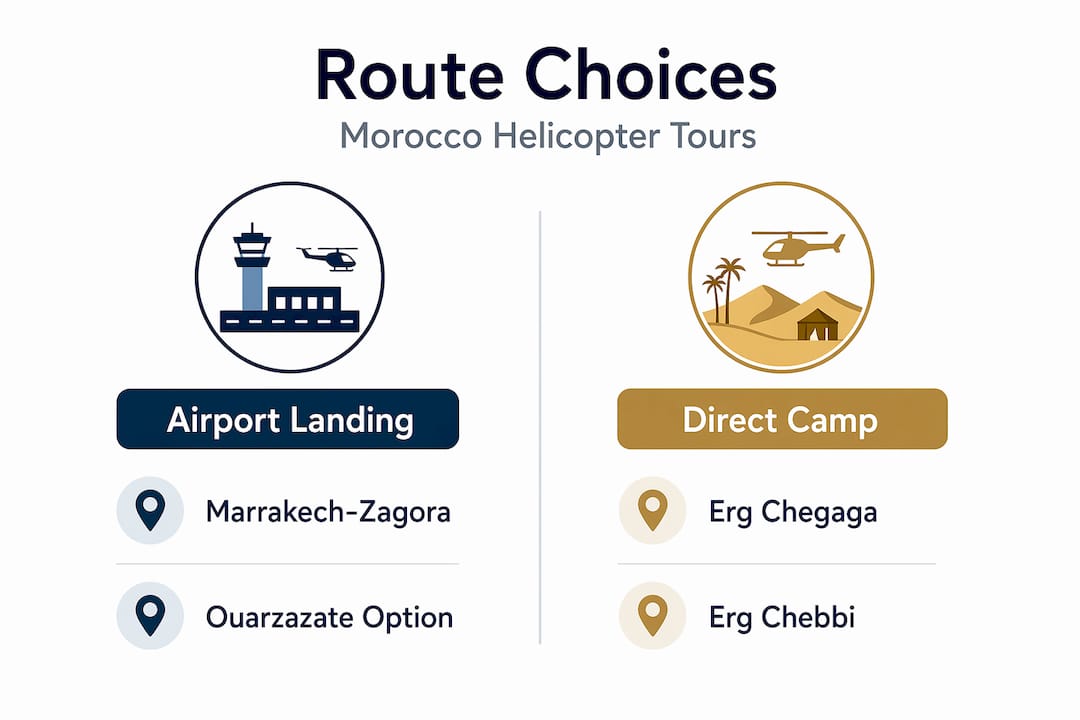
A second route substitutes Ouarzazate for Zagora as the landing point. Ouarzazate sits farther from the deep desert, which adds ground transfer time. The payoff is flying over the Draa Valley with the ancient kasbah of Ait Ben Haddou visible below. For travelers who care as much about the film history of southern Morocco as the dunes themselves, this routing is worth considering.
The third option is the one most travelers do not know exists until they start digging. A private helicopter transfer to Erg Chegaga lands directly at a desert camp with no ground transfer at all. Flight time runs approximately 100 minutes, and you step off the aircraft directly into the sand. That single detail changes the arrival into an event of its own.
Pro Tip: Ask any operator which specific landing zone the direct camp flight uses. Erg Chegaga and Erg Chebbi are both Saharan dune fields, but they are hours apart by road. Knowing which one your itinerary targets determines whether the rest of your desert activities align with your plans.
The key insight from route design and passenger experience analysis is that route choice is not just a logistics decision. It fundamentally shapes whether you feel like a traveler in transit or an adventurer making a dramatic arrival.
Helicopter types and why they matter
Operators rarely volunteer details about their aircraft. Most travelers do not ask. That gap in information leads to surprises in the air, and not always good ones.
The three aircraft most commonly deployed on Sahara-bound routes are the AS350 Ecureuil (also called the H125), the Airbus H130, and the Bell 407. All three are dust-rated and capable of flying at Atlas Mountain altitudes, but they serve different kinds of passengers.
Here is how they compare for the tours that matter most:
- Airbus H130: The preferred aircraft for direct desert landings because of its dust-resistant design and comparatively quiet cabin. It typically carries two to three passengers in luxury configurations, making it the right call for couples or small groups who prioritize comfort.
- AS350 Ecureuil (H125): A workhorse of mountain and desert aviation. Slightly noisier than the H130 but highly maneuverable at altitude, which makes it well-suited for routes that cross high passes in the Atlas range.
- Bell 407: Larger cabin, smoother ride for first-time flyers. Better for small groups of four or more passengers who want more space without sacrificing performance.
Passenger comfort in desert landings depends specifically on noise levels, dust mitigation, and cabin space. None of those factors are equal across aircraft. When you call an operator to book, the right question is not “what helicopter do you use?” but “which aircraft will you use for a direct landing in sand conditions, and what is the cabin configuration?”
Operators who hesitate on that question are telling you something important about their preparation. The best ones will walk you through the aircraft choice unprompted because they know it matters to the experience.
What the air reveals: sightseeing highlights and immersive arrivals
Scenic helicopter flights Morocco offers rank among the most photogenic aerial experiences anywhere in North Africa. That is not hyperbole. It is a function of geography. Within a single flight corridor from Marrakech south, you cross three dramatically different terrains in under two hours.
The High Atlas Mountains appear first, with snowcapped ridges in winter months and deep gorges year-round. Then the landscape drops into the Draa Valley, where palm groves and kasbahs line ancient riverbeds. By the time the Sahara dunes appear on the horizon, the visual contrast with where you started is striking enough to stop conversation in the cabin entirely.
The specific sightseeing landmarks that make Morocco helicopter sightseeing stand apart:
- High Atlas ridgeline: The view from altitude reveals how dramatically the terrain divides Morocco’s climate zones, with green valleys on the north face and stark desert on the south.
- Kasbah Ait Ben Haddou: Visible from the air on Ouarzazate-routed flights, this UNESCO World Heritage site looks more ancient from above than from the ground approach. Its mud-brick towers cluster along a hillside in a way you simply cannot read from road level.
- Erg Chegaga dune fields: The first aerial view of a major erg is the kind of visual that rewires your sense of scale. The dunes run for miles, and the shadows they cast change color across the day.
Helicopter tours provide aerial views inaccessible by any ground route, and that access genuinely transforms photography opportunities. Bring a camera with a fast shutter speed. The vibration from rotors at altitude is manageable, but longer exposures will blur.
Direct camp landings also create something no airport arrival can replicate. You arrive in total silence after the rotors wind down, with nothing but sand and the camp ahead of you. Many operators build in packages that sequence helicopter arrivals with camel rides into the sunset and overnight stays in Berber camps. The combination of speed of arrival and slowness of the camel ride afterward works better as a sequence than either experience does alone.
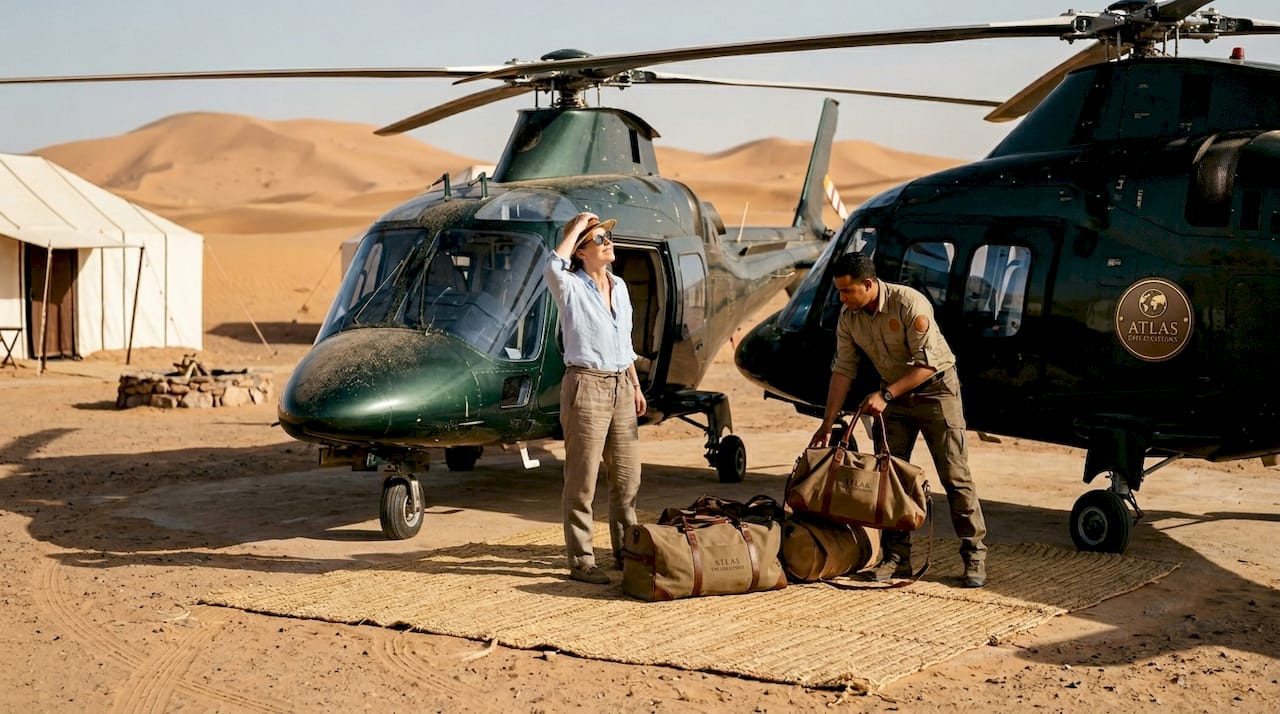
Pro Tip: Book a helicopter arrival timed for late afternoon when the dunes are lit at a low angle. The colors shift from gold to deep amber in the final hour before sunset, and arriving at that moment means your first ground-level view of the camp happens in the best possible light.
For travelers weighing whether the luxury version justifies the cost, the honest answer is that the gap between a standard and a luxury helicopter tour in Morocco is mostly about what happens before and after the flight. Small group sizes, refreshments onboard, and pre-arranged camp experiences all come with the premium tier. They are worth it if you are already treating this trip as a once-in-a-decade experience.
You can read more about pairing these aerial arrivals with ground experiences in Moroccotravel1’s luxury desert travel guide.
Practical planning: booking, weather, and cost
Helicopter adventures in Morocco involve real logistics that many travel sites gloss over. Here is what actually shapes the planning process.
Booking lead times: Standard helicopter routes require at least 7 days’ notice, while direct camp landings need a minimum of 14 days. The reason is not just aircraft availability. Direct desert landings involve permit coordination, ground crew preparation at the landing zone, and sometimes fuel logistics. Operators who tell you they can arrange a direct camp landing in 48 hours are cutting corners somewhere.
Weather and contingency planning: Helicopter flights may be canceled or delayed due to wind, visibility, or sand conditions. Every reputable operator keeps a ground transfer alternative ready. Asking about the backup plan before you book is not being pessimistic. It is the standard check that separates experienced travelers from surprised ones.
Here is a side-by-side look at what affects pricing:
| Factor | Budget impact | Notes |
|---|---|---|
| Route (airport vs. direct camp) | High | Direct landings cost more due to permits and ground prep |
| Aircraft type | Medium | H130 private configurations carry a premium |
| Private vs. group tour | High | Private tours cost roughly 2 to 3 times more per person |
| Season | Medium | Peak season (October to April) sees higher demand and pricing |
| Add-on packages | Variable | Camp stays, camel rides, and meals add cost but transform value |
Safety questions to ask every operator:
- Which aircraft will be used, and what are its dust and altitude certifications?
- Who is the pilot, and what are their hours in type for this specific aircraft?
- What is the cancellation policy if weather grounds the flight on departure day?
- Does the operator coordinate all permits end-to-end, or does the traveler handle any paperwork?
Choosing an operator who manages end-to-end coordination covers permits, weather risks, and operational safety. That single criterion filters out most of the bad options quickly.
The best helicopter tours Morocco travelers should prioritize are those where the operator treats the aircraft, route, and ground experience as a single system. Not three separate services stitched together.
Helicopters vs. hot air balloons and ground transfers
Tourist helicopter experiences Morocco offers get compared constantly to hot air balloon rides and traditional 4×4 or camel treks. The comparison is worth making clearly.
| Experience | Flight control | Landing options | Weather dependency | Time to destination |
|---|---|---|---|---|
| Helicopter tour | Full pilot control | Airports or direct desert | Moderate | Fast (60 to 100 min) |
| Hot air balloon | Wind-dependent | Fixed, open terrain only | Very high | Slower, variable |
| 4×4 desert transfer | Roadbound | Anywhere with road access | Low | 4 to 6 hours typical |
| Camel trek | Slow, ground level | Anywhere passable | Very low | Days to cover same distance |
Helicopters allow controlled, faster travel and direct landings that balloon rides cannot match. Balloons are beautiful, and Marrakech balloon flights over the palm grove at dawn are genuinely memorable. But a balloon cannot put you down in a specific camp in the middle of the Sahara. A helicopter can.
The case for ground transfers is different. A 4×4 journey through the Draa Valley gives you time to stop at roadside kasbahs, talk to locals, and feel the gradual change from mountain to desert in real time. That transition has its own value. The helicopter skips it entirely in exchange for the aerial perspective. Neither is objectively better. They serve different travelers with different priorities.
For Moroccan aerial tours that also incorporate cultural depth, the best strategy is not to replace ground experiences with flight but to combine them. Fly in. Explore by camel and foot. Drive out through terrain you have already seen from above. That sequence gives both the visual overview and the ground-level texture.
For more on how to structure this kind of multi-modal trip, Moroccotravel1’s desert tour planning guide walks through specific itinerary combinations.
My honest take on what most travelers miss
I have worked closely with Moroccan helicopter operators for years, and the single thing I see most travelers undervalue is the arrival moment itself. Everyone focuses on the flight. Few think carefully enough about what they are arriving to.
A direct landing at a desert camp is not just faster than a 4×4 transfer. It is a completely different psychological experience. The silence after the rotors stop is one of those rare travel moments that actually lives up to what you imagined. That silence only works if the camp is properly set up for it: far from other tourists, with the dunes in the right position and the right staff waiting. The helicopter gets you there. The operator’s ground team determines what you find when you land.
My strongest advice is to stop treating the aircraft as the main event. The aircraft is the delivery mechanism. What matters is the 48 hours around the flight. I have seen travelers book an excellent helicopter and land at a mediocre camp, leaving disappointed not because the tour failed but because nobody connected the pieces. The operators who do this well are those who think in complete itineraries, not single flights.
I also think most travelers overestimate how much a group tour saves versus a private one. The price gap feels large upfront, but when you factor in the flexibility of timing, the ability to choose your aircraft, and the difference between sharing a four-seat helicopter with strangers and flying with your own group, the private option usually wins on experience. On a trip this distinct, being able to time your arrival to the light conditions or adjust the route slightly is worth considerably more than the savings.
— Moroccotravel1.com
Plan your Morocco helicopter adventure with Moroccotravel1
Moroccotravel1.com specializes in building Morocco trips where the helicopter experience is one piece of a fully connected itinerary. Whether you are considering a compact 10-day circuit or a more expansive exploration, our packages integrate helicopter arrivals with luxury desert camps, guided cultural stops, and private transportation across the country’s most spectacular terrain.
Our 10-day family Morocco tour includes optional helicopter transfers to the Sahara, sequenced with camel rides and overnight Berber camp experiences designed for both adults and children. For travelers who want to cover more of Morocco in a single trip, the 14-day grand tour package incorporates aerial sightseeing alongside the Imperial Cities, the High Atlas, and the Atlantic coast.
Every itinerary we build is customizable. If you want the direct desert landing, we arrange the right aircraft, the permits, and the camp. If you prefer combining a standard flight with a 4×4 road journey back through the Draa Valley, we design that instead. Request a personalized quote through Moroccotravel1.com and tell us exactly what kind of arrival you want to remember.
FAQ
How long do Morocco helicopter tours typically take?
Standard routes from Marrakech to Zagora Airport take 60 to 75 minutes of flight time plus a 45-minute 4×4 transfer to the dunes. Direct camp landing flights to Erg Chegaga run approximately 100 minutes with no ground leg required.
What is the best aircraft for a direct desert landing in Morocco?
The Airbus H130 is the preferred choice for direct desert landings because of its dust-rated design, quieter cabin, and suitability for two to three passengers in luxury configurations.
How far in advance should I book a Morocco helicopter tour?
Book standard airport-landing routes at least 7 days ahead. Direct desert camp landings require a minimum of 14 days’ advance notice to coordinate permits, aircraft, and ground preparation.
Can weather cancel my helicopter flight in Morocco?
Yes. Wind, low visibility, and sand conditions can delay or cancel flights. Reputable operators keep a ground transfer backup ready so your desert arrival still happens even if the helicopter cannot fly.
How do helicopter tours compare to hot air balloons in Morocco?
Helicopters offer full pilot control, faster transit, and the ability to land directly at desert camps. Hot air balloons are more weather-dependent and cannot target specific landing zones, making helicopters the more flexible option for desert arrivals.


