

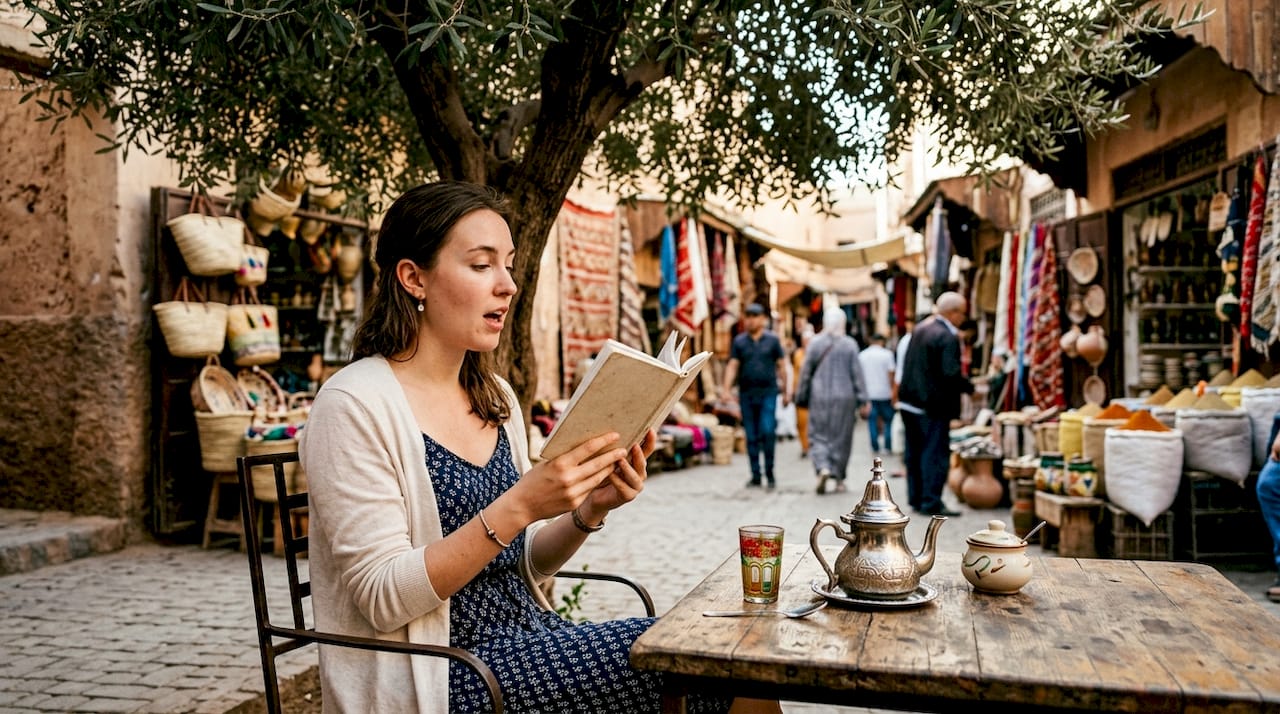
- Most Moroccans speak Darija daily, though Arabic, French, and Amazigh also influence communication.
- Learning basic Darija greetings improves interactions, especially in markets and social settings, and shows cultural respect.
- French remains useful in cities and formal situations, while English and Spanish serve specific regions and tourist areas.
A Morocco language guide is defined as a practical reference covering the country’s official languages, everyday dialects, and the key phrases travelers need to communicate with confidence. Morocco recognizes Modern Standard Arabic and Standard Moroccan Amazigh (Berber) as its two official languages, but the language most Moroccans actually speak day to day is Moroccan Arabic, known as Darija. French functions as the country’s business and administrative lingua franca, while English is gaining ground among younger generations and in tourist centers. Knowing even a handful of Moroccan Arabic phrases before you arrive changes every interaction, from bargaining in a souk to ordering mint tea in a riad.
What languages are spoken in Morocco and where?
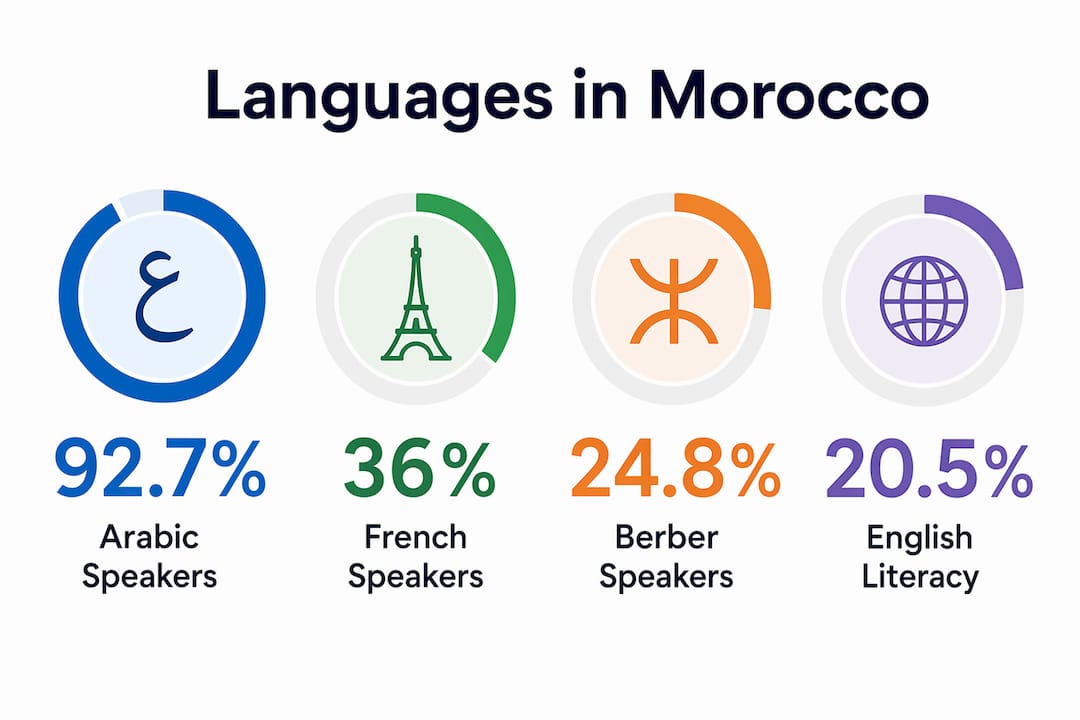
Arabic is spoken by 92.7% of Moroccans, making it the dominant language across the country. That figure includes both Modern Standard Arabic, used in formal writing and broadcasting, and Darija, the spoken dialect that fills everyday life. The two forms are related but distinct. Most Moroccans switch between them depending on context, the way an American might shift between formal writing and casual speech.
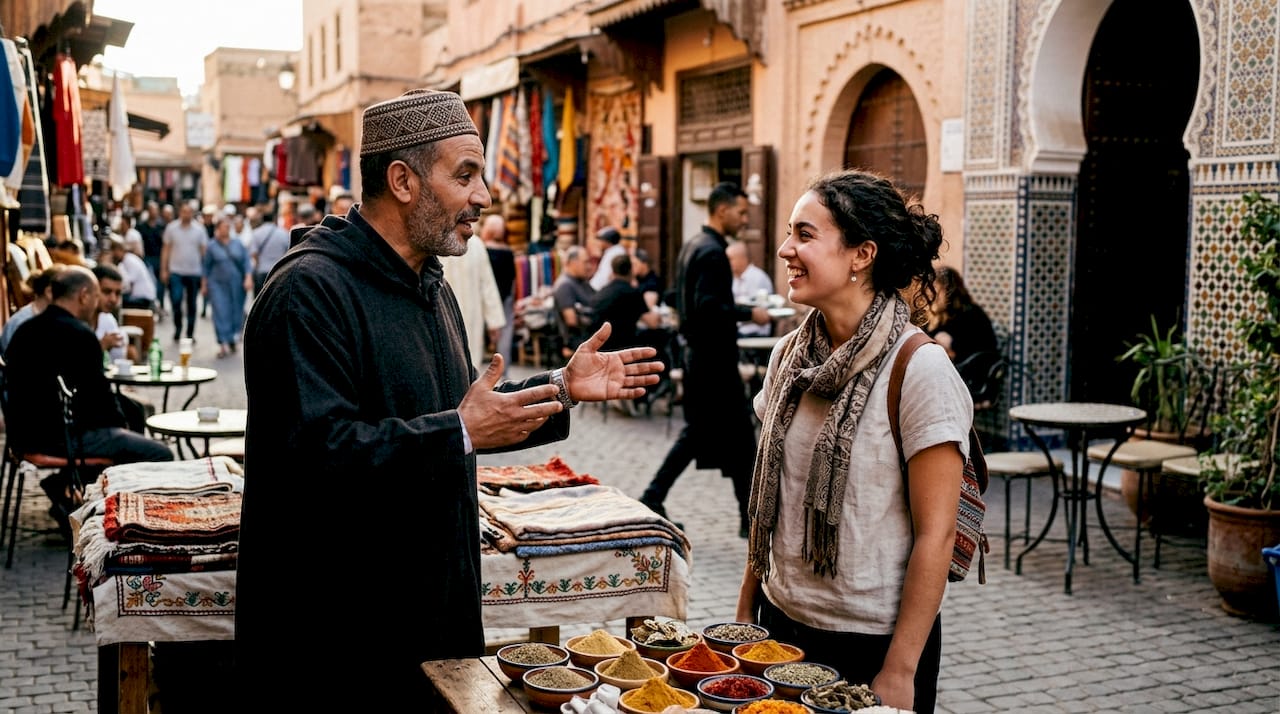
Berber languages, collectively called Amazigh, are spoken by 24.8% of the population, with 18.9% claiming Berber as their native tongue. This matters for travelers heading beyond the major cities. Three main Berber varieties exist: Tashlhit in the south and the High Atlas, Tamazight in the Middle Atlas and central regions, and Tarifit in the northern Rif Mountains. If you plan a trek through the Atlas or a visit to a rural Berber village, you will hear these languages far more than Darija.
French is the language of commerce, education, and government. About 36% of Moroccans speak French overall, and it dominates in cities like Casablanca, Rabat, and Marrakech. Signs, menus, and official documents often appear in both Arabic and French. Spanish holds a strong presence in the north, particularly around Tangier and Tetouan, a legacy of the Spanish Protectorate era. English is growing fast, especially among Generation Z and in tourist-heavy areas, but only 20.5% of Moroccans have English literacy compared to 57.7% for French.
The table below gives travelers a quick regional reference.
| Region | Primary spoken language | Secondary language |
|---|---|---|
| Casablanca, Rabat | Darija | French |
| Marrakech, Fes | Darija | French, some English |
| High Atlas, rural south | Tashlhit (Berber) | Darija |
| Middle Atlas | Tamazight (Berber) | Darija |
| Tangier, Tetouan | Darija | Spanish, French |
| Rif Mountains | Tarifit (Berber) | Darija |
| Tourist centers nationwide | Darija | English, French |
How is Moroccan Arabic (Darija) different, and why learn basic phrases?
Darija differs from Modern Standard Arabic significantly enough that speakers of Egyptian or Levantine Arabic often cannot follow a conversation in Morocco. It pulls vocabulary from French, Spanish, and Amazigh, layering them over an Arabic grammatical base. The result is a dialect that feels familiar to linguists but sounds foreign to most Arabic speakers outside North Africa. Think of it as Arabic’s Moroccan cousin: related, but with its own personality.
That distinctiveness is actually good news for travelers. You are not competing against fluency in a widely spoken dialect. A few well-chosen Darija phrases signal genuine effort and cultural respect. Moroccans respond warmly to travelers who try, even imperfectly.
The core phrases every traveler should know before arriving include:
- Salam alaykum (Peace be upon you): the standard greeting, used everywhere and at any time of day
- Labas? (How are you?): the natural follow-up after the initial greeting
- Labas, hamdullah (Fine, praise God): the expected response, showing you understand the ritual
- Shukran (Thank you): used constantly and always appreciated
- 3afak (Please): the “3” represents a throat-constricted sound unique to Arabic
- La shukran (No, thank you): polite refusal, useful in markets
- Bslama (Goodbye): warm and widely used
The greeting sequence matters more than any individual word. Skipping the greeting ritual before asking a question or making a purchase signals rudeness and can result in higher prices or a cold reception. The correct sequence is: Salam alaykum, then Labas?, then your actual question. That three-step opener costs you five seconds and earns you genuine goodwill.
Pronunciation is the biggest hurdle for English speakers. The “3” sound, written as the number three in transliteration, is a voiced pharyngeal fricative. It comes from deep in the throat. Moroccan Arabic speakers genuinely appreciate any attempt at this sound, even an imperfect one. The effort signals respect, and that matters more than accuracy.
Pro Tip: Practice “3afak” (please) and “shukran” (thank you) out loud before your trip. These two words appear in nearly every transaction, and getting comfortable with them removes the hesitation that makes interactions feel awkward.
Essential travel phrases for Morocco: shopping, dining, and directions
The souk is where language becomes a practical tool. Bargaining is not optional in Moroccan markets. It is a cultural institution, and haggling is a performance involving humor, patience, and the right phrasing. Walking in with the right words signals that you understand the game.
Market and bargaining phrases
- Bshhal? (How much?): your opening move at any stall
- Ghali bzzaf (Too expensive): said with a smile, not frustration
- Nqes shwiya (Reduce it a little): the polite counter-offer
- Khlas (Done, finished): signals you accept the final price and closes the deal
Using “Ghali bzzaf” with humor rather than irritation keeps the exchange friendly. Ending with “Khlas” shows you know the local rhythm, which often earns a better final price and a warmer farewell.
Pro Tip: Never name a price you are not willing to pay. Moroccans take “Khlas” seriously. If you say it, the deal is done.
Dining and food phrases
Moroccan food culture is generous and social. Knowing a few phrases at the table deepens the experience.
| Phrase | Meaning | When to use it |
|---|---|---|
| Bghit atay | I want tea | Ordering mint tea, a social staple |
| Bnin | Delicious | Complimenting the cook or host |
| Bla sukkar | Without sugar | Specifying tea preference |
| Bghit | I want | General ordering phrase |
| Wach kayn…? | Is there…? | Asking about menu items or ingredients |
Complimenting the food with “Bnin” after a meal is one of the highest forms of social currency in Morocco. Hosts and restaurant staff light up when a foreign traveler uses it. It costs nothing and creates a memorable moment.
Directions and transportation phrases
Getting around Moroccan cities requires a few navigation basics. Taxis are common, and drivers in smaller towns may speak limited French or English.
- Fin kayn? (Where is it?): your go-to for asking directions
- Sir nishan (Go straight): useful for directing taxi drivers
- Limin (To the right) and Liser (To the left): essential for any navigation
- Waqef hna (Stop here): tells your driver exactly where you want out
- Bshhal men hna? (How far from here?): helps gauge walking distance
Start every interaction with a greeting before asking for directions. A local who feels greeted as a person, not treated as a GPS device, gives better and more patient directions. This is not just politeness. It is the most practical language tip for Morocco any traveler can follow.
How do French, English, Spanish, and Amazigh fit into daily communication?
French is the language you fall back on when Darija runs out. French dominates in government, business, and education, making it the most reliable second language for formal settings. A bilingual model combining Classical Arabic and French is widely considered the standard for Morocco’s professional world. If you speak French at even a conversational level, you will navigate cities, hotels, and restaurants with ease.
English works well in tourist centers and with younger Moroccans, but its reach is uneven. In Marrakech’s medina or Fes’s old city, you will find English speakers at tourist-facing businesses. Step two streets off the main drag, and French or Darija becomes necessary. Younger Moroccans increasingly advocate for English as a modernizing second language, reflecting a generational shift that is visible in cities but not yet universal.
Spanish is the practical choice in the north. Around Tangier, Tetouan, and the Rif region, Spanish speakers are common, a direct result of the Spanish Protectorate that ended in 1956. If you speak Spanish, use it freely in these areas. It will serve you better than English and sometimes better than French.
Amazigh (Berber) became an official language in 2011, but its role in daily traveler communication remains limited. Only about 10% of pupils currently study it in school, and written literacy in Amazigh is low. The language is primarily a spoken vernacular used in family and community contexts in rural areas. Travelers heading into the Atlas Mountains or Berber villages will hear it constantly, but learning it is not practical for a short trip. A warm greeting in Darija still works in these areas, since most rural Moroccans also speak it.
Here is a practical guide to which language to use and when:
- Darija: use everywhere, especially in markets, taxis, and casual social settings
- French: use in hotels, restaurants, pharmacies, banks, and any formal interaction
- English: use in tourist zones, with guides, and with travelers under 30
- Spanish: use in Tangier, Tetouan, and northern Morocco
- Amazigh: recognize it when you hear it; a smile and Darija greeting still work.
Key Takeaways
Morocco’s linguistic landscape rewards travelers who learn even basic Darija, since the greeting ritual alone opens more doors than any translation app.
| Point | Details |
|---|---|
| Darija is the daily language | Most Moroccans speak Moroccan Arabic (Darija), not Modern Standard Arabic, in everyday life. |
| Greetings come first | Always open with “Salam alaykum” before any question or transaction to avoid cold responses. |
| French is the backup | French works in cities, hotels, and formal settings when Darija runs out. |
| Bargaining has its own script | Use “Bshhal?”, “Ghali bzzaf”, and “Khlas” in that order for respectful market negotiations. |
| Regional languages vary | Spanish works in the north; Amazigh is heard in rural areas but Darija still connects everywhere. |
What I’ve learned from years of sending travelers to Morocco
Most travelers arrive worried about the wrong thing. They stress over not speaking Arabic fluently when the real skill Morocco rewards is knowing the greeting ritual cold. I have seen travelers with zero Arabic background get invited for tea, offered better prices, and treated like guests rather than tourists purely because they opened with “Salam alaykum” and followed it with “Labas?” That two-phrase sequence does more work than a phrasebook.
The “3” sound trips everyone up at first. My honest advice: do not avoid it. Attempt it badly, laugh about it, and try again. Moroccans value the attempt far more than the result. A traveler who stumbles through “3afak” with a grin gets a warmer response than one who silently points at a menu item. The imperfection is the point. It shows you tried.
French is your safety net, not your primary tool. Travelers who lean on French from the start miss the warmth that Darija unlocks. Use French when you need precision, in pharmacies, at banks, or when negotiating a hotel rate. Use Darija when you want connection. The first-timer’s guide to Morocco makes this distinction clearly, and it is one of the most practical pieces of advice for any new visitor.
One more thing: write your key phrases on a small card and keep it in your pocket for the first two days. By day three, you will not need it. The phrases become automatic faster than you expect, because you use them constantly.
— Moroccotravel1.com
Plan your Morocco trip with cultural confidence
Language is one piece of the puzzle. Knowing how to greet a carpet seller in Darija matters more when you are actually standing in a Fes medina with a knowledgeable guide beside you. Moroccotravel1 designs tours that put you inside Morocco’s culture, not just in front of it. The 10-day Morocco family tour includes guided medina walks, souk visits, and local interactions where your new phrases get real use. For travelers who want the full picture, the 14-day Morocco Grand Tour covers imperial cities, desert camps, and Atlas villages, giving you the full range of Morocco’s linguistic and cultural depth. Every itinerary includes local expert guides who bridge the language gap and make every conversation count.
FAQ
What is the main language spoken in Morocco?
Moroccan Arabic (Darija) is the primary spoken language for daily life, used by the vast majority of Moroccans. Modern Standard Arabic and Amazigh are the two official languages, but Darija dominates in markets, taxis, and casual conversation.
Do I need to speak French to travel in Morocco?
French is widely useful in cities, hotels, restaurants, and formal settings, where about 36% of Moroccans speak it. You can travel without French, but knowing basic phrases makes formal interactions significantly easier.
Is English widely spoken in Morocco?
English is growing, especially in tourist centers and among younger Moroccans, but only about 20.5% have English literacy. Outside tourist zones, French or Darija is more reliable.
What are the most important Moroccan Arabic phrases for travelers?
The most practical travel phrases for Morocco are “Salam alaykum” (hello), “Shukran” (thank you), “3afak” (please), “Bshhal?” (how much?), and “Waqef hna” (stop here). These cover greetings, gratitude, and the two most common traveler situations: markets and taxis.
Why does the greeting ritual matter so much in Morocco?
Starting any interaction with “Salam alaykum” followed by “Labas?” signals respect and social awareness. Skipping the greeting before asking a question or making a purchase is considered rude and can result in higher prices or an unwelcoming response.


