


- Most travelers leave Moroccan markets having experienced a rich cultural education rather than just shopping.
- Guided tours help visitors access authentic artisan workshops, understand local traditions, and negotiate respectfully.
- Engaging with cooperatives and artisans supports sustainable development, fair wages, and the preservation of craft traditions.
Most travelers arrive in Morocco expecting a simple shopping trip and leave realizing they experienced something closer to a cultural masterclass. Morocco shopping tours are not about finding the cheapest rug or loading a suitcase with souvenirs. They are about stepping into centuries-old artisan traditions, learning to read the social rhythm of a souk, and walking away with pieces that carry real stories. This guide breaks down everything you need to navigate Moroccan markets with confidence: where to go, how to bargain respectfully, which cooperatives to support, and why a guided tour can transform a confusing afternoon in the medina into the highlight of your entire trip.
Table of Contents
- Key takeaways
- Morocco shopping tours: the cities and souks you need to know
- The art of bargaining in Moroccan souks
- Supporting ethical shopping: women’s cooperatives
- How guided shopping tours transform the experience
- Practical tips for planning your Morocco shopping tour
- My take on what Moroccan shopping really teaches you
- Plan your Morocco shopping tour with Moroccotravel1
- FAQ
Key takeaways
| Point | Details |
|---|---|
| Morocco shopping is cultural | Shopping in souks is a social experience rooted in tradition, not just a transaction. |
| Bargaining has rules | Opening prices run 2 to 4 times the real value; expect to settle at 50 to 65% of the ask. |
| Fixed prices exist | Cooperatives, pharmacies, and supermarkets have set prices; haggling there is disrespectful. |
| Cooperatives offer fair value | Women’s cooperatives sell authentic goods at transparent prices and support local communities. |
| Guided tours unlock access | Expert guides connect you to hidden artisan workshops and protect you from tourist pricing. |
Morocco shopping tours: the cities and souks you need to know
Morocco does not have one shopping scene. It has dozens, each shaped by geography, local craft traditions, and the kind of traveler each city attracts. Understanding where to go before you arrive is what separates a frustrating afternoon from an unforgettable one.
Marrakech is the most famous, and for good reason. The medina’s souks are organized by trade: dyers in one lane, leather workers in another, spice merchants filling the air with cumin and saffron. The sheer volume is staggering, and so are the prices. Tourist prices in Marrakech run 15 to 25% higher than comparable products in Fes or Meknes, driven purely by tourism intensity. That does not mean you should skip it. It means you should go in knowing that.
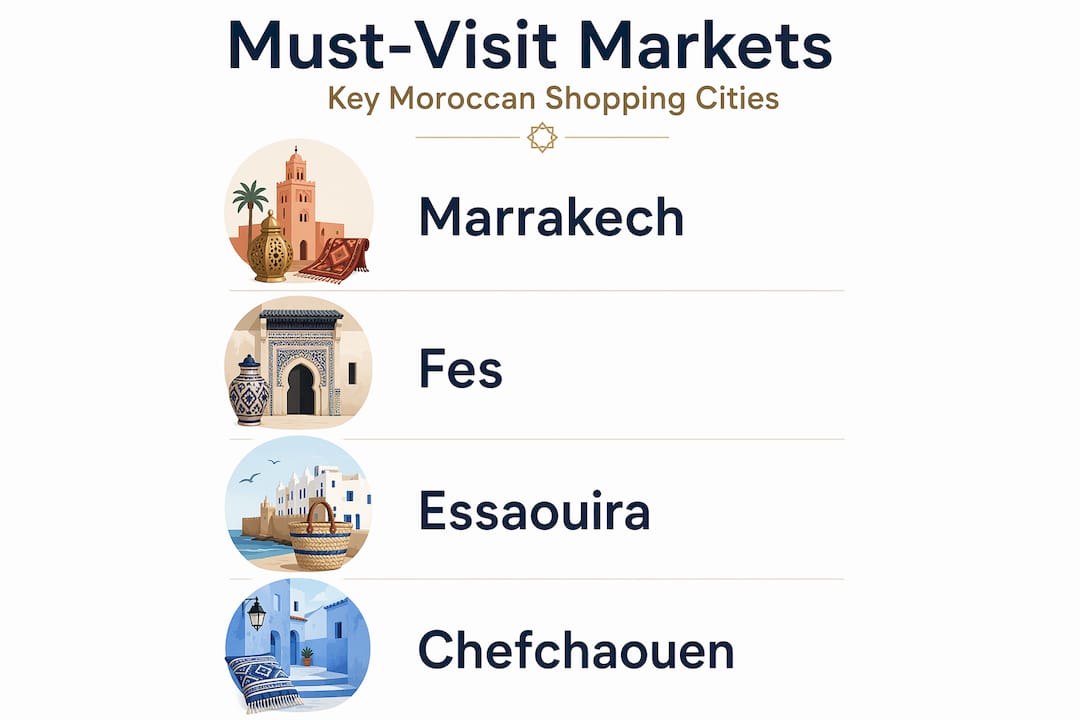
Fes el-Bali is where serious shoppers go. The medina here is a UNESCO World Heritage Site, and the craft culture runs deeper than almost anywhere else in the country. You can watch leather being dyed at the Chouara tannery and buy directly from workshops that have operated for generations. Prices are more honest, and the artisans are more likely to engage with you as a customer rather than a target.
Essaouira draws artists and musicians, and its shopping reflects that. You will find thuya wood carvings, silver jewelry, and independent boutiques alongside the traditional souk stalls. The pace is slower and the pressure lower than Marrakech, making it a great first experience for travelers new to Moroccan markets.
Chefchaouen, the blue city of the Rif Mountains, specializes in woven goods, particularly the distinctive wool blankets and djellabas you will not find elsewhere. The souk here is compact, relaxed, and genuinely off the tourist-trap circuit.
Agadir operates differently. As a modern resort city, it has both a traditional souk and a fixed-price artisan market called Souk El Had. For those who want local crafts shopping without the high-pressure negotiation, Agadir is a practical choice.
Here is a quick breakdown of what to look for by product category:
- Leather goods: Best sourced in Fes and Marrakech, where tanneries feed directly into workshop shops
- Carpets and rugs: Seek out Berber cooperatives in the Atlas Mountain region or established merchants in Marrakech’s carpet souk
- Spices and herbs: Marrakech’s Rahba Kedima square is the classic destination; buy whole spices, not pre-ground mixes
- Argan oil: Purchase exclusively from women’s cooperatives near Agadir or on the road between Agadir and Essaouira
- Ceramics: Fes produces the most distinctive blue and white pottery; Safi is also renowned for its ceramic tradition
- Silver jewelry and textiles: Essaouira and Chefchaouen for jewelry; the Souss Valley region for handwoven textiles
The art of bargaining in Moroccan souks
Here is the thing most travel blogs get wrong about bargaining in Morocco. They frame it as combat: you versus the vendor. It is the opposite. Bargaining is a social dance built on humor, respect, and relationship-building. Sellers actively enjoy the exchange when done well. Aggressive or dismissive haggling does not get you better prices. It damages the interaction entirely.
The mechanics work like this. Opening prices in Moroccan souks typically run 2 to 4 times the realistic value, precisely because negotiation is expected. Your goal is not to replicate what a local pays, which reflects years of relationships and context. Your goal is to pay fairly for the quality you are receiving. Final prices generally settle at 50 to 65% of the first ask, though this varies by product, city, and vendor.
The right sequence to follow
- Greet the vendor before you ask about anything. A genuine “Salam alaykum” or “Bonjour” opens the conversation on the right foot and signals respect. Vendors who receive a proper greeting consistently offer better interactions and fairer starting positions.
- Show genuine curiosity about the craft. Ask how the piece is made. This is not a negotiating trick; it is an honest signal that you value the work.
- When you are ready to ask the price, listen without reacting. Nod. Then make a counter-offer at roughly 40 to 50% of what they quoted.
- Expect a counter. Let it go back and forth two or three times, calmly and with lightness. Smiling matters here.
- Know your walk-away point before the conversation starts. If the price does not reach it, thank them sincerely and leave. Sometimes this triggers a final offer. Sometimes it does not. Either outcome is fine.
Where not to bargain
Fixed-price environments include supermarkets, pharmacies, official government cooperatives, and most modern boutique stores. Attempting to negotiate in these settings reads as rude, not savvy. The sign will often say “prix fixe” or “fixed price.” Believe it.
Pro Tip: Carry small bills and coins. Vendors cannot always make change for large notes, and pulling out a thick wallet full of cash changes the negotiating dynamic immediately. Break your larger bills at a cafe or pharmacy before entering the souk.
One more thing: even minimal Darija phrases like “Salam alaikum” at the start and “Bslama” when leaving increase vendor goodwill measurably. You do not need to be fluent. You need to be human.
Supporting ethical shopping: women’s cooperatives
Shopping at a women’s cooperative is one of the most straightforward ways to spend your money well in Morocco. These organizations are not charity shops. They are professional operations run by skilled artisans, and the quality of what they produce reflects that.
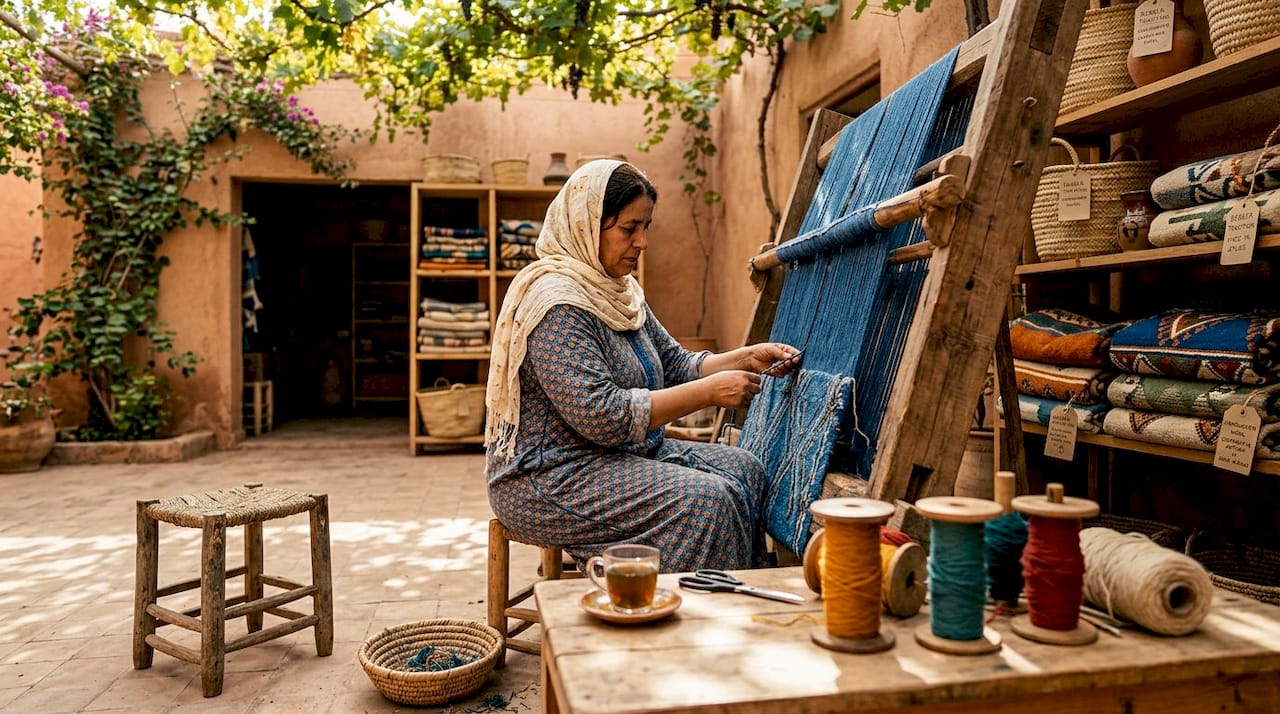
Authentic women’s cooperatives pay fair wages, offer transparent pricing, and in many cases run literacy programs and economic development initiatives for their workers. Several have earned international recognition for their impact on rural communities. When you buy from them, you are not getting a bargain price. You are paying what the work is worth, and the person who made it receives that value.
The most well-known category is argan oil. Morocco is the only country in the world where argan trees grow in the wild, and the oil is produced through a labor-intensive process of cracking the nuts by hand. Argan oil cooperatives near Agadir offer free guided tours showing the full production process from raw nut to finished product. Prices there run approximately 50% lower than what you find in tourist-facing shops along the main roads. The difference is significant enough that a stop at a cooperative should be on every traveler’s itinerary in the south.
Here is how to identify a reputable cooperative and shop there effectively:
- Look for a sign indicating official certification or government registration
- Prices are fixed and clearly marked; if someone invites you to negotiate, that is a red flag
- The space will have visible production activity, not just a sales floor
- Staff can typically explain the production process in detail
- Many sell a range of products: oils, soaps, hand creams, and culinary products alongside crafts
Ethical shopping in Morocco is not about sacrifice. It is about choosing quality over convenience and people over profit. Every dirham you spend at a cooperative stays in the community that earned it.
The broader economic impact of ethical buying extends well beyond the individual transaction. It supports sustainable craft traditions, keeps traditional skills from disappearing, and gives rural women economic independence they would not otherwise have. That context makes the purchase mean something.
How guided shopping tours transform the experience
There is a category of traveler who reads every guide, arrives prepared, and still spends the first afternoon in a Marrakech souk completely lost, paying tourist prices, and buying things they did not intend to buy. It is more common than you would think, and it is not a failure of preparation. It reflects just how disorienting these markets can be without a local anchor.
Guided shopping tours solve this in ways that go beyond avoiding tourist traps. A skilled guide knows which workshops are still family-run and which have been replaced by factory-supplied imitations. They know which vendors speak English well enough to have a genuine conversation and which rely on pressure tactics with foreigners. They also know the history: why the Fes medina is organized the way it is, what the different carpet patterns represent, and how the dyeing process at a tannery has changed over the past century.
The specific advantages of joining a guided shopping experience in Morocco include:
- Access to hidden artisan workshops not listed on any tourist map, where you watch craftspeople at work before purchasing
- Price orientation from someone who knows what fair looks like in each market and each city
- Language support that goes beyond translation. A guide can read the social temperature of a negotiation and tell you when to hold and when to close
- Cultural context that transforms a carpet from “something pretty on the floor” into a map of a specific Berber tribe’s symbolic language
- Customized focus based on what you actually care about. Serious textile shoppers can spend three hours with a weaving cooperative. Foodies can spend a morning in the spice market followed by a cooking class
- Safety and logistics in medinas where it is genuinely easy to get lost
Pro Tip: Book a luxury immersive tour that combines market visits with artisan workshops and a riad lunch. The midday break gives you time to reflect on what you saw, which actually makes you a better shopper in the afternoon because you are not exhausted and overwhelmed.
Private shopping tours are also available for travelers who want maximum flexibility. These allow you to move at your own pace, revisit vendors you found interesting, and spend as long as you want in any single space without worrying about group dynamics.
Practical tips for planning your Morocco shopping tour
Timing matters in Moroccan markets. Souks are most relaxed and least crowded in the mornings, particularly between 9 and 11 a.m. on weekdays. Friday mornings shift around midday prayers, so plan accordingly. Avoid shopping in the final hour before sunset during Ramadan, when vendors are focused entirely on getting home for iftar.
The best overall season for shopping tours is spring (March through May) and early fall (September through October). Temperatures are manageable, the tourist density is lower than summer, and vendors are in better spirits than in July’s heat.
Here are the practical essentials to organize before you go:
- Cash is non-negotiable. Most souk vendors do not accept cards, and those who do often add a surcharge. Carry dirhams in small denominations.
- Check airline liquid restrictions before buying argan oil, rose water, or other liquid products. A 250ml bottle of oil will be confiscated at security if packed incorrectly.
- Dress respectfully. Covered shoulders and knees are not legally required in medinas, but they signal cultural awareness and almost universally improve your reception from vendors.
- Do not hire an unsolicited guide. In Marrakech and Fes especially, people who approach tourists and offer to “show them around” often receive commissions from specific shops that inflate your prices.
- Know your budget before you enter. The most common regret travelers report is buying something impulsively early in the trip and missing a better version of the same thing later.
Connecting with family tour packages that include guided market visits is a smart way to combine shopping with broader cultural exploration, especially if you are traveling with children who need structured activities alongside the market wandering.
My take on what Moroccan shopping really teaches you
I have watched hundreds of travelers walk into a Moroccan souk and come out the other side fundamentally changed in how they think about buying things. That sounds dramatic, but it is accurate. The process forces you to slow down, make eye contact, and have a real conversation before any money changes hands. That is rare in modern retail.
What I have come to believe after years of experience with Morocco’s markets is that the tourists who walk away most satisfied are rarely the ones who drove the hardest bargain. They are the ones who were patient, curious, and genuinely interested in the person behind the product. I have seen travelers spend an extra 30 dirhams on a piece of pottery because they asked about the artisan’s family, and the conversation went somewhere unexpected. They never regret it.
Watching a weaver work at a hand loom for two hours before buying a single scarf changes your relationship to that object permanently. You do not leave it on the back of a chair when you get home. You hang it somewhere and tell people about it. That shift, from souvenir to story, is what the best shopping experiences in Morocco actually deliver.
The cooperatives have taught me the most. Spending time with the women who produce argan oil, understanding the physical work involved in cracking those nuts by hand, puts a price tag in a completely different context. It is not that the oil is cheap or expensive. It is that it is worth what it costs, and you understand exactly why. That clarity is worth more than any discount.
— Moroccotravel1.com
Plan your Morocco shopping tour with Moroccotravel1
At Moroccotravel1.com, we build shopping into our tours because we know it is one of the experiences travelers remember most. Our private and custom tour packages are designed around what each traveler actually wants to find, whether that is a specific carpet style, an argan oil cooperative, an afternoon in Fes’s leather district, or all three. Our guides know the markets, the artisans, and the stories behind what is being sold.
If you want to explore Morocco across multiple cities with time built in for serious market exploration, our 14-day Morocco Grand Tour covers Marrakech, Fes, Essaouira, and the south, with guided souk time at every stop. For families, our 10-day family tour package integrates artisan visits that keep kids engaged while adults shop with purpose. Browse all our private Morocco tours and find the itinerary that fits how you want to travel.
FAQ
What makes Morocco shopping tours worth it?
Guided shopping tours in Morocco connect you to artisan workshops, provide cultural context, and protect you from tourist-trap pricing in ways that solo exploration rarely achieves. They turn market visits into a genuine cultural experience rather than a stressful transaction.
How much should I budget for shopping in Morocco?
Budget varies widely by product, but a realistic daily shopping allowance of 300 to 800 MAD (roughly $30 to $80 USD) covers meaningful purchases without overspending. Carpets and large leather goods are exceptions and can cost significantly more.
Is bargaining expected everywhere in Morocco?
No. Fixed-price settings like cooperatives, supermarkets, and pharmacies do not allow negotiation, and attempting it is considered disrespectful. Bargaining belongs in traditional souk environments where the vendor invites it.
What are the best things to buy in Morocco?
The strongest buys are handmade leather goods, Berber carpets, genuine argan oil from cooperatives, hand-painted ceramics from Fes, and silver Berber jewelry from Essaouira. Buying directly from artisans or cooperatives guarantees authenticity.
When is the best time to visit Moroccan markets?
Weekday mornings between 9 and 11 a.m. offer the calmest atmosphere and most engaged vendors. Spring and early fall provide the most comfortable temperatures for extended market exploration across the country.


