


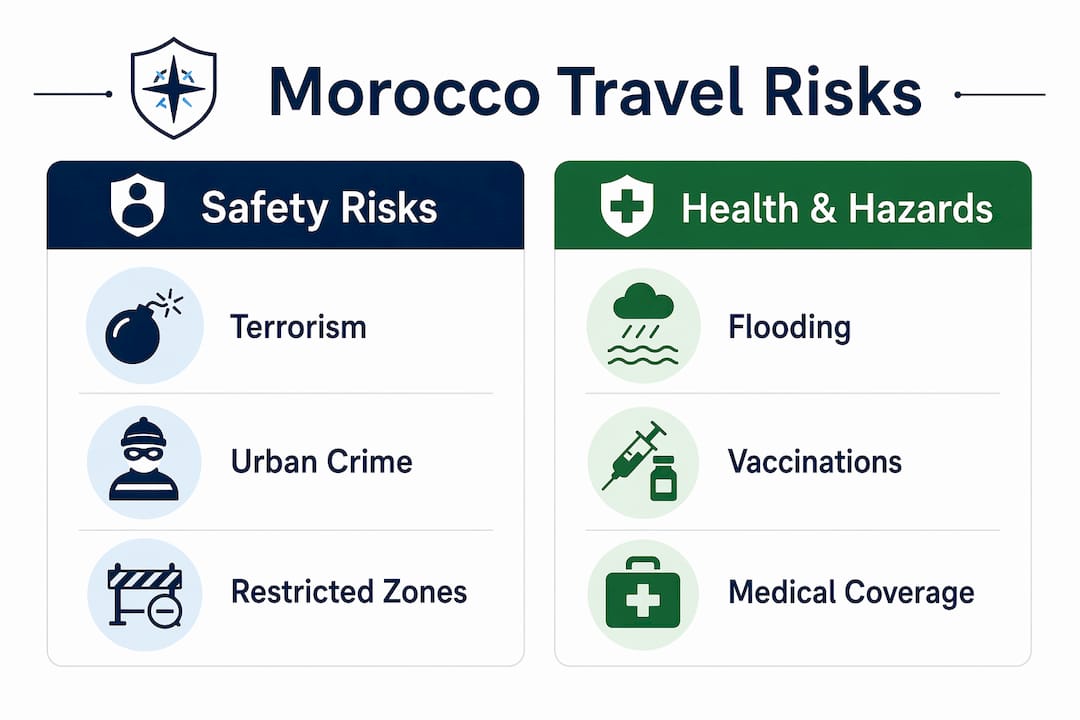
- Morocco’s travel advisory highlights high caution due to terrorism, regional conflicts, and natural hazards, but major cities remain safe for tourists who follow guidance.
- Restricted zones near Western Sahara and Algeria are strictly off-limits, while urban crime and demonstrations pose manageable risks with situational awareness.
- Planning with precise geographic understanding and expert guidance ensures safe, enjoyable visits to Morocco’s vibrant cultural destinations.
Morocco travel advisories from the U.S., Canada, and Australia currently rate the country at “exercise a high degree of caution” due to terrorism threats, regional border conflicts, and periodic natural hazards. That rating does not mean Morocco is off-limits. Cities like Marrakech, Fes, and Casablanca remain open, active tourist destinations with visible security infrastructure and millions of safe visits each year. What the advisory does demand is geographic precision. Specific zones near the Western Sahara border and the Algerian frontier carry strict “avoid all travel” designations that are non-negotiable. This guide breaks down every layer of those warnings so you can plan with confidence, not anxiety.
What are the main safety risks and regional travel warnings in Morocco?
Morocco’s official advisory status reflects terrorism risk in public places rather than a country-wide security collapse. The distinction matters enormously for planning. Crowded tourist sites, markets, transportation hubs, and places of worship carry the highest theoretical exposure. Staying alert in those environments is the core behavioral requirement, not avoiding Morocco altogether.
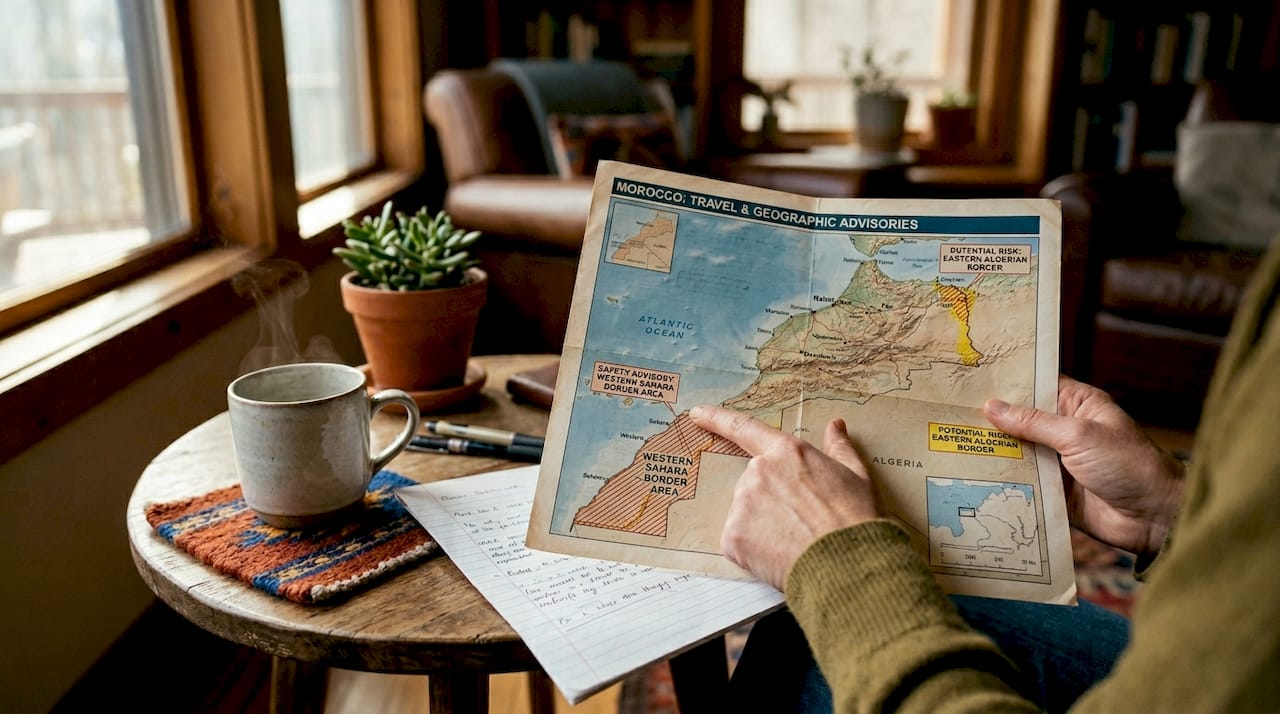
Regional zones with strict travel bans
The geography of risk in Morocco is highly uneven. Canada’s advisory specifies “avoid all travel” to the Western Sahara border regions and “avoid non-essential travel” to the broader Western Sahara territory. The immediate border zone with Algeria also carries an “avoid all travel” designation due to kidnapping risk and armed conflict activity. These are not soft recommendations. Travelers who stray into these corridors face genuine threats, including landmines in disputed territories, limited consular access, and armed group activity.
Major tourist cities sit entirely outside these restricted zones. Marrakech, Fes, Casablanca, Rabat, Chefchaouen, and Agadir are all well within the safe travel perimeter. Most tourists experience no serious security incidents when they follow standard guidance and stay within established tourist circuits.
Urban crime and everyday risks
Petty crime is the most statistically common threat for travelers in Moroccan cities. Pickpocketing, bag snatching, and credit card skimming occur in medinas, souks, and around ATMs, particularly in Marrakech and Fes. The Smartraveller Australia advisory specifically flags harassment near ATMs and in crowded market areas as recurring concerns.
Political demonstrations add a separate layer of risk. Large public gatherings in Morocco can turn violent without warning, particularly on Fridays and national holidays. The advice is consistent across all government sources: do not join or observe protests, leave the area immediately if one forms nearby, and monitor local news for scheduled demonstrations.
Key urban risks to monitor:
- Pickpocketing and bag snatching in medinas and souks
- Credit card fraud and ATM skimming in tourist areas
- Unofficial “guides” in Marrakech and Fes who lead travelers to commission-based shops
- Nighttime street crime in poorly lit areas of major cities
- Violent demonstrations, especially around political anniversaries
Pro Tip: Register your trip with your government’s travel registry before departure. The U.S. State Department’s STEP program, Canada’s Registration of Canadians Abroad, and Australia’s Smartraveller registration all provide emergency alerts and consular support at no cost.
How do health and natural hazards affect the Morocco travel advisory?
Morocco carries no mandatory vaccination requirements for entry from most Western countries. Routine vaccines, including hepatitis A, typhoid, and tetanus, are recommended by travel health clinics for most visitors. The more pressing concern is the flexibility of entry health requirements. Health screening measures can change at short notice in response to disease outbreaks, and travelers showing symptoms at the border may face isolation or quarantine. Checking your government’s health advisory page within 72 hours of departure is not optional. It is the minimum standard.
Natural hazards and flooding
Northern Morocco experiences significant seasonal flooding that directly affects road access and travel routing. The Smartraveller advisory warns explicitly against crossing floodwaters and notes that road closures in northern provinces can materialize rapidly. This is not a theoretical risk. Flooding in the Rif Mountain region and around Chefchaouen has disrupted travel plans for visitors who did not check conditions before setting out.
The Western Sahara region carries an additional hazard that most travelers overlook: unexploded landmines in disputed territories. This is one of the primary reasons the “avoid all travel” designation for border zones is so firm. The risk is not visible or predictable, which makes it categorically different from urban crime.
Critical health and hazard considerations:
- Confirm vaccination recommendations with a travel health clinic at least four weeks before departure
- Purchase comprehensive travel insurance that covers medical evacuation, trip interruption, and natural disaster impacts
- Check road and weather conditions for northern routes within 24 hours of travel
- Carry a basic first aid kit and any prescription medications in original labeled packaging
- Know the location of the nearest hospital or clinic in each city on your itinerary
Travel insurers increasingly require Morocco-bound travelers to carry coverage against medical expenses and natural disaster disruption. A policy that excludes evacuation or weather-related cancellation is inadequate for this destination. Read the fine print before you buy.
What are the entry requirements, visa policies, and border regulations travelers must know?
Morocco grants visa-free entry for up to 90 days to nationals from the United States, the United Kingdom, European Union member states, Canada, and Australia, among others. That 90-day window covers the vast majority of tourist itineraries without any additional paperwork. The practical requirements are straightforward but non-negotiable.
Follow this checklist before you depart:
- Passport validity: Your passport must be valid for at least six months beyond your planned departure date from Morocco. Border agents enforce this strictly. An expiring passport will result in denied entry.
- Proof of onward travel: Carry a return or onward ticket. Moroccan border officials may ask for evidence that you plan to leave within the 90-day window.
- Accommodation confirmation: Have at least your first night’s accommodation details available. Hotels are required to register foreign guests with local authorities, and border agents occasionally verify this.
- Health screening compliance: If you show symptoms of illness at the border, Moroccan health authorities have the authority to require testing or temporary isolation. Requirements can change based on active disease outbreaks, so verify current protocols with your embassy before flying.
- Border zone awareness: Entry into Western Sahara border regions and the Algerian frontier is either restricted or prohibited. Attempting to cross into these zones without authorization creates serious legal and physical risk.
- Embassy registration: Register with your country’s embassy in Rabat before or immediately after arrival. This step is free and provides a critical safety net if your situation changes.
Travelers should verify the latest requirements directly through their government’s official travel advisory portal no more than 48 hours before departure. Rules around health screening in particular have shifted multiple times in recent years and can change again with little notice.
What practical travel safety tips and transportation advice help reduce risks in Morocco?
Safe travel in Morocco is primarily a product of behavioral choices rather than luck. The risks outlined in the official advisory are real, but they are also largely avoidable with consistent situational awareness and a few firm habits.
Getting around safely
Morocco’s rail network, operated by ONCF, connects Casablanca, Rabat, Fes, Marrakech, and Tangier with reliable, affordable service. Trains are the safest and most predictable mode of intercity travel. For routes not covered by rail, pre-booked private transfers from reputable operators are the next best option. Avoid unmarked taxis or rides arranged by strangers in medinas.
Driving in Morocco is manageable in cities during daylight hours, but rural night driving carries significant risk. Road conditions outside major cities can deteriorate quickly, and flooding in northern provinces creates unpredictable closures. If you rent a car, plan all rural legs for daylight hours and check road conditions locally before each leg of the journey.
Pro Tip: In Marrakech’s Djemaa el-Fna square and Fes’s medina, unofficial guides will approach you confidently and claim to know exactly where you want to go. Politely decline and use only guides licensed by the Moroccan Ministry of Tourism. Licensed guides carry official ID cards and are accountable to a regulatory body.
Daily safety practices
- Avoid walking alone at night in poorly lit streets, particularly in older medina districts
- Keep copies of your passport, visa, and travel insurance documents stored separately from the originals
- Use hotel safes for passports and excess cash
- Withdraw cash from ATMs inside banks rather than street-facing machines
- Dress modestly, particularly outside major tourist zones and in rural areas, to reduce unwanted attention
- Female travelers benefit from carrying a scarf to cover shoulders and hair when visiting mosques or conservative neighborhoods
For female travelers specifically, solo travel in Morocco is common and generally manageable but requires more deliberate situational awareness than in many Western destinations. Traveling with a reputable local expert guide significantly reduces friction and exposure to harassment in medinas and markets.
Staying informed is the final and most continuous safety practice. Local news in Arabic and French covers weather events, road closures, and political developments faster than international sources. Apps like Google Translate make Arabic-language news accessible even without language skills. Check conditions each morning before heading out, particularly in northern Morocco during the rainy season from October through March.
Key takeaways
Morocco travel advisories require geographic precision: the country is safe for tourism in major cities but carries firm “avoid all travel” designations for Western Sahara border zones and the Algerian frontier.
| Point | Details |
|---|---|
| Advisory level | Morocco sits at “exercise a high degree of caution” due to terrorism and regional border risks. |
| Restricted zones | Western Sahara border regions and the Algerian frontier carry strict “avoid all travel” designations. |
| Urban safety | Marrakech, Fes, and Casablanca are safe for tourists who practice standard situational awareness. |
| Health and insurance | Travel insurance covering medical evacuation and natural disaster disruption is required, not optional. |
| Entry requirements | Visa-free entry for up to 90 days applies to U.S., EU, UK, Canadian, and Australian nationals with valid passports. |
Why I read Morocco advisory differently than most travelers do
Most travelers read a “high degree of caution” advisory and either dismiss it entirely or cancel their trip. Both reactions miss the point. At Moroccotravel1, we have worked with thousands of visitors to Morocco, and the pattern is consistent: the travelers who struggle are the ones who either ignored the advisories or treated them as a blanket warning against the entire country.
The advisories are a geographic map, not a verdict. When Canada says “avoid all travel” to the Western Sahara border and “exercise a high degree of caution” everywhere else, those are two completely different instructions. Conflating them is how people either take unnecessary risks or miss out on one of the most extraordinary travel destinations in the world.
The terrorism risk is real, and I will not minimize it. But effective risk mitigation in Morocco is behavioral, not geographic, for the vast majority of the country. Staying alert in Djemaa el-Fna, avoiding demonstrations, and not flashing expensive gear in a medina are the actual risk-reduction tools. Avoiding Marrakech entirely is not.
What I tell every traveler planning a Morocco trip: read the advisory in full, map your specific itinerary against the restricted zones, check for updates within 48 hours of departure, and then go. Morocco’s medinas, desert camps, and mountain villages are worth the preparation. The advisories exist to help you get there safely, not to stop you from going.
— Moroccotravel1
Plan your Morocco trip with expert guidance
Understanding Morocco travel advisories is the first step. Building an itinerary that keeps you in the safe, culturally rich parts of the country while avoiding restricted zones is where expert guidance pays off. Moroccotravel1 designs private and custom Morocco tours that integrate current safety intelligence with authentic local experiences, from Sahara Desert camps to Fes medina walks and Atlas Mountain treks. Whether you are planning a 10-day family adventure, a honeymoon, or a luxury 8-day circuit, every itinerary is built around vetted transportation, licensed guides, and accommodations that meet international standards. Explore curated Morocco itineraries and travel with the confidence that comes from local expertise.
FAQ
Is Morocco safe to visit?
Morocco is safe to visit for tourists who follow official travel guidelines and stay within established tourist circuits. Major cities, including Marrakech, Fes, and Casablanca, have visible security infrastructure, and most visitors experience no serious incidents when exercising standard precautions.
Which areas of Morocco should travelers avoid?
The Western Sahara border regions and the immediate Algerian frontier carry “avoid all travel” designations from multiple governments, including Canada and Australia. These zones carry risks, including landmines, kidnapping, and armed conflict, that make them genuinely off-limits for tourists.
Do I need a visa to enter Morocco?
U.S., EU, UK, Canadian, and Australian nationals qualify for visa-free entry for 90 days with a valid passport. Your passport must be valid for at least six months beyond your planned departure date from Morocco.
What vaccinations do I need for Morocco?
No vaccinations are mandatory for entry from most Western countries, but travel health clinics recommend hepatitis A, typhoid, and tetanus as routine precautions. Health entry requirements can change at short notice, so verify current protocols with your government’s travel advisory page before departure.
How should I stay safe in Moroccan cities?
Avoid walking alone at night in medina districts, use ONCF trains or pre-booked transfers for intercity travel, and decline unofficial guides in Marrakech and Fes. Checking local news for demonstrations and road closures each morning is the most practical daily safety habit you can build.


