


- A 10-day Morocco itinerary offers a balanced route from Marrakech to Fes, covering imperial cities, mountains, and the Sahara.
- Traveling during spring or fall ensures pleasant weather, while advance booking and local guides help avoid common pitfalls.
- Tailoring transportation and pacing helps travelers experience Morocco’s rich culture, landscapes, and hidden gems efficiently.
A Morocco travel itinerary is a structured day-by-day plan that moves you through the country’s imperial cities, mountain passes, and Saharan dunes while managing the logistics that can overwhelm first-time visitors. Morocco spans Marrakech’s ancient medinas, the Atlas Mountains, the Sahara Desert near Merzouga, and the coastal city of Essaouira. Each destination demands different pacing, transport, and cultural preparation. Without a clear plan, travelers routinely underestimate distances, miss the best seasonal windows, and lose hours getting lost in medinas that have no street grid. This guide gives you the framework to avoid all of that.
What is the ideal Morocco travel itinerary length, and which destinations should you include?
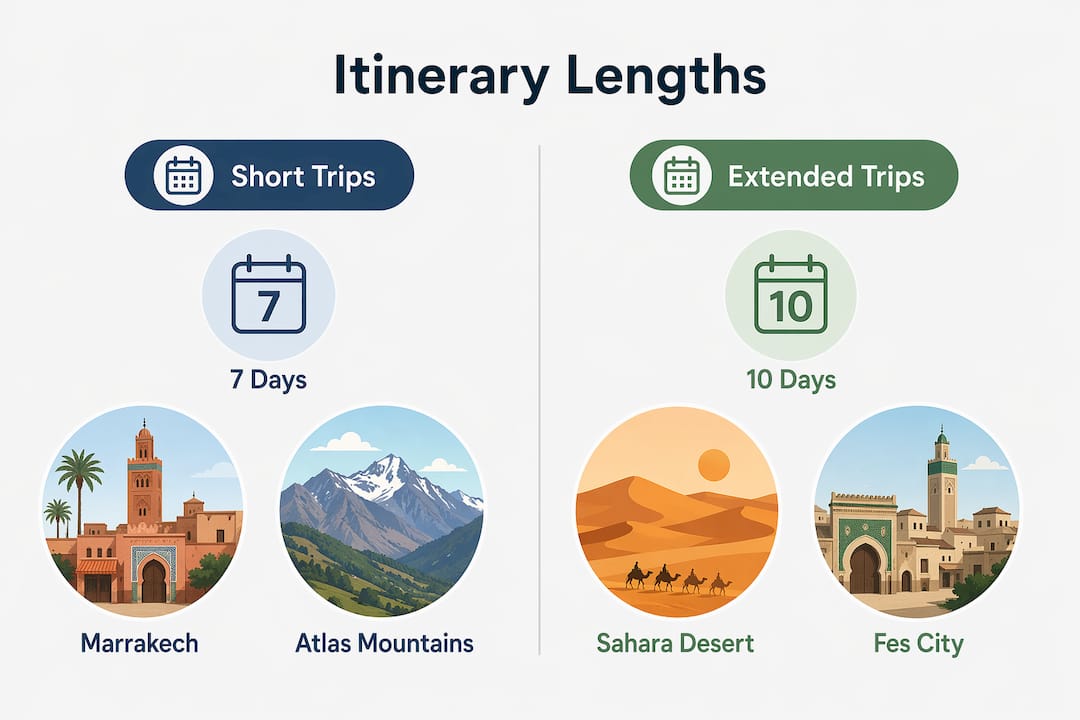
A 10-day itinerary is the optimal balance for first-timers covering Marrakech, Fes, the Atlas Mountains, and the Sahara Desert without rushing. That finding matters because Morocco’s key destinations are spread across a country roughly the size of California, and cutting the trip short forces you to skip either the desert or the imperial cities. Both are non-negotiable for a first visit.
Comparing itinerary lengths
| Duration | Destinations covered | Best for |
|---|---|---|
| 7 days | Marrakech, Atlas Mountains, Sahara | Travelers with limited time |
| 10 days | Marrakech, Atlas, Sahara, Fes | First-timers wanting the full circuit |
| 14 days | All of the above plus Chefchaouen, Essaouira, Casablanca | Travelers seeking a slower pace |
A 7-day trip forces you to rush every leg, often spending more time in transit than at the destination. A 14-day trip, available as a grand tour package, suits travelers who want to add the blue city of Chefchaouen in the Rif Mountains or the Atlantic port town of Essaouira to their route. For most first-timers, 10 days hits the sweet spot.
The classic route runs south from Marrakech through the Atlas Mountains, east to the Sahara near Merzouga, then north to Fes. Starting in Marrakech and ending in Fes eliminates backtracking and keeps your travel direction logical. Flying into Marrakech Menara Airport and out of Fes-Saïss Airport is the cleanest way to execute this loop.
Pro Tip: Book a one-way flight into Marrakech and out of Fes. The price difference is minimal, and you save an entire day you would otherwise spend retracing your route.
When is the best time to visit Morocco for your trip?
The best travel seasons for Morocco are spring (March through May) and fall (September through November), when days are warm and evenings are cool enough for comfortable walking. This matters most in the desert and the medinas, where summer temperatures regularly exceed 100°F and make afternoon sightseeing genuinely unpleasant. For a detailed 2026 seasonal breakdown, timing your visit around these windows pays off significantly.
Here is how each season plays out in practice:
- Spring (March to May): Wildflowers cover the Atlas Mountains, desert temperatures are manageable, and the medinas are active without being dangerously crowded. This is the most popular window.
- Fall (September to November): Similar conditions to spring with the added bonus of fewer tourists than peak summer. Ramadan occasionally falls in spring or fall depending on the lunar calendar, which changes restaurant hours and some services.
- Summer (June to August): Coastal cities like Essaouira benefit from Atlantic breezes, but Marrakech, Fes, and the desert are brutally hot. Only experienced travelers comfortable with extreme heat should plan a summer desert visit.
- Winter (December to February): The Atlas Mountains receive snow, making mountain passes occasionally impassable. Marrakech and Fes are cool but pleasant. Desert nights drop below freezing, so pack accordingly.
Morocco attracted 17.4 million visitors in 2024, a 20% increase from the prior year. That surge means popular riads and desert camps fill up weeks in advance, especially during spring and fall. Booking at least three weeks ahead is now the minimum standard, not a suggestion.
Pro Tip: Pack layers regardless of season. Moroccan temperatures swing dramatically between midday and midnight, especially in the desert and mountains. A light down jacket and a linen shirt will both earn their place in your bag.
How do you get around Morocco during your trip?
Morocco’s transport network is more developed than most first-timers expect, but each mode has clear limits. Morocco’s train network is clean, reliable, and efficient for connecting major cities like Marrakech, Casablanca, and Fes. The ONCF rail system is the fastest and most comfortable option for those city-to-city legs, and tickets are inexpensive by Western standards.
Transport options compared
| Mode | Best for | Key limitation |
|---|---|---|
| Train (ONCF) | Marrakech, Casablanca, Fes connections | Does not reach desert or mountains |
| CTM/Supratours bus | Budget intercity travel | Slower than trains; limited schedules |
| Grand taxi | Short regional hops | Departs only when full; no fixed schedule |
| Car rental | Atlas Mountains, rural areas | Police checkpoints; cash fines required |
| Private transfer | Comfort and flexibility | Higher cost |
Renting a car is the right call for the Atlas Mountains and smaller towns, but it comes with a specific requirement: carry at least 1,000 MAD in cash at all times. Police checkpoints are frequent on mountain roads, and fines must be paid immediately in cash with no card option. Drivers should also know that driving at night in mountainous regions is genuinely hazardous due to poor road lighting and unexpected livestock on the road. Plan every mountain leg to finish before sunset.
Grand taxis are shared long-distance taxis that connect smaller towns and villages. They are cheap and authentic but depart only when all seats are filled, which can mean a 45-minute wait at the taxi stand. For travelers on a tight schedule, a private transfer booked through a local agency removes that uncertainty entirely.
Key practical points to keep in mind:
- Book train tickets on the ONCF website at least 48 hours in advance during peak season.
- CTM buses are the most reliable bus operator for routes the train does not cover.
- Carry Moroccan dirhams (MAD) in cash for rural purchases, small medina vendors, and any roadside situations.
- Confirm your rental car insurance covers Morocco before leaving the agency lot.
Sample day-by-day Morocco itinerary for first-timers
This 10-day route starts in Marrakech and ends in Fes, covering the country’s most iconic experiences with realistic daily pacing.
- Day 1, Marrakech arrival: Check into your riad in the medina and spend the evening at Jemaa el-Fna square. Jemaa el-Fna is a vibrant hub of storytellers, street food vendors, and live music that captures Marrakech’s energy better than any museum. Eat dinner at one of the rooftop restaurants overlooking the square.
- Day 2, Marrakech sightseeing: Visit the Bahia Palace, the Saadian Tombs, and the Ben Youssef Madrasa in the morning when crowds are thin. Spend the afternoon exploring the souks in the medina. The dyers’ souk and the spice market near Rahba Kedima are the most visually striking. Booking riads well in advance is critical here since the best properties have only four to eight rooms and fill quickly.
- Day 3, Marrakech to Ouarzazate: Drive or take a private transfer over the Tizi n’Tichka Pass in the High Atlas Mountains. Stop at the Kasbah Aït Benhaddou, a UNESCO World Heritage site and filming location for Gladiator and Game of Thrones. Overnight in Ouarzazate, known as the “door of the desert.”
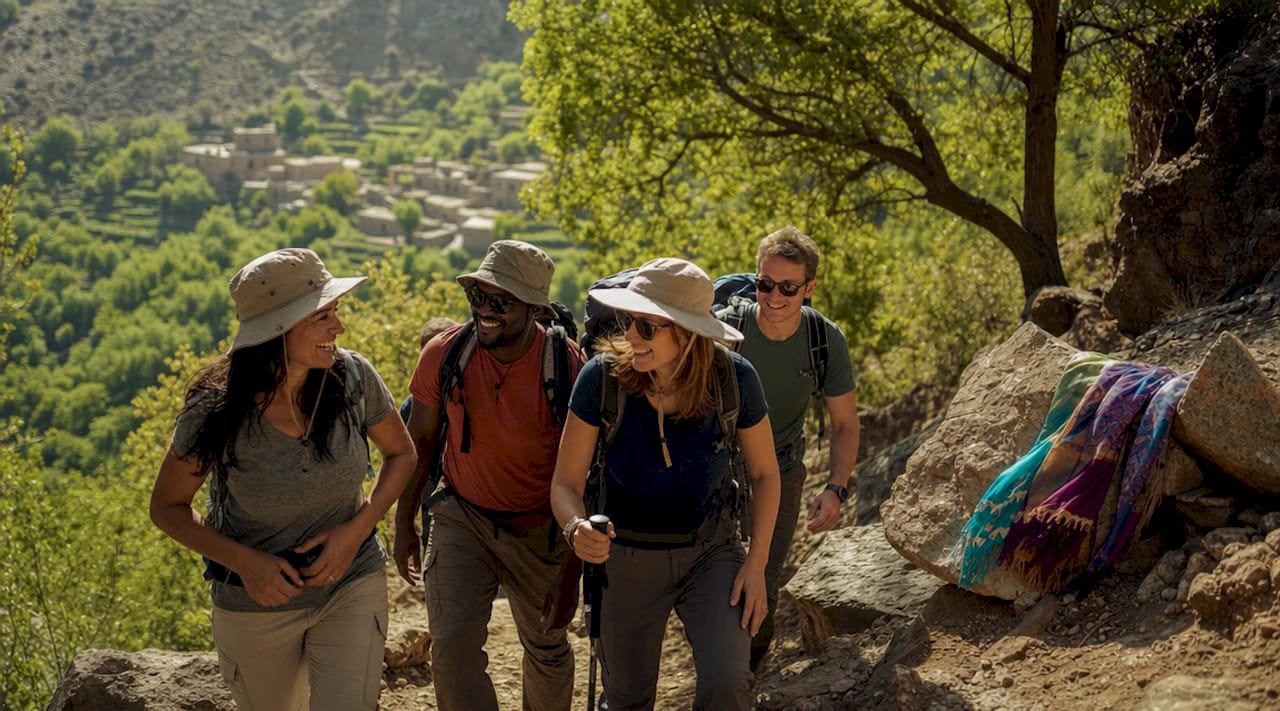
- Day 4, Atlas Mountains cultural immersion: Detour into the Draa Valley or visit a Berber village in the foothills. Local guides in these areas offer home-cooked tagine lunches and explain traditional Amazigh architecture. This is the part of the trip most travelers say they underestimated. For a deeper adventure, the Atlas Mountains hiking routes through Toubkal National Park are worth considering if your schedule allows.
- Day 5, drive to Merzouga: The drive from Ouarzazate to Merzouga takes roughly five hours through dramatic desert scenery. Arrive by late afternoon to check into your desert camp at the edge of the Erg Chebbi dunes. The camp experience, with traditional Berber tents and a fire under the stars, is one of the trip’s defining nights.
- Day 6, Sahara Desert experience: Merzouga at the Erg Chebbi dunes is the classic base for camel trekking, with rides taking approximately 1.5 hours each way into the dunes. Wake before sunrise for the dune climb, which offers the most photographed view in Morocco. Spend the afternoon resting at camp or visiting the nearby village of Khamlia, known for its Gnawa music performances.
- Day 7, Merzouga to Fes via Midelt: This is a long driving day of roughly seven hours, best broken up with a lunch stop in Midelt, a small town known for its apple orchards and carpet workshops. Arrive in Fes by evening and check into a riad in the medina. The contrast between the open desert and the dense medieval city hits immediately.
- Day 8, Fes medina exploration: Fes’s medina is the world’s largest intact medieval city and requires a licensed guide for effective navigation. A guided morning tour covers the Chouara Tannery, the Al-Qarawiyyin University (founded in 859 AD and recognized as the world’s oldest continuously operating university), and the Bou Inania Madrasa. Afternoons are best spent wandering independently once you have your bearings.
- Day 9, Fes day trip or Chefchaouen extension: Travelers with a 10-day itinerary can use this day for a two-hour drive to Chefchaouen, the blue-painted mountain town in the Rif Mountains. It is a half-day trip from Fes and worth it purely for the visual contrast with everything you have seen. Alternatively, spend the day exploring Fes el-Jdid (the new medina) and the Mellah, the historic Jewish quarter.
- Day 10, departure from Fes: Fes-Saïss Airport handles direct flights to major European hubs, including Paris, London, and Amsterdam. Morning flights are common, so plan your final riad night accordingly. If your flight is in the afternoon, a final walk through the medina and a last mint tea at a café near Bab Bou Jeloud are the right way to close the trip.
Pro Tip: Flexibility within your itinerary is not a weakness. Morocco’s medinas are genuinely disorienting, and building in buffer time prevents the frustration of missing a connection because you got turned around in Fes for an hour.
Key takeaways
A well-executed Morocco travel itinerary requires 10 days, a south-to-north routing from Marrakech to Fes, and advance booking of riads and desert camps at least three weeks out.
| Point | Details |
|---|---|
| Optimal trip length | Ten days cover Marrakech, the Atlas Mountains, the Sahara, and Fes without rushing. |
| Best travel season | Spring and fall offer the most comfortable temperatures across all destinations. |
| Transport strategy | Use trains for city connections and rent a car only for mountain and rural legs. |
| Accommodation booking | Riads and desert camps have four to eight rooms; book three weeks ahead minimum. |
| Routing logic | Start in Marrakech and end in Fes to eliminate backtracking and maximize daily coverage. |
What I’ve learned from planning Morocco itineraries for first-timers
The single biggest mistake I see first-time travelers make is treating Morocco like a European city break where you can improvise your way through. You cannot. The medinas in Fes and Marrakech have no street grid, GPS directions are unreliable inside the walls, and the cultural context of what you are seeing is almost invisible without a guide. Hiring a licensed local guide for at least your first full day in each medina is not a luxury. It is the difference between a meaningful experience and an expensive walk in circles.
The second thing I would push back on is the instinct to pack in too many cities. Chefchaouen photographs beautifully, but if adding it means you spend three hours in a car on day nine when you could be sitting in a Fes café watching the world go by, you have made the wrong trade. Morocco rewards slowness. The best moments on any itinerary I have ever seen come from the unplanned ones: a conversation with a carpet weaver in the Fes souks, a spontaneous invitation to tea in a Berber village, a sunset from a desert dune with no one else around.
I also think travelers underestimate how physically demanding the country is. The medinas involve hours of walking on uneven stone surfaces. The desert involves early mornings and cold nights. The mountain drives are long. Build rest into your itinerary the same way you build in sightseeing. A 90-minute afternoon break at your riad is not wasted time. It is what keeps you sharp for the evening, which in Morocco is often the best part of the day.
Finally, carry more cash than you think you need. Moroccan dirhams are the only currency that works reliably outside of major hotels, and ATMs in smaller towns are not always stocked. The traveler who runs out of cash in the Atlas Mountains has a bad afternoon. The traveler who carries 2,000 MAD in reserve does not.
— Moroccotravel1.com
Plan your Morocco trip with Moroccotravel1
Moroccotravel1.com builds private and custom Morocco tour packages designed specifically for travelers who want the itinerary above handled by local experts. The 10-day family tour package covers Marrakech, the Atlas Mountains, the Sahara, and Fes with family-appropriate pacing and vetted accommodations. For travelers who want more time, the 14-day grand tour adds Chefchaouen, Essaouira, and Casablanca to the route. Every package includes licensed local guides, private transfers, and pre-booked riads and desert camps. Explore the full range of private Morocco tours to find the package that fits your travel style and timeline.
FAQ
What is the best Morocco itinerary for 10 days?
The best 10-day route starts in Marrakech, moves through the Atlas Mountains and Ouarzazate, reaches the Sahara Desert at Merzouga, and ends in Fes. This direction eliminates backtracking and covers Morocco’s most iconic landscapes and cities.
When is the best time to visit Morocco for good weather?
Spring (March to May) and fall (September to November) are the ideal seasons, offering warm days and cool evenings across cities, mountains, and desert. Summer heat in Marrakech and Fes regularly exceeds 100°F, making those months difficult for first-timers.
Do I need a guide in Morocco’s medinas?
A licensed guide is strongly recommended for Fes’s medina, which is the world’s largest intact medieval city and genuinely difficult to navigate without local knowledge. Marrakech’s medina is more manageable independently after an initial guided orientation.
How far in advance should I book accommodations in Morocco?
Book riads and desert camps at least three weeks in advance, especially during spring and fall peak seasons. The best riads in Marrakech and Fes have only four to eight rooms and fill quickly given Morocco’s record tourism numbers.
Is it safe to drive in Morocco as a tourist?
Driving is safe during daylight hours with the right preparation. Carry at least 1,000 MAD in cash for police checkpoint fines, avoid mountain roads after dark, and confirm your rental car insurance covers Morocco before departing the agency.


