


- Morocco weather varies dramatically across regions, with unpredictable weather changes happening within a single week.
- Travelers must plan for diverse conditions, including extreme heat, snow in the mountains, and desert temperature swings, by checking forecasts and timing activities carefully.
- Understanding these regional differences enhances safety and enjoyment during visits, especially in extreme weather episodes.
Morocco baffles most travelers who arrive expecting one kind of weather and find three. The Morocco weather shifts dramatically depending on where you are standing: freezing Atlas Mountain passes, scorching Saharan plains, and breezy Atlantic coastlines can all exist within the same week of travel. Morocco’s climate, formally described as a Mediterranean-influenced continental climate with desert and alpine variations, is genuinely one of the most diverse in North Africa. Recent events have made understanding it even more pressing. In May, temperatures hit 44°C across southern provinces while snow fell in the Atlas. This guide cuts through the confusion.
Table of Contents
- Key Takeaways
- Morocco Weather: Understanding the Four Climate Zones
- Current conditions: Morocco’s extreme weather
- Practical travel planning around Morocco’s weather
- Month-by-month snapshot for popular destinations
- My honest take on planning around Morocco’s weather
- Plan your Morocco trip with the right weather in mind
- FAQ
Key Takeaways
| Point | Details |
|---|---|
| Morocco has four distinct climate zones | The coastal, interior plains, Sahara, and Atlas Mountains each require different packing and planning strategies. |
| Heat waves reached 44°C | Southern provinces saw extreme heat while coastal cities stayed relatively cooler at 34–38°C. |
| Mountain weather changes fast | Snowfall above 2,000 m can close roads with little warning, even in late spring. |
| Best months for most travelers | March through May and September through November offer the most comfortable conditions across regions. |
| Check DGM forecasts before each destination | Morocco’s General Directorate of Meteorology issues multi-day alerts that help travelers plan activities around extreme weather. |
Morocco Weather: Understanding the Four Climate Zones
Most people picture Morocco as endlessly sunny and warm. The reality is a country split into four meaningfully different climate systems, and knowing which one applies to your destination changes everything about what to pack and when to go.
The Mediterranean coast
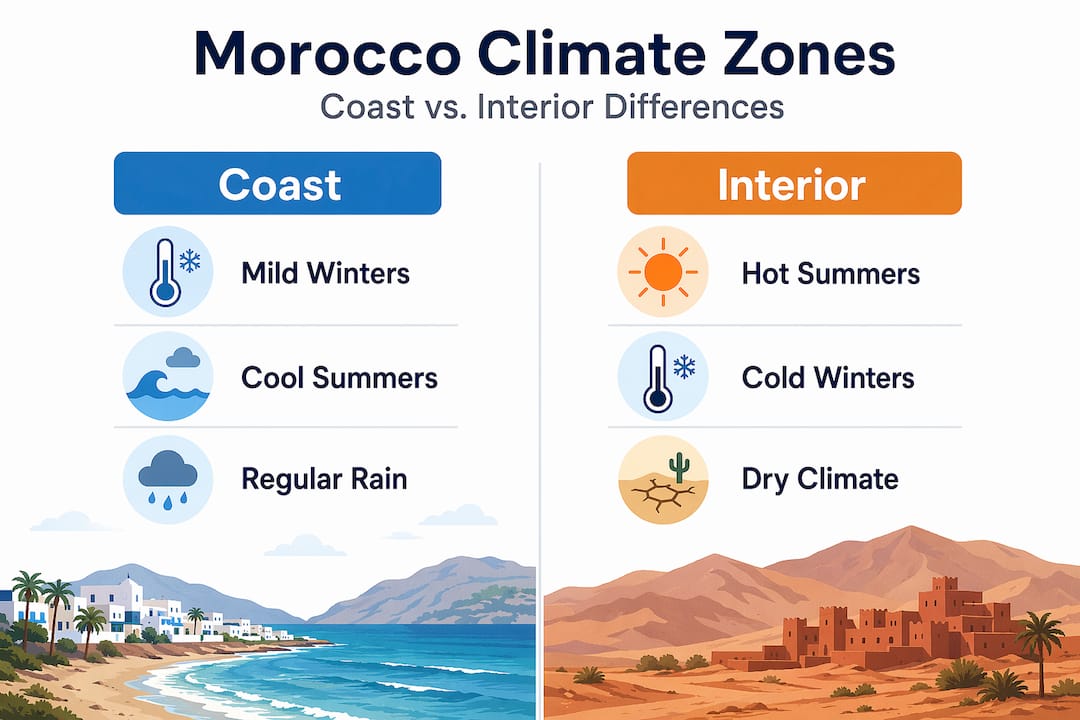
The Atlantic and Mediterranean coastline, stretching from Tangier through Casablanca down to Agadir, follows a classic Mediterranean pattern. Winters are mild and occasionally wet, with average temperatures sitting between 12°C and 18°C. Summers are warm and dry, rarely oppressive near the water thanks to sea breezes. Agadir benefits from the Canary Current, which keeps summer highs in the comfortable mid-20s even when the interior is baking. Rainfall concentrates in November through February, and summers are almost entirely dry.
The interior plains
Moving inland toward Fes, Meknes, and Marrakech, the Mediterranean influence fades. Summers turn genuinely hot. Marrakech regularly sees July and August highs above 38°C, and the air is dry enough that the heat feels tolerable in the shade but punishing in direct sun. Winters are cooler than the coast, with cold nights and daytime temperatures that can drop to single digits in January. Spring and fall are the sweet spots: warm afternoons, cool evenings, and very little rain.
The Sahara and desert south
The desert interior operates by its own rules. Saharan regions experience extreme day-night temperature swings, where a midday reading of 42°C can drop to 15°C after sunset. This is not an exaggeration. Travelers who plan desert camping without a warm layer learn this lesson the hard way. Annual rainfall in places like Merzouga is under 100 mm. Summer is genuinely inhospitable for most tourists, while winter offers clear skies, mild daytime warmth, and spectacular stargazing.
The Atlas Mountains
The High Atlas represents Morocco’s most extreme weather zone in terms of variability. Elevations above 2,000 m receive significant snowfall from November through April. The ski resort at Oukaimeden, just 80 km from Marrakech, sits at 2,600 m and can hold snow well into March. Summer brings cool, pleasant temperatures that feel like a different country compared to Marrakech below. The key dynamic here is elevation: a 1,000 m gain means roughly a 6°C temperature drop. This is why the Toubkal region and passes like Tizi n’Tichka can surprise visitors who drive up from the warm valley floor without a jacket.
| Climate Zone | Winter Temps | Summer Temps | Rainfall Pattern |
|---|---|---|---|
| Mediterranean coast | 12–18°C | 22–28°C | Wet Nov–Feb, dry summer |
| Interior plains | 5–15°C | 32–40°C | Light rain Oct–Apr |
| Sahara/desert south | 8–20°C (day/night swing) | 38–45°C | Under 100 mm annually |
| Atlas Mountains | Below 0°C to 10°C | 15–25°C | Snow above 2,000 m Nov–Apr |
Current conditions: Morocco’s extreme weather
If you are researching current weather conditions in Morocco right now, it has been a year worth paying close attention to. The pattern has been one of sharp contrasts and fast-moving alerts.
Morocco issued orange-level vigilance alerts across multiple provinces as a significant heat wave pushed temperatures well above seasonal norms. Provinces including Tata, Es-Semara, Assa-Zag, Boujdour, and Oued Ed-Dahab saw highs of 41°C to 44°C. At the same time, coastal cities remained considerably more manageable. The inland and southern regions hit 37–44°C, while coastal areas like Casablanca settled at 34–38°C, a gap that reinforces how different these zones truly are even during a single weather event.
Meanwhile, the Atlas Mountains were dealing with a completely different situation. Wind gusts of 70–85 km/h hit several provinces in the same period, with snowfall of 10–25 cm above 2,000 m recorded across Ouarzazate, Azilal, Midelt, and Tinghir. Travelers who had booked trekking trips to the High Atlas during this window faced real access issues, with road conditions changing within hours.
For travelers, an orange-level alert from Morocco’s General Directorate of Meteorology (DGM) means authorities consider the weather genuinely dangerous, not just uncomfortable. These alerts come with official recommendations to limit outdoor exposure during peak afternoon hours and take extra precautions around hydration and sun exposure. Understanding what these alert levels mean helps you make smart decisions rather than pushing through conditions that local authorities consider hazardous.
Pro Tip: Bookmark the DGM’s official alerts page before your trip. The DGM issues multi-day forecasts that show temperature bands and timing windows. This lets you shift outdoor activities to early morning or evening and avoid the worst heat hours with actual data, not guesswork.
Dust storms are another reality worth planning around. Wind gusts causing blowing sand reduce visibility significantly and increase driving hazards on secondary roads. If you have photography on your itinerary, dust storms also affect image quality and can damage camera equipment if you are not prepared with protective cases.
Practical travel planning around Morocco’s weather
Understanding the climate is half the work. Translating that knowledge into a smarter trip is where most travelers fall short. Here is how to plan well, based on the seasonal weather Morocco throws at visitors throughout the year.
- Schedule outdoor activities around the heat window. During heat waves, locals shift their entire rhythm. Mornings and evenings are for movement; midday is for shade and rest. Plan your medina walks, desert treks, and market visits before 10 a.m. or after 5 p.m. between June and September. This is not a suggestion. It is how Moroccans survive summer, and it works.
- Build a region-aware packing list. A single bag needs to handle beach weather in Essaouira, mountain cold in the Atlas, and Saharan heat in Merzouga. Lightweight, breathable clothing is the base layer. Add a warm fleece or insulated jacket for mountain elevations or desert nights. Sun protection, including a hat, high-SPF sunscreen, and UV-blocking sunglasses, is non-negotiable. If you want a thorough checklist covering temperature extremes, the ultimate packing guide is worth reviewing before you finalize your bag.
- Stay hydrated beyond what feels necessary. The Morocco Weather Agency recommends specific hydration precautions during heat alerts, particularly for older travelers, children, and anyone with cardiovascular conditions. In practice, this means drinking water before you feel thirsty, carrying a refillable bottle, and avoiding alcohol during the hottest parts of the day.
- Build flexibility into mountain itineraries. Mountain travel in Morocco requires slack time to absorb sudden weather changes. If your plan includes the Toubkal region, Dades Gorge, or any Atlas pass above 2,000 m, build in at least one buffer day per three days of mountain travel. Roads close. Trails become unsafe. Having a backup plan in a lower valley town is not pessimism. It is good planning.
- Check the Morocco climate forecast per destination, not per country. Searching “current weather Morocco” gives you a national average that is nearly useless when Marrakech and Ifrane are 80 km apart but at completely different temperatures. Use weather apps that allow city-level or elevation-level input. Check each stop on your itinerary separately, particularly if you are crossing altitude zones.
Pro Tip: Packing for Morocco means preparing for weather extremes that can coexist within a single week. Even if you are visiting in spring, pack as if the Atlas Mountains are on your itinerary. Unexpected snowfall has caught travelers in light clothing as late as May.
Month-by-month snapshot for popular destinations
Knowing the average temperature Morocco records by month, by city, is the most direct way to pick your travel dates. Here is how the major destinations play out across the year.
Marrakech runs warm most of the year. March through May brings highs of 25–32°C, low humidity, and comfortable evenings. June through August peaks at 38–40°C with intense afternoon sun. September and October cool back to the mid-30s and are excellent for outdoor sightseeing. Winters are mild with the occasional cold night dropping to 5–8°C.
Casablanca and the Atlantic coast stay more moderate. Summer highs hover around 26–28°C. Winters are mild and occasionally rainy. This makes the coast a year-round destination, though winter months see the most reliable rainfall.
Fes follows the interior pattern. Spring is exceptional, with highs in the mid-20s and the city’s medina at its most photogenic. Summer gets hot, reaching 38°C or more in July. Winter is cool and can be genuinely cold at night.
Agadir is Morocco’s most consistent weather destination. It rarely exceeds 30°C in summer and rarely drops below 15°C in winter, making it a reliable beach destination from October through April when the rest of Morocco is less predictable.
| Month | Marrakech | Casablanca | Fez | Agadir |
|---|---|---|---|---|
| January | 8–18°C | 9–17°C | 5–16°C | 11–20°C |
| April | 15–28°C | 13–22°C | 13–25°C | 15–24°C |
| July | 22–38°C | 19–27°C | 20–38°C | 20–27°C |
| October | 17–29°C | 16–24°C | 15–27°C | 18–27°C |
For Morocco weather by month planning purposes, the clearest rule is this:
- March to May: Best across almost all regions. Wildflowers in the Atlas, warm desert days, manageable heat in cities.
- June to August: Best for coast and mountains. Avoid the Deep South and interior cities unless you are heat-adapted.
- September to November: Excellent across the board. Crowds thin, temperatures drop from summer peaks, and the Sahara becomes genuinely enjoyable again.
- December to February: Best for Agadir, the Sahara (clear skies, cold nights), and budget travelers who do not mind cooler temps in the cities.
The best time to visit Morocco for most first-time travelers is April or October. Both months offer wide geographic flexibility, with good weather across coastal, urban, and desert destinations simultaneously.
My honest take on planning around Morocco’s weather
I have seen travelers return from Morocco frustrated because they treated the whole country as one weather experience. They booked a desert camp in July, spent two days hiding from heat they were not prepared for, and missed the very magic they came to find. That is a planning failure, not a Morocco failure.
In my experience, the travelers who enjoy Morocco most are the ones who understand that they are traveling through multiple climates, not one country with one forecast. The geographic diversity means you can encounter three climate types in a single week of travel. That is remarkable. But it requires you to actually prepare for each leg of the journey as if it were a distinct destination.
The heat waves reinforced something I already believed: checking the forecast once before you fly is not enough. Conditions shift fast. A trip that starts pleasantly in Marrakech can hit a heat spike by day three or find the Atlas pass you planned to drive snowed in. The travelers who adapt quickly are the ones who have already thought through their backup options.
My practical advice is specific: plan your most physically demanding activities, whether that means medina walks, mountain hikes, or desert rides, for the first 60 to 90 minutes of daylight and the last 90 minutes before sunset. Skip the midday hero hours. You will see more, feel better, and remember the trip fondly instead of just surviving it. Check destination-specific forecasts, not national ones. And give yourself real schedule flexibility in the Atlas, not just optimistic buffer time.
Morocco rewards the informed traveler generously. The weather is part of the experience. Let it be interesting, not overwhelming.
— Moroccotravel1.com
Plan your Morocco trip with the right weather in mind
At Moroccotravel1.com, every itinerary is built with Morocco’s regional climate in mind. Whether you are looking at the 14-day Morocco Grand Tour that takes you from the Atlantic coast through the High Atlas and into the Sahara, or a family-friendly 10-day package timed around comfortable seasonal weather, the tours are designed to maximize what each destination offers when it offers it best. Local guides bring real-time weather awareness to every day of travel, adjusting activity timing and routes when conditions shift. If you want expert help planning around Morocco’s climate, Moroccotravel1’s team is available 24/7 to help you choose dates and destinations that match your preferences and comfort level. Book early to secure the best dates during peak shoulder seasons.
FAQ
What is the best time to visit Morocco?
March through May and September through November offer the most comfortable temperatures across coastal, urban, and desert destinations simultaneously. These shoulder seasons avoid extreme summer heat and winter mountain closures.
How hot does Morocco get in summer?
Southern and interior regions regularly exceed 38°C, with heat waves reaching 44°C in provinces like Tata and Oued Ed-Dahab. Coastal cities stay considerably cooler, typically in the mid-to-upper 20s.
Does it snow in Morocco?
Yes. The Atlas Mountains above 2,000 m receive significant snowfall from November through April, and late-season snowfall of 10–25 cm has been recorded as late as May in provinces including Midelt and Azilal.
What does an orange-level weather alert mean for travelers?
An orange-level DGM alert signals conditions the Moroccan government considers genuinely hazardous. Travelers should limit outdoor activity during peak afternoon hours, prioritize hydration, and check local guidance before driving or trekking in affected areas.
Is Marrakech’s weather different from the rest of Morocco’s?
Significantly. Weather in Marrakech follows a hot interior pattern with summer highs above 38°C, while the coast stays 10–15°C cooler, and the Atlas Mountains directly above the city can have snow in the same season. Checking each destination separately is far more useful than any national average.


