


- Tangier is a Moroccan port city where Africa and Europe are only 14 kilometers apart across the water.
- It offers diverse transportation options, including airfare, high-speed trains, and ferries from Spain, with each suited to different travelers.
- Key attractions include the medina, Kasbah, Caves of Hercules, and multicultural religious sites, all best explored with a local guide.
Tangier city is a port city where the Mediterranean meets the Atlantic and where Africa and Europe face each other across just 14 kilometers of open water. No other Moroccan city carries this kind of geographic drama. The medina, the Kasbah, the Caves of Hercules, and the coastal corniche all sit within a city shaped by Andalusian, Arab, Berber, and European influences layered over centuries. This guide covers how to get here, what to see, and how to move through Tangier with confidence.
What are the best ways to get to Tangier City, Morocco?
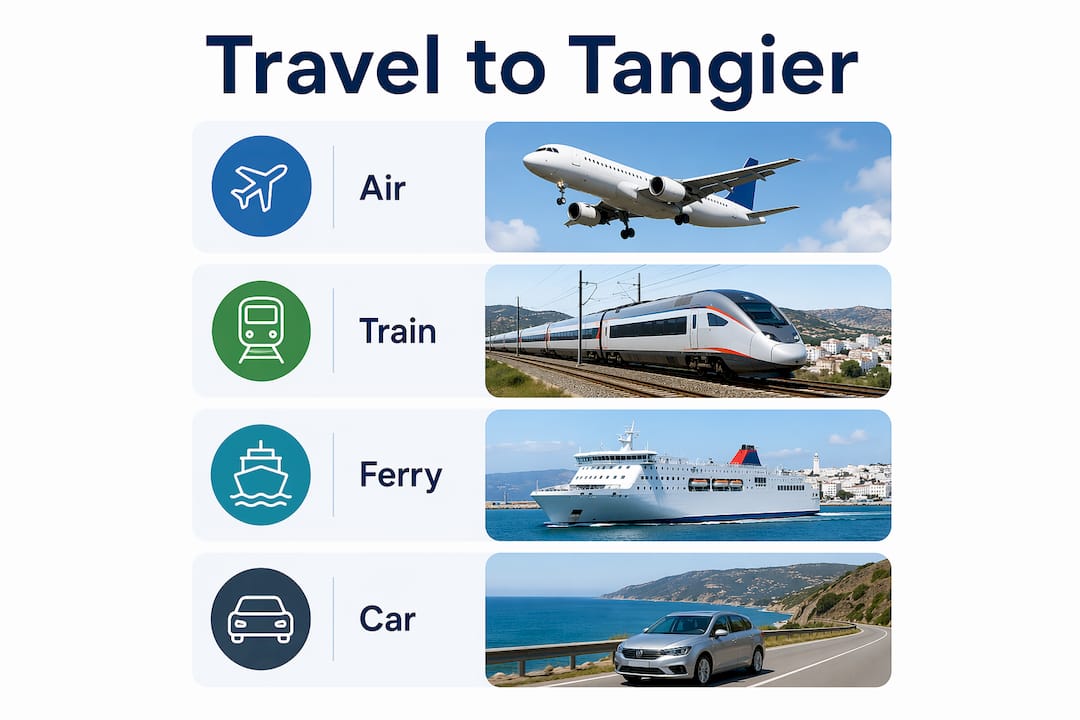
Three main routes bring travelers to Tangier: air, rail, and sea. Each suits a different traveler profile, and knowing the differences saves real time.
Flying into Tangier
Tangier Ibn Battouta Airport sits close to the city center, making it one of the more convenient arrivals in Morocco. Direct flights connect from major European hubs, and the transfer into the medina takes under 30 minutes by taxi. For travelers coming from within Morocco, the airport also handles domestic connections from Casablanca and Marrakech.
Taking the Al Boraq high-speed train
The Al Boraq train connects Tangier to Casablanca in 2 hours and 10 minutes and to Rabat in 1 hour and 30 minutes. That makes it the fastest domestic travel option in Morocco. Seats are comfortable, punctual, and significantly cheaper than flying. Travelers coming from Fez or Marrakech connect through Casablanca.
Crossing by ferry from Spain
The ferry crossing is the most cinematic way to arrive, and for travelers coming from southern Spain, it is also the most practical.
- Tarifa to Tangier Ville: The best option for foot passengers. The crossing takes roughly 60 minutes with 8–10 daily departures in summer, and walk-on fares start around €37 one-way. Tangier Ville port drops you a 10-minute walk from the medina.
- Algeciras to Tangier Med: The standard car ferry route. Tangier Med port sits 45 km outside the city, so foot passengers face a long transfer. This route works best for travelers with vehicles.
- Booking online: Digital confirmations must be exchanged for printed boarding passes at the ferry company’s terminal desk before boarding. Skipping this step risks denied boarding.
- Passport stamping on the ferry: The Moroccan police desk inside the ferry closes about 15 minutes before arrival. Get your passport stamped soon after departure to avoid delays at disembarkation.
- Driving from Spain: Travelers bringing a personal vehicle need original vehicle registration and a valid driver’s license and must pay for temporary vehicle insurance at the port. Ferry prices vary across operators, so comparing rates before booking saves money.
Pro Tip: If you are a foot passenger arriving from Spain, always choose Tarifa to Tangier Ville over Algeciras to Tangier Med. The Ville Port puts you directly in the city. Tangier Med requires a separate bus or taxi transfer that adds at least an hour to your arrival.
Which Tangier tourist attractions should travelers not miss?
Tangier rewards travelers who go beyond the obvious. The city’s best sites sit close together, and a single day of walking covers most of the historic core.
The medina and Kasbah
The medina is the old walled city, and the Kasbah sits at its highest point, with views over both the Strait of Gibraltar and the Atlantic. Walking the medina’s narrow lanes reveals tiled doorways, spice stalls, and centuries-old mosques. The Kasbah Museum, housed in a former sultan’s palace, holds Moroccan artifacts and Roman mosaics from the nearby ancient site of Volubilis.
Petit Socco and the bazaars
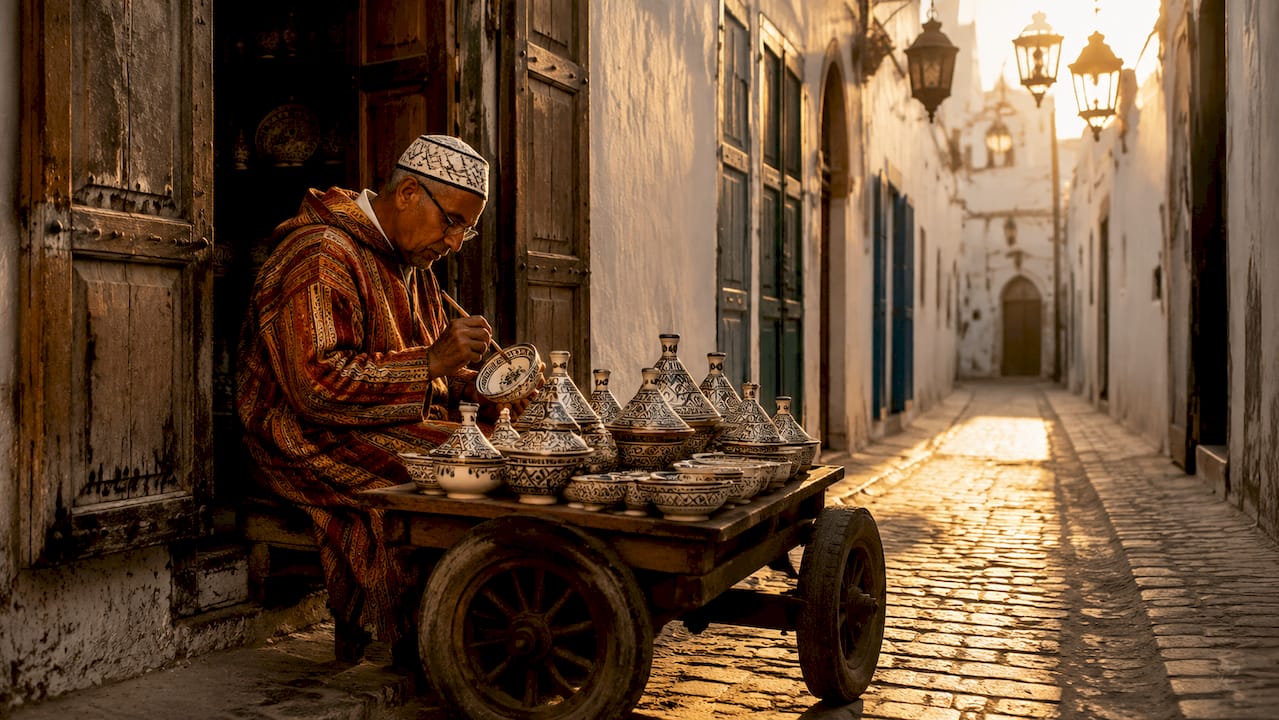
The Petit Socco is a small square at the heart of the medina where locals drink mint tea and watch the world pass by. It was once the social center of Tangier’s International Zone era, and the cafes lining it still carry that faded cosmopolitan atmosphere. The surrounding lanes hold leather goods, ceramics, and textiles sold in traditional bazaars. Prices are negotiable, and shopping here feels genuinely local rather than staged for tourists.
Caves of Hercules
The Caves of Hercules sit 15 km west of Tangier along the Atlantic coast. The sea-facing opening is shaped like the African continent, which makes it one of the most photographed natural formations in Morocco. Legend connects the caves to Hercules’ 11th labor, and the site carries UNESCO-listed heritage status. Late afternoon is the best time to visit. The golden hour light through the cave opening is genuinely striking.
Multicultural landmarks
Tangier holds mosques, Catholic churches, and synagogues within walking distance of each other. This density of religious sites in a small area reflects the city’s layered history in a way that no museum exhibit can replicate. The Spanish Cathedral, the Grand Mosque, and the former Jewish quarter all sit within the medina or its immediate surroundings.
| Attraction | Location | Best time to visit |
|---|---|---|
| Kasbah and medina | Old city center | Morning, before crowds |
| Petit Socco | Heart of the medina | Late afternoon |
| Caves of Hercules | 15 km west of city | Late afternoon, golden hour |
| Coastal corniche | Seafront promenade | Sunset |
| Multicultural religious sites | Medina and surroundings | Daytime |
Pro Tip: Hire a licensed local guide for your first medina walk. The lanes look identical from the outside, and a guide adds historical context that transforms a confusing maze into a readable city.
How does Tangier’s multicultural history shape its modern identity?
Tangier was jointly governed by up to nine nations as an international city for much of the 20th century. That arrangement ended in 1956 when Morocco gained independence, but its effects are still visible everywhere in the city.
“The close proximity of mosques, churches, and synagogues reflects Tangier’s multicultural heritage stemming from its International Zone status, creating a unique coexistence rarely seen elsewhere in Morocco.” — Bewildered in Morocco
European architecture lines the Boulevard Pasteur, the city’s main commercial street. French-style apartment buildings stand next to Moorish archways. Spanish signage appears on older storefronts. The city does not feel like a theme park version of Morocco. It feels like a place that absorbed multiple cultures and kept all of them.
What sets Tangier apart from Marrakech or Fez is its cosmopolitan and gritty port character. The city has always been a place of transit, negotiation, and exchange. That energy is still present in the port district, the souks, and the cafes. Travelers drawn to border cultures and layered histories find Tangier more interesting than Morocco’s more polished tourist destinations.
The International Zone era also attracted writers, artists, and intellectuals from Europe and America. Paul Bowles, William S. Burroughs, and Henri Matisse all spent significant time in Tangier. Their presence shaped the city’s reputation as a place where creative and unconventional lives were possible. That legacy is part of what gives Tangier its distinct atmosphere today.
What practical travel tips should visitors know before exploring Tangier?
Tangier is one of Morocco’s more accessible cities for first-time visitors. A few practical details make the difference between a smooth trip and an avoidable headache.
- Language: Locals in Tangier often speak four to five languages, including Arabic, French, Spanish, and English. Spanish is particularly useful given the city’s proximity to Spain. English works well in tourist areas and hotels. French is the language of business and government.
- Getting around: Petit taxis are the standard way to move around the city. They are metered, inexpensive, and widely available. The medina itself is pedestrian only, so walking is the only option inside the old city walls. Wear comfortable shoes. The lanes are uneven, stone.
- Currency: Morocco uses the Moroccan dirham (MAD). ATMs are widely available near the port and along Boulevard Pasteur. Credit cards work in most hotels and larger restaurants, but smaller medina shops and market stalls are cash only. Exchange currency at banks or official exchange offices rather than street vendors.
- Cultural etiquette: Dress modestly when visiting mosques and the medina. Shoulders and knees covered is the standard expectation. Non-Muslims cannot enter active mosques in Morocco, so admire them from the exterior. Greet shopkeepers and locals with a simple “Salam” before asking questions or negotiating prices.
- Best time to visit: Spring (march through may) and fall (september through november) offer the most comfortable temperatures. Summer brings heat and larger crowds, particularly from European day-trippers arriving by ferry. Winter is mild and quiet, which suits travelers who prefer fewer tourists.
Pro Tip: Avoid the medina during Friday midday prayers. Many shops close for one to two hours, and the lanes become very quiet. Use that window to visit the Caves of Hercules or the corniche instead.
Key Takeaways
Tangier is Morocco’s most accessible and culturally layered city, best reached by Al Boraq train from Casablanca or by ferry from Tarifa, with its medina, Kasbah, and Caves of Hercules forming the core of any visit.
| Point | Details |
|---|---|
| Best arrival for foot passengers | Take the Tarifa to Tangier Ville ferry for direct city access in roughly 60 minutes. |
| Fastest domestic connection | The Al Boraq train reaches Tangier from Casablanca in 2 hours and 10 minutes. |
| Top cultural site | The Kasbah and medina hold the city’s deepest history and are best explored with a licensed guide. |
| Unique natural attraction | The Caves of Hercules, 15 km west of the city, are best visited at golden hour for the full visual effect. |
| Multicultural identity | Tangier’s International Zone past left mosques, churches, and synagogues within walking distance of each other. |
What Tangier taught me about traveling at the edge of two worlds
Most travelers arrive in Tangier expecting a gateway city, a place to pass through on the way to Fez or Marrakech. I made that mistake on my first visit. I booked one night and moved on. It took a second trip, with three full days, to understand what Tangier actually is.
The city does not perform for tourists the way Marrakech does. The Djemaa el-Fna square in Marrakech is spectacular, but it knows it is spectacular. Tangier’s Petit Socco does not care whether you find it charming. The old men are playing cards, the teenagers are on phones, and the vendor is arguing with a customer over the price of olives. That is the real thing.
What I find most underrated about Tangier is the luxury and cultural depth available to travelers who look past the port. The riads in the medina are quieter and cheaper than their equivalents in Marrakech. The food is exceptional, particularly the grilled fish near the port and the pastilla in the old city restaurants. The corniche at sunset, with Spain visible across the water, is one of the most quietly dramatic views in North Africa.
My practical advice: spend at least two nights. Do the Caves of Hercules on day one in the late afternoon. Spend day two entirely inside the medina and Kasbah. On the morning you leave, walk the corniche before breakfast. Tangier rewards travelers who slow down.
— Moroccotravel1.com
Plan your Morocco trip with Moroccotravel1.com
Tangier is a natural starting point for a broader Morocco itinerary. Moroccotravel1 builds custom Morocco tour packages that include Tangier alongside Fez, Chefchaouen, the Sahara, and Marrakech, with local expert guides, private transport, and vetted accommodations throughout. The 14-Day Morocco Grand Tour covers the full north-to-south arc of the country, including time in Tangier’s medina and Kasbah. For families, the 10-Day Morocco Family Tour is built around accessible sites and comfortable pacing. Every itinerary includes 24/7 support and flexible booking.
FAQ
How far is Tangier from Spain?
Tangier sits approximately 14 kilometers from the Spanish coast at its closest point. The Tarifa to Tangier Ville ferry crossing takes roughly 60 minutes.
What language do people speak in Tangier?
Locals in Tangier commonly speak Arabic, French, Spanish, and English. Spanish is widely understood due to the city’s proximity to Spain.
Is Tangier safe for tourists?
Tangier is generally safe for tourists. The medina and tourist areas are well-traveled, and standard precautions like keeping valuables secure and staying aware of your surroundings apply as they would in any port city.
What is the best time of year to visit Tangier?
Spring (March through May) and fall (September through November) offer the most comfortable weather and fewer crowds. Summer is busy with European day-trippers arriving by ferry.
Do I need a visa to visit Morocco from the United States?
American passport holders do not need a visa for stays up to 90 days in Morocco. Your passport must be valid for at least six months beyond your travel dates.


