


- Morocco offers diverse horseback riding experiences across mountains, coasts, and deserts, each requiring different skills.
- The country’s strong equestrian culture emphasizes quality horses, cultural immersion, and respectful interactions with local communities.
- Planning with reputable operators and clear communication ensures a rewarding and authentic Moroccan riding adventure.
Morocco is nothing like most equestrians expect. The country is not just a backdrop for a quick beach ride or a single desert sunset. Morocco horse riding spans three distinct worlds: the jagged passes of the High Atlas Mountains, the wave-swept Atlantic coast, and the sweeping dunes of the Sahara Desert. Each terrain demands something different from you and your horse. Each one rewards you in ways that are hard to describe until you have actually done it. If you are an equestrian or an adventure seeker planning a serious riding trip, this guide will tell you exactly what to expect, where to go, and how to get it right.
Table of Contents
- Key takeaways
- Morocco horse riding terrains you need to know
- The horses: Barb and Barb-Arabian breeds
- Cultural immersion you will not find on any other riding tour
- Choosing the right tour: options, logistics, and safety
- Practical tips for your Morocco riding adventure
- My honest take on Moroccan equestrian travel
- Plan your Morocco riding experience with Moroccotravel1
- FAQ
Key takeaways
| Point | Details |
|---|---|
| Three distinct terrains | Morocco offers mountain, coastal, and desert riding, each with different skill demands and seasonal windows. |
| Barb and Barb-Arabian breeds | These hardy, sure-footed horses handle all Moroccan terrain and suit confident riders who can control a forward-going mount. |
| Horse-rider matching matters | Tell your operator your exact skill level and preferences upfront. The right match makes or breaks the experience. |
| Cultural immersion is built in | Riding tours weave through Amazigh communities, offering genuine cultural exchange alongside the adventure. |
| Season timing is critical | Coastal rides peak October through March; Atlas and Sahara rides are best in spring and fall shoulder seasons. |
Morocco horse riding terrains you need to know
Morocco sits at a geographic crossroads, and that means riders get three genuinely different environments within one country. You are not choosing between good and better. You are choosing between experiences that feel like entirely different sports.
The High Atlas Mountains
The High Atlas range runs through the center of the country and offers some of the most dramatic trail riding available anywhere in North Africa. Trails climb through Berber villages, cut across rocky passes above 2,000 meters, and drop into green valleys where mule tracks have served as the only roads for centuries. Standard treks run 6 to 7 days, with some expedition-style journeys stretching to a full month and covering up to 875km. Mid-range mountain trekking typically starts around $1,300 per person, with a standard rider weight limit of 90 kg.
Altitude changes fast in the Atlas, and so does the temperature. Mornings can be cold enough for frost, even in May. You will be climbing on rocky terrain that demands a balanced seat and a horse that trusts its footing.
The best months for Atlas riding are April through June and September through October. Summer heat at lower elevations and winter snow at altitude make those shoulder seasons by far the most comfortable choice.
The Atlantic Coast
Coastal horseback riding in Morocco is a different pace entirely. Imagine long canters across firm sand with the Atlantic wind off the water and fishing villages breaking up the shoreline. Coastal rides are best planned between October and March, when temperatures sit in the comfortable range and the summer tourist crowds are gone.
These rides tend to be more accessible for intermediate riders because the terrain is forgiving. Sand is softer on horses’ legs, and the flat profiles allow for longer canters without the technical demands of mountain passes.
The Sahara Desert
Morocco desert horseback riding is the experience most people imagine when they first think of riding in North Africa, and it delivers. Long canters through golden dunes, nights in a desert camp under stars with no light pollution, and a silence so complete it becomes its own kind of noise. Sahara rides typically combine desert camping with lodge stays along the route.
The Sahara demands extra preparation. Heat is intense from June through August, so the best windows are March through May and October through November.
| Region | Best Season | Terrain Difficulty | Typical Pace |
|---|---|---|---|
| High Atlas Mountains | Apr-Jun, Sep-Oct | Challenging | Walk, trot, occasional canter |
| Atlantic Coast | Oct-Mar | Moderate | Trot to canter, flat stretches |
| Sahara Desert | Mar-May, Oct-Nov | Moderate | Canter and gallop across open sand |
The horses: Barb and Barb-Arabian breeds
Not every horse is built for Morocco, and the operators who understand this make a big difference. The breeds you will encounter on quality Morocco horse trekking tours are almost universally Barb or Barb-Arabian crosses. Understanding what these horses are actually like shapes how you prepare.
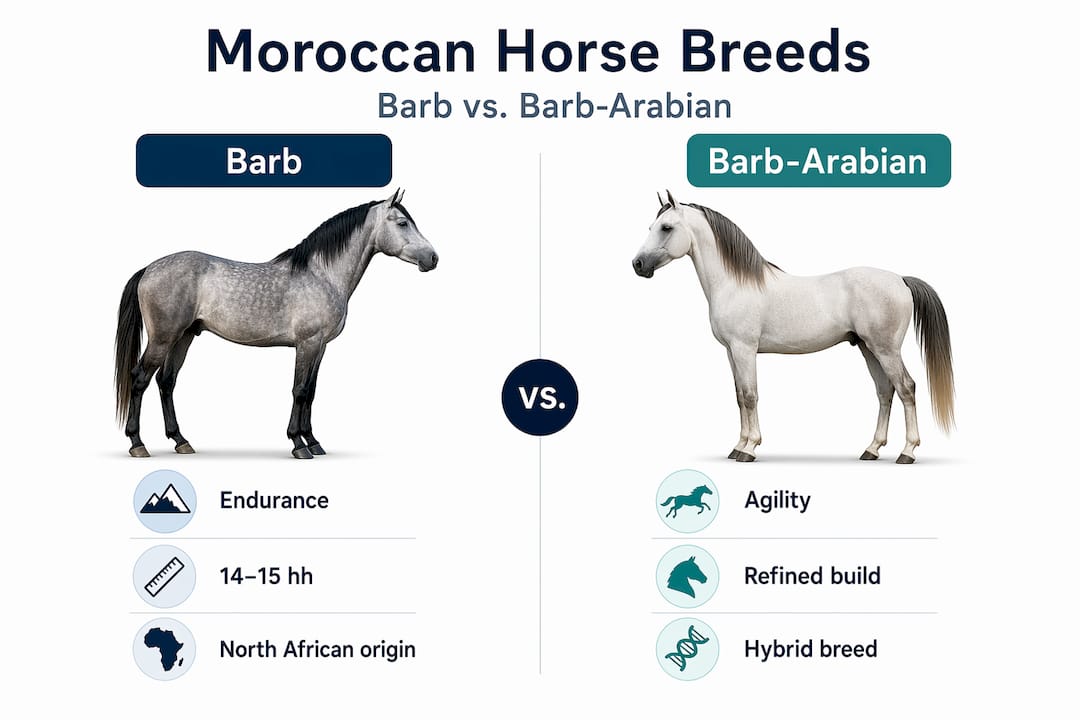
Barb horses originated in North Africa and have been bred here for over a thousand years. They stand between 14hh and 15.2hh, which makes them compact without being small. What they lack in height they make up for in endurance, sure-footedness on rough terrain, and a kind of forward-going energy that experienced riders find deeply satisfying. Barb-Arabian horses used in coastal riding are treated as genuine partners by reputable operators, not just transport.
The critical thing to know is that many of these horses, particularly on long-distance trail rides, are forward-going stallions who are sensitive and responsive. That is not a flaw. It is a feature of a working horse bred for endurance. But it does mean you need to be genuinely confident and balanced in the saddle.
Here is what most operators require before putting you on one of these horses:
- You must be able to control your horse independently at walk, trot, and canter
- A rider weight limit of 90kg applies across most operators
- You should be comfortable with forward paces and able to rate a horse’s speed
- Fitness matters. Riding four to six hours a day for multiple consecutive days is physically demanding
- Previous multi-day riding experience is strongly recommended for Atlas and Sahara treks
Good operators understand that not every rider wants a fast, forward horse. Even inexperienced riders can succeed when horse-rider matching is done carefully by experienced local guides. The key is honest communication before you arrive.
Pro Tip: When booking any Moroccan equestrian tour, send your operator a written summary of your riding history, including what breeds you have ridden, your strongest gaits, and any preferences or concerns. A good operator will use this to match you deliberately, not just assign the next available horse.
For riders heading into mountain trekking preparation, building core strength and leg fitness in the weeks before your trip significantly reduces saddle soreness on days two and three.
Cultural immersion you will not find on any other riding tour
This is where Morocco horse riding truly separates itself from equestrian travel in Europe, the American Southwest, or Southeast Asia. The riding is genuinely good. But the cultural layer underneath it is what makes people come back.
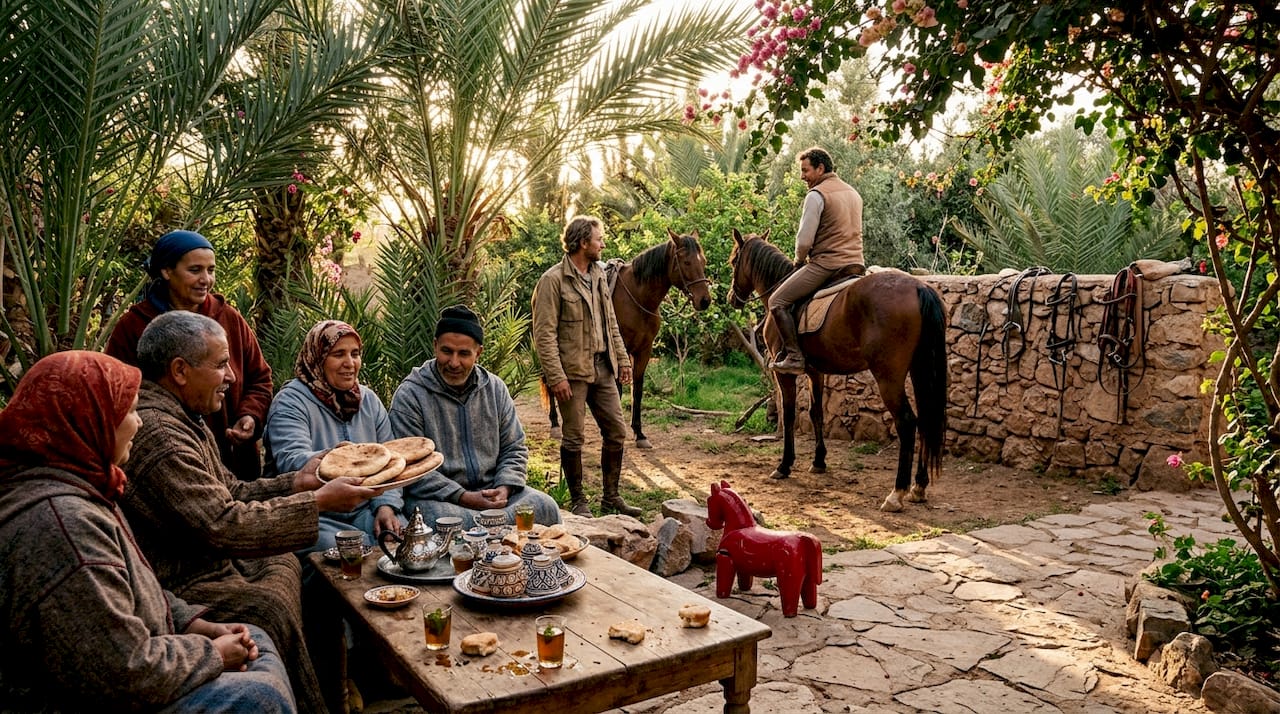
Most of Morocco’s trail riding country runs through the ancestral territory of the Amazigh people, Morocco’s indigenous Berber population. These are communities that have lived alongside horses for generations, and their relationship with the land and animals shows in every interaction you have along the route.
On a well-run tour, you will stop in villages where a family invites you in for mint tea and bread baked in a clay oven. You will hear music played on instruments with no Western equivalent. You will see how a Berber shepherd moves horses through terrain that would stop most Western riders cold. These are not staged cultural performances. They are actual daily life, and you are moving through it at the pace of a horse, which is exactly the pace at which you can take it in.
Morocco has also invested significantly in its formal equestrian heritage. The country hosted the Emirates Arabian Horse Global Cup in Rabat, showcasing nearly 200 Arabian horses in an event organized by SOREC, the country’s official equine regulatory body. That commitment to preserving equestrian culture runs from the highest level of government down to the local groom who has cared for his family’s horses since childhood.
A few things to keep in mind for respectful cultural participation:
- Ask before photographing people or their homes. A simple gesture of asking goes a long way.
- Accept tea when offered. Refusing hospitality without explanation can cause genuine offense.
- Dress modestly when passing through villages, regardless of how hot the day gets.
- Learn five words of Tamazight or Darija. The effort earns you immediate respect and usually a lot of laughter.
“The best rides I’ve witnessed are the ones where the horses, the riders, and the communities along the route are all being treated with genuine respect. When that balance holds, Morocco delivers something that no other riding destination can match.”
Choosing the right tour: options, logistics, and safety
The range of riding holidays available in Morocco is broader than most riders realize. Understanding the categories helps you match the right experience to your actual skill level and travel style.
Multi-day mountain trekking tours combine lodge stays with camping nights and typically include a support vehicle for luggage. Atlas treks mix lodge accommodation with camping, with riders responsible for daily grooming duties and mounting multiple times a day. The physical demand is real and should not be underestimated.
Coastal riding holidays tend to offer more comfort, with guesthouse or riad accommodation and shorter daily ride times. These work well for riders returning to the saddle after a gap or those combining riding with broader Morocco sightseeing.
Desert expedition tours are the most logistically involved. Support vehicles carry camping equipment and supplies, meals are prepared in camp, and daily rides can cover significant distances across open terrain. Operating across rocky passes, sand, and coastal environments requires horses and riders who are both genuinely prepared.
| Tour Style | Skill Level Needed | Accommodation | Typical Duration |
|---|---|---|---|
| Coastal riding holiday | Intermediate | Riads, guesthouses | 5-8 days |
| Atlas mountain trek | Advanced intermediate | Mix of lodge and camp | 6-14 days |
| Sahara desert expedition | Advanced | Desert camp, basic lodges | 7-14 days |
| Short intro ride | Beginner-intermediate | Day trip only | Half day to 1 day |
When selecting an operator, look for these markers of quality:
- Clear documentation of horse welfare practices and daily care routines
- Affiliation with SOREC or similar professional equestrian bodies
- Transparent rider weight and skill level requirements
- References or reviews from riders with similar experience levels to yours
- Support vehicles on multi-day treks for safety and logistics
Leading operators collaborate with SOREC to maintain animal welfare and safety standards, which gives you a reliable benchmark when comparing companies.
Pro Tip: Book at least three months in advance for spring and fall shoulder season rides. The best operators with the best horse-rider matching fill quickly, and last-minute bookings often mean you get whoever is left, not who is right for you.
For a broader look at how to structure your Morocco trip packages around riding and other experiences, planning your itinerary in advance gives you far more flexibility.
Practical tips for your Morocco riding adventure
Preparation separates a great riding trip from a painful one. Here is what actually matters:
- Pack riding-specific gear. Bring your own half chaps, riding tights, and gloves. Do not assume the operator will have your size. Helmets are sometimes provided, but bringing your own is always safer.
- Protect yourself from the sun aggressively. Morocco’s UV intensity is higher than most Northern European or North American riders are used to. Factor 50, a neck gaiter, and riding gloves with UV protection are not optional here.
- Hydrate before you think you need to. Mountain and desert environments accelerate dehydration. Drink a liter of water before you mount and carry at least one liter per ride segment.
- Prepare your core. Do planks, bridges, and single-leg exercises for four to six weeks before your trip. A strong core prevents lower back pain on long riding days far better than any saddle pad upgrade.
- Learn the basics of horse care in trail conditions. Operators expect riders to participate in basic grooming. Knowing how to pick hooves and check saddle fit builds trust with your guide and helps keep your horse comfortable.
- Stay connected on the trail. Consider picking up a Morocco eSIM for connectivity before you leave, especially for remote Atlas or desert routes where navigation and emergency contact matter.
Pro Tip: Bring a small first-aid kit with blister treatment, ibuprofen, and an antihistamine. The combination of sun, new saddles, and physical effort creates a predictable set of minor problems that a $15 kit fixes in minutes.
My honest take on Moroccan equestrian travel
I have spent considerable time studying what makes horse riding travel genuinely worthwhile, and Morocco keeps rising to the top of that list in ways that surprise even seasoned equestrians. But I want to be direct about something most articles gloss over.
Morocco’s best riding is not for people who want to sit passively on a horse while someone else leads them through scenery. It demands real engagement, real riding, and real physical preparation. The horses are forward and sensitive. The terrain is unforgiving in places. The cultural layer requires you to show up with genuine curiosity and humility, not just a camera.
What I find most compelling about the Moroccan equestrian experience is the integrity of the best operators. The ones worth booking treat their horses with clear affection and expertise. You can see it in the condition of the animals and in how the guides handle them. The worst thing you can do as a traveler is book the cheapest option without asking about horse welfare. Those operations exist, and they damage the experience for everyone.
Morocco also stands out because it actively invests in its equestrian identity at a national level. The country’s hosting of major Arabian horse events and its SOREC infrastructure signal that this is not just tourism. It is a genuine culture that has been building for centuries.
If you are heading to Morocco on your first riding trip there, my honest advice is this. Be humble about your skill level when booking, communicate clearly with your operator, and leave room in your itinerary for the unexpected stops in villages that end up being the moments you remember longest. The horses will take you places. The people you meet along the way will change how you see the world.
— Moroccotravel1.com
Plan your Morocco riding experience with Moroccotravel1
Moroccotravel1.com specializes in building travel experiences around what you actually want, not a generic itinerary pulled from a catalog. For equestrians and adventure seekers, that means combining the best Morocco horse riding opportunities with quality accommodations, expert local guides, and seamless logistics across the Atlas Mountains, the Atlantic coast, and the Sahara Desert.
Whether you are planning a family adventure that includes a 10-day Morocco family tour with riding days woven into a broader cultural experience or a couples trip that pairs coastal riding with a Morocco honeymoon package and desert camp nights, the team at Moroccotravel1 designs itineraries that fit your skill level, travel style, and budget. For those who want to go deeper, the 14-day grand tour covers Morocco’s most spectacular landscapes with built-in flexibility for extended riding segments. Contact Moroccotravel1 to speak with a specialist who will match your riding experience to the right terrain, operator, and tour structure from day one.
FAQ
What skill level do you need for Morocco horse riding?
Most multi-day Morocco horse riding tours require riders to confidently control a horse at a walk, trot, and canter independently. Beginner-friendly coastal day rides are available, but Atlas and Sahara treks are designed for intermediate to advanced riders.
What breeds of horses are used on Moroccan riding tours?
The standard horses for Moroccan equestrian tours are Barb or Barb-Arabian breeds, standing 14 hh to 15.2 hh. They are known for endurance, sure-footedness, and forward energy suited to varied terrain.
What is the best time of year for horseback riding in Morocco?
The best time depends on the region. Coastal rides are best from October through March, while Atlas Mountain and Sahara Desert rides are most comfortable during the spring and fall shoulder seasons from March through May and September through November.
How long do Morocco horse trekking tours typically last?
Standard Morocco horse trekking tours run six to seven days, though some expedition-style rides extend to a full month and cover up to 875km across multiple terrain types.
Is Morocco an expensive destination for equestrian travel?
Morocco offers riding experiences across a wide price range. Mid-range mountain trekking starts around $1,300 per person for a multi-day trek, making it comparable to or more affordable than similar equestrian tours in Europe or South America.


