

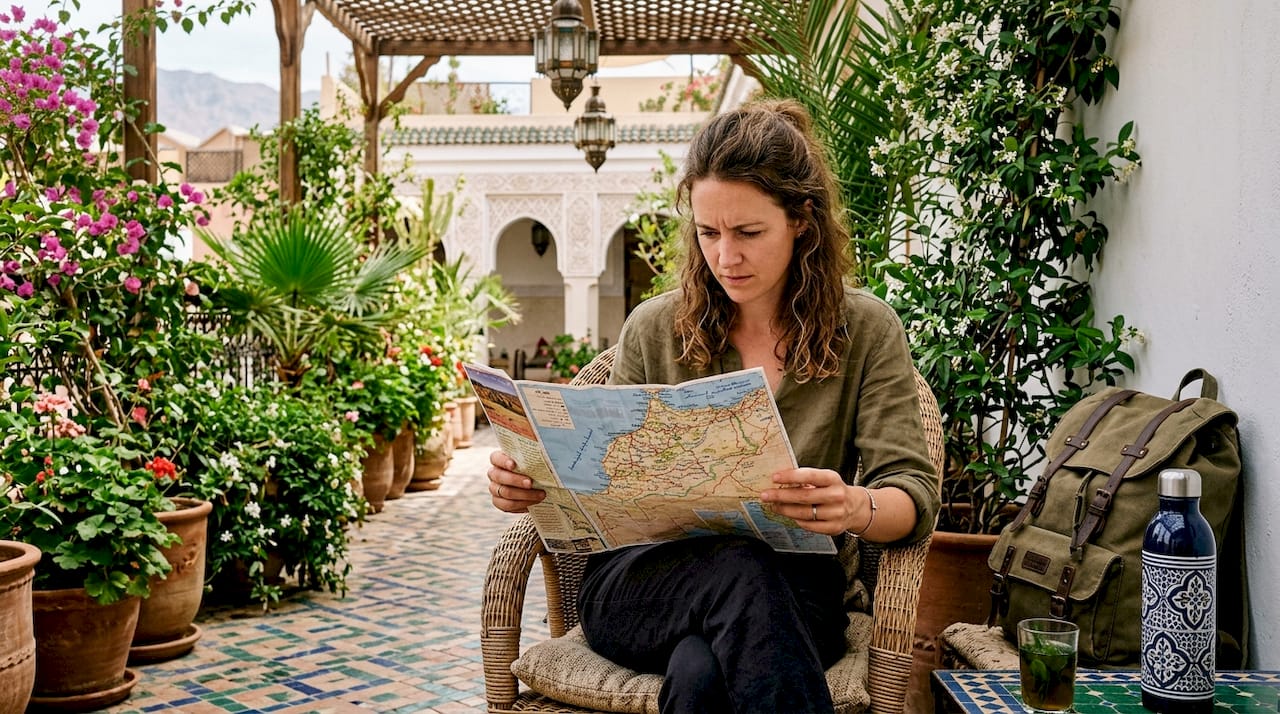
- Morocco tours combine cultural, desert, mountain, and city experiences across its diverse landscapes, with itineraries suited for various travel preferences.
- Travelers should select the appropriate tour type, book early during peak seasons, and travel with a knowledgeable guide to ensure a rich and smooth experience.
- The best time to visit is during spring and autumn, with specific seasons recommended for desert and mountain trekking, while entry requirements are straightforward for most Western travelers.
Morocco tours are structured travel experiences that combine cultural immersion, desert adventure, mountain trekking, and urban sightseeing across one of North Africa’s most geographically diverse countries. A single itinerary can take you from the medieval medina of Fes to the Sahara dunes of Erg Chebbi, then up to the summit of Mount Toubkal at 4,167 meters, all within two weeks. Travelers who plan Morocco tours well in advance consistently report richer experiences because seasonal timing, regional sequencing, and tour type all interact in ways that can make or break a trip. This guide covers every major decision you will face, from choosing between a family-friendly package and a hardcore mountain trek to understanding visa rules and the best months to travel.
What types of Morocco tours are available?
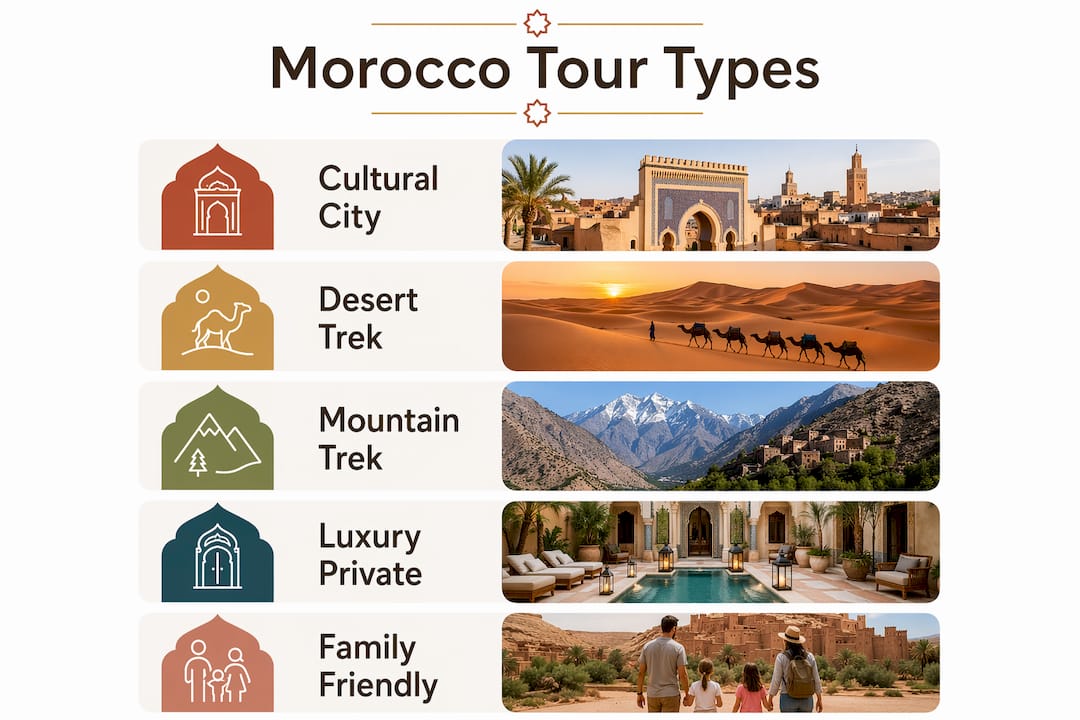
Morocco tours fall into five distinct categories, and knowing which one fits your travel style saves weeks of research.
Cultural city tours are the most popular entry point. A guided visit to Marrakech covers Djemaa el-Fna square, the Bahia Palace, and the souks of the medina in a single day. Fez adds the world’s oldest university, the Al-Qarawiyyin, and the famous Chouara tanneries. These tours work best with a local expert guide because navigating a medina without one means missing the historical context that makes these places extraordinary.
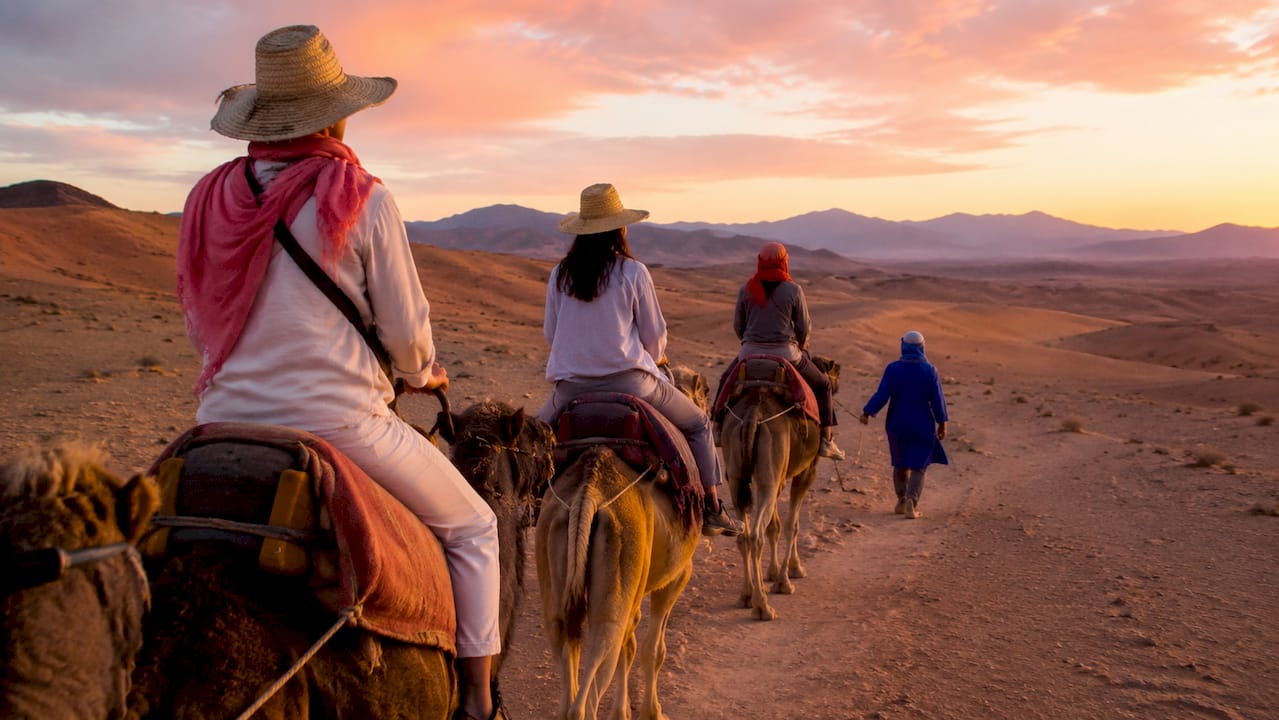
Desert tours range from a single overnight camel trek to multi-day expeditions crossing multiple dune fields. Overnight desert treks in Merzouga include sunset camel rides, Berber tent accommodation, mint tea ceremonies, and drum performances around a fire. The difference between a standard camp and a luxury camp is not the view. Luxury camps provide private bathrooms and optional air conditioning, which matters significantly if you travel in warmer months.
Mountain trekking tours center on the Atlas Mountains, with Mount Toubkal as the flagship objective. Multi-day Toubkal treks typically run five to seven days and include acclimatization stops in Berber villages before the summit push. These tours are not for casual walkers. You need solid cardiovascular fitness and proper gear.
Luxury and private tours offer fully customized itineraries with riad accommodations, private drivers, and exclusive dining experiences. They cost more but eliminate the logistical friction that group tours carry.
Family trips to Morocco balance cultural visits with manageable activity levels. A well-designed family itinerary mixes a cooking class in Marrakech, a camel ride at the edge of the Sahara, and a visit to the blue city of Chefchaouen without exhausting younger travelers.
| Tour type | Best for | Typical duration |
|---|---|---|
| Cultural city tour | History and architecture lovers | 3 to 5 days |
| Desert camel trek | Adventure and stargazing seekers | 1 to 3 nights |
| Mountain trekking | Fit hikers and summit chasers | 5 to 7 days |
| Luxury private tour | Couples and high-comfort travelers | 7 to 14 days |
| Family Morocco tour | Mixed-age groups | 7 to 10 days |
Pro Tip: Book your desert camp tier before your flights. Luxury camp spots in Erg Chebbi sell out months ahead during peak season, and upgrading on arrival is rarely possible.
When is the best time to book Morocco tours?
Spring and autumn are the two ideal windows for most Morocco travel packages, with March through May and September through November delivering comfortable temperatures across cities, mountains, and desert regions simultaneously. This matters because Morocco’s climate varies dramatically by region. Marrakech in July regularly exceeds 40°C, while the Atlas Mountains can freeze overnight in January.
For Sahara desert tours specifically, October through April is the sweet spot. Days are warm enough for comfortable camel trekking, and nights are cool enough to make sleeping in a Berber tent genuinely pleasant rather than suffocating. Summer desert tours are possible but demand early morning activity and midday rest.
Mount Toubkal trekking follows a tighter seasonal window. Spring and autumn offer the safest conditions, with snow-free trails and stable weather. Proper acclimatization through gradual ascent is non-negotiable regardless of season. Attempting a fast summit push without rest days at altitude is the most common reason trekkers turn back.
Ramadan adds a layer of planning complexity that many first-time visitors underestimate. Ramadan shifts roughly 11 days earlier each year, so its impact on your tour depends entirely on the calendar year you travel. During Ramadan, many non-tourist restaurants close during daylight hours, local business rhythms change, and the atmosphere in medinas shifts noticeably. This is not a reason to avoid Morocco during Ramadan. It is a reason to prepare and engage respectfully with the cultural significance of the month.
Here is a quick seasonal breakdown to guide your booking decision:
- Spring (March to May): Best overall window for cities, desert, and mountains
- Summer (June to August): Ideal for coastal destinations like Essaouira; avoid inland cities and desert midday heat
- Autumn (September to November): Second-best window, slightly less crowded than spring
- Winter (December to February): Quiet tourism, excellent for desert nights, cold in the mountains
Pro Tip: Check the season-by-season guide from Moroccotravel1 before locking in dates. Regional weather differences in Morocco are large enough that the “right” month depends entirely on which regions your itinerary covers.
What are the entry requirements for Morocco tours?
Citizens of the US, UK, EU, Canada, Australia, New Zealand, Japan, and UAE enter Morocco visa-free for stays up to 90 days. Entry is granted by a stamp at arrival, with no pre-application required. This covers the vast majority of travelers booking Morocco guided excursions from Western markets.
Your passport must be valid for at least six months beyond your planned departure date. Border officers check this consistently, and travelers with passports expiring within six months have been turned away. Renew before you book, not after.
Beyond the passport, you should carry:
- Proof of accommodation for at least the first few nights (hotel confirmation or riad booking)
- Onward or return flight tickets showing you plan to leave within 90 days
- Travel insurance documentation covering medical evacuation, which is especially relevant for mountain trekking tours
- Emergency contact list including your tour operator’s local number
Safety in Morocco’s main tourist cities is generally good with standard urban precautions. Remote border areas require more care, and reputable tour operators route itineraries through confirmed safe intercity transport options like trains between Marrakech, Casablanca, and Fes, or vetted private transfers for desert routes.
Travel insurance deserves more attention than most travelers give it. A standard policy covers trip cancellation and lost luggage. For Morocco adventure tours involving Mount Toubkal or multi-day desert treks, you need a policy that explicitly covers high-altitude trekking and emergency helicopter evacuation. Read the exclusions before you buy.
Pro Tip: Carry physical copies of all your documents in a separate bag from your originals. Moroccan border officials occasionally request paper documentation even when digital versions are available.
How do Morocco tours vary by region?
Morocco’s geography divides naturally into four distinct tour zones, and the best itineraries treat each zone as a separate experience rather than a checklist item.
Imperial cities: Marrakech, Fes, and Meknes
The imperial cities deliver Morocco’s densest concentration of history, architecture, and sensory experience. Marrakech’s Djemaa el-Fna square transforms from a food market by day into a performance space by night. Fes contains the world’s largest car-free urban area, the Fes el-Bali medina, where streets have not changed their basic layout in 1,000 years. Meknes offers the same historical depth with far fewer tourists. Morocco sightseeing tours through these cities work best over three to four days each, with a local guide who can explain the social and religious context of what you are seeing.
Atlas Mountains: trekking and Berber culture
The High Atlas offers Morocco’s most physically demanding tour experiences. A standard Mount Toubkal circuit runs five to seven days, with the route passing through Berber villages like Imlil and Aroumd before reaching the Toubkal refuge at 3,207 meters. Mountain trekking itineraries prioritize multi-day circuits with balanced ascents and village stops for acclimatization rather than single-day summit attempts. This approach produces safer climbs and far richer cultural encounters. The Berber hospitality you experience in these villages is genuinely unlike anything available in the cities.
Sahara Desert: Erg Chebbi and Erg Chigaga
The Sahara is the centerpiece of most Morocco adventure tours, and for good reason. Erg Chebbi near Merzouga is the more accessible dune field, reachable by road from Marrakech in about nine hours or by a short flight to Errachidia. Erg Chigaga is more remote, requires a 4×4 transfer, and rewards travelers with near-total solitude. Desert overnight experiences center on the timing of sunset and sunrise, which is why a two-day trip feels fundamentally different from a three-day one. The extra night gives you a full day in the dunes rather than arriving at sunset and leaving at dawn.
“The Sahara does not reveal itself in a single night. The travelers who stay two or three nights consistently describe a shift in perspective that one-night visitors simply do not report.” This observation holds across every tour format, from budget camping to luxury tented suites.
Coastal destinations: Essaouira and beyond
Essaouira offers a completely different Morocco from the inland cities. The Portuguese-built ramparts, the Atlantic wind that makes it a world-class kitesurfing destination, and the relaxed medina atmosphere attract travelers who want culture without the intensity of Marrakech. Coastal tours work particularly well in summer when inland heat makes city tours uncomfortable. Agadir provides beach resort infrastructure for families who want a base for day trips rather than a full touring itinerary.
Combining regions for a full Morocco experience
The best tours in Morocco combine at least three of these zones. A 10-day itinerary might include Marrakech for two days, the Atlas Mountains for three days, the Sahara for two nights, and then Fes for two days before flying home. This structure gives you cultural depth, physical adventure, and natural spectacle without rushing any single experience. The 11-day Sahara and cities package from Moroccotravel1 follows exactly this logic, sequencing regions in a way that minimizes backtracking and maximizes variety.
Key takeaways
Morocco tours deliver the most value when you match the tour type, season, and region to your specific travel priorities rather than booking the most popular itinerary.
| Point | Details |
|---|---|
| Match tour type to fitness level | Desert treks suit most travelers; Mount Toubkal requires solid cardiovascular fitness and proper gear. |
| Book peak seasons early | Spring and autumn fill fast; luxury desert camps sell out months ahead of the October to April window. |
| Carry complete entry documents | Passport valid 6 months beyond departure, plus proof of accommodation and return tickets. |
| Combine regions strategically | Itineraries covering cities, mountains, and desert deliver the widest range of Moroccan experience. |
| Get adventure-specific insurance | Standard travel policies exclude high-altitude trekking; verify coverage before booking mountain tours. |
Why guided tours make the difference in Morocco
I have worked with travelers across every Morocco tour format, from solo budget backpackers to families booking 14-day private itineraries, and the single factor that most consistently separates a great trip from a frustrating one is whether the traveler had a knowledgeable local guide in the medinas and on the mountain routes.
The medinas of Fes and Marrakech are genuinely disorienting. Not in a romantic, getting-lost way. In a you-have-been-walking-in-circles-for-forty-minutes way. A local guide does not just show you where to go. They tell you which carpet seller is worth your time, which food stall has been there for three generations, and which “shortcut” is actually a dead end used to funnel tourists toward commission shops. That context transforms a confusing walk into a coherent cultural experience.
On the mountainside, I have seen fit, experienced hikers underestimate the Atlas. The altitude at Mount Toubkal is not Himalayan, but it is enough to cause real problems if you push too fast. The itineraries that build in village stops and refuge nights are not padding. They are the difference between summiting and turning back at 3,800 meters with a splitting headache.
My honest recommendation: do not try to self-guide your first Morocco trip through both the medinas and the mountains. Use a guided tour for those sections, then give yourself free time in coastal towns like Essaouira, where the layout is straightforward and the pace is forgiving. That combination gives you the depth of a guided experience and the freedom of independent travel without the stress of navigating Morocco’s most complex environments alone.
— Moroccotravel1.com
Plan your Morocco tour with Moroccotravel1
Moroccotravel1 offers curated Morocco travel packages built around the regional logic described in this guide. The 10-day family Morocco tour balances cultural visits, a Sahara overnight, and coastal relaxation at a pace that works for mixed-age groups. The 14-day grand tour package covers all four major regions with private transfers and riad accommodations throughout. For hikers, the 10-day Atlas, desert, and cities hiking package combines Mount Toubkal trekking with Sahara dunes and imperial city visits. All itineraries are customizable, and Moroccotravel1 provides 24/7 support from booking through return. Browse the full range of private Morocco tours and request a custom quote for your travel dates.
FAQ
Is Morocco safe for tourists on guided tours?
Safety in Morocco’s main tourist cities is generally good with standard precautions. Reputable tour operators use vetted transport and avoid remote border areas in their itineraries.
Do US citizens need a visa for Morocco?
US citizens enter Morocco visa-free for up to 90 days. Your passport must be valid for at least six months beyond your planned departure date.
What is the best time for a Sahara desert tour?
October through April is the optimal window for desert tours, with warm days and cool nights that make camel trekking and overnight camp stays comfortable.
How long does a Mount Toubkal trek take?
Mount Toubkal treks typically run five to seven days, including acclimatization stops in Berber villages before the summit day at 4,167 meters.
Can families with young children do Morocco tours?
Family trips to Morocco work well on itineraries designed around manageable activity levels, with camel rides, cooking classes, and medina visits replacing strenuous hikes. Moroccotravel1’s 10-day family package is specifically structured for mixed-age groups.


